


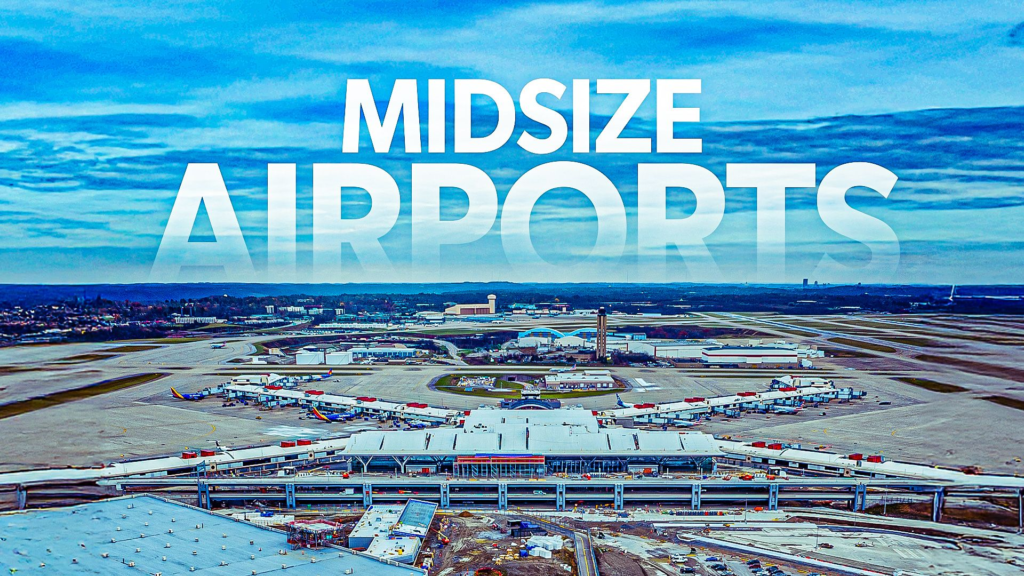
For years, Asian airports, as well as select European airfields, have stolen the spotlight in terms of architectural and interior design. Names like Singapore Changi Airport, Paris Charles de Gaulle Airport, and Doha Hamad International Airport have emerged as some of the most visually impressive airports in the world. This has overshadowed the United States, the world’s largest aviation market, which has long been filled with aging terminal designs that are ill-equipped to handle the increased passenger volumes of today.
Today, however, that’s changing. Several airports across the US have undergone terminal renovation and rebuilding projects, such as Newark Liberty International Airport or LaGuardia Airport (which has arguably gone from being the nation’s worst airport to one of the best). However, scores of smaller airports across the US have also been refreshing or rebuilding their terminal buildings, not only increasing capacity but also providing more visually appealing facilities.
New Airport Renovation Projects In The US

Airports in the US are almost universally owned by the federal government, and as such, funding is partially provided directly from the government. This money is far from the only source of income for airports, but it does still represent an important revenue source. Traditionally, most of these funds have gone towards airside projects, such as runways and taxiways, but increased funding as part of a bipartisan infrastructure bill passed in 2021 has allowed for a greater focus to be placed on upgrading terminals.
Combined with an increasing need to replace aging facilities that are visually outdated and are at capacity, we’re seeing a wave of new airport renovation projects across the United States. Naturally, it’s the biggest airports that receive the most publicity, such as LAX’s renovation of Terminal 5, LaGuardia’s reconstruction of Terminals B and C, as well as the new Terminal A at 

However, scores of non-hub and regional airports across the US have also been receiving terminal retrofits. These range from large airports like Portland International Airport, a focus city for Alaska Airlines, to the new five-gate terminal set to open at Mobile International Airport. These impressive new buildings are more efficient and stylish than their predecessors, while also being more technologically advanced. On an individual level, these terminals are transforming the travel experience out of their respective airports, but collectively, they’re transforming regional air travel in the United States.
The New Terminal At Portland International Airport


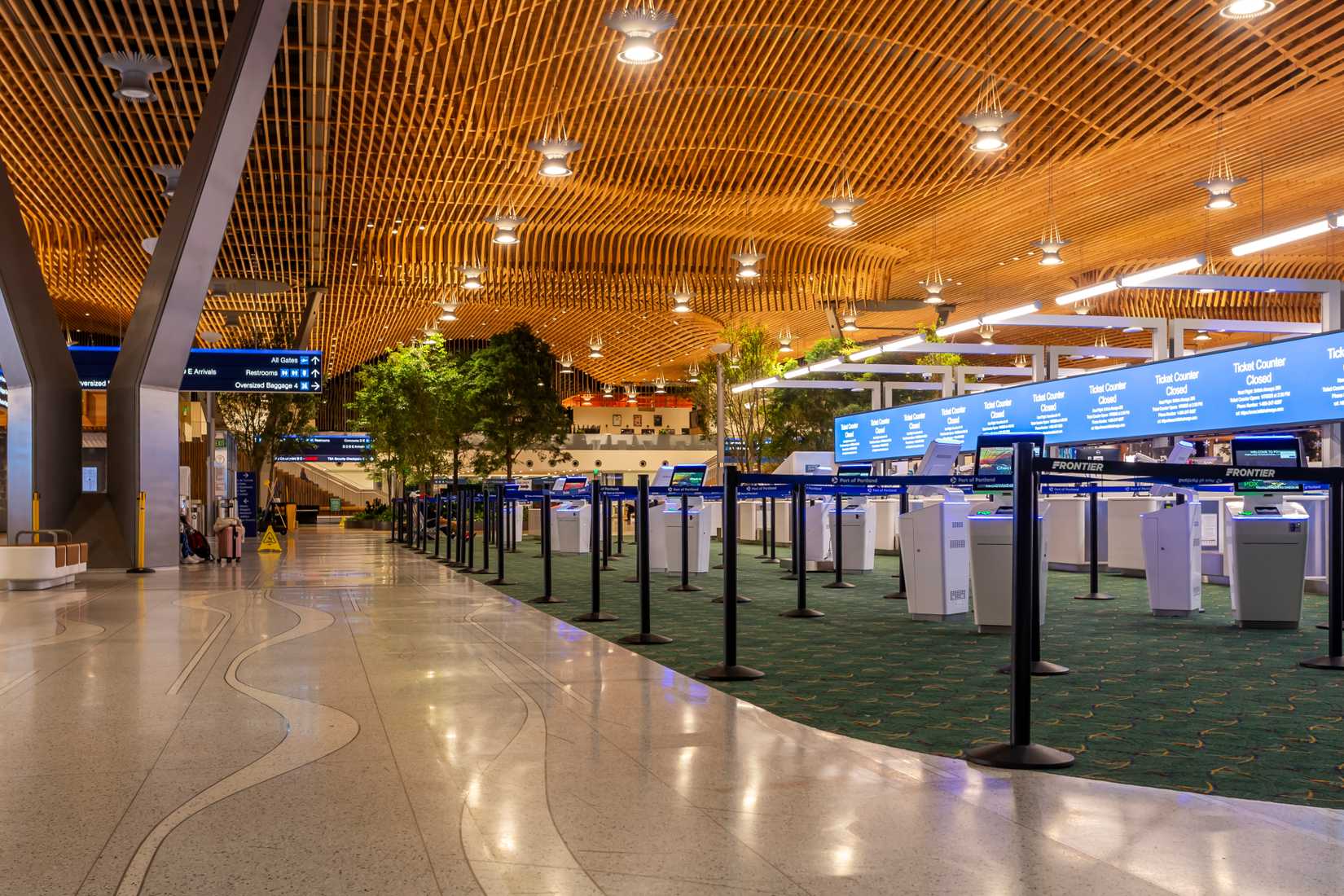
Upon the opening of its new terminal in 2024, Portland International Airport called itself “the local-est airport yet”. This was reflected in its commercial spaces, as nearly all of the airport’s dining and shopping options are branches of locally-based companies. Additionally, the interior design is meant to evoke the nature of the Pacific Northwest (a region known for its lush and expansive forests) and, as such, features extensive wood designs on the ceiling and walls sourced from locally grown trees.
However, while the design is meant to be a faithful representation of Portland and the state of Oregon, it still features elements that are to be expected of any large space designed in the 2020s. High ceilings and floor-to-ceiling windows create a visually spacious environment with abundant natural lighting. The terminal features abundant greenery to provide a nature-themed environment for passengers while also continuing to represent the Pacific Northwest.
Functionally, the new terminal features more open space in the pre-security area, and the airport is also receiving more gates to better accommodate future flight demand. This is especially important as Portland continues to grow in passenger count and as 
The New Terminal At Pittsburgh International


Pittsburgh International Airport is the primary airport for Pittsburgh, Pennsylvania. Once home to a large US Airways hub, it was dehubbed in the 2000s and has since become a large spoke catering to the local Pittsburgh market rather than a connecting hub. Its terminal, while world-class when it first opened in 1992, is outdated today and was designed to accommodate a connecting hub rather than an operation optimized for O&D (origin & destination) travel.
In 2017, Allegheny County officials announced a plan to revitalize Pittsburgh International Airport’s facilities, including a new landside terminal, which is set to open on November 18, 2025. The old terminal would be demolished and replaced with a new facility focused on how to best serve local passengers rather than a major airline. The new terminal will feature streamlined security and a significantly more efficient baggage handling system, along with more parking spaces.
Inside, Pittsburgh’s new terminal will feature a modern design, along with four outdoor terraces, a rare amenity in the US. As a whole, the new terminal is meant to be more convenient than its predecessors, reducing walking times from the entrance to the gate and streamlining time-consuming processes like security and baggage deliveries. These all contribute to making an experience that is more convenient for passengers starting or ending their journey at Pittsburgh.
The Upcoming Terminal At Myrtle Beach


Myrtle Beach International Airport is the primary airport serving Myrtle Beach, South Carolina. It’s the second busiest airport in the state (after Charleston International Airport), but it’s a smaller airport that is categorized by the FAA as a small-hub primary commercial service facility. Spirit Airlines is the largest carrier serving Myrtle Beach, followed by Southwest Airlines and then Delta Air Lines. While it is named as an international airport, Myrtle Beach currently only sees domestic services.
In 2023, the airport announced an expansion project for the main terminal building. This would be a renovation project rather than a reconstruction, but would also involve new construction to add six gates to the terminal, going from 12 to 18 gates. Naturally, the expanded Concourse A will include higher ceilings and larger windows. The new section is also physically bigger than before, creating more walking space that can better handle current passenger volumes.
Functionally, not only does the renovation include more gates and a larger interior, but it also comes with additional, larger restrooms for passengers. There are new retail spaces, along with countertop charging tables and an improved wayfinding system. The updated terminal will also feature a new baggage handling system that’s meant to be more advanced and efficient. The renovation and expansion are in the final stages of construction, with completion slated by year’s end.
Why The Demand For New Terminals Is Higher Than Ever

All of these projects are improving or replacing aging terminals, which were designed in the 20th century using 20th-century design trends. Not only are the buildings themselves aging, but their designs are no longer visually appealing as modern architecture and interior design have evolved. These new terminals breathe life into the airport experience, which is often viewed as sterile and cumbersome at best in the United States.
This is enhanced by an increased focus on offering more shopping spaces, amenities like the aforementioned outdoor terraces in 
On top of that, these new projects aim to better accommodate the continued increase in passenger volumes. Not only is this done by adding more gates, but also by creating wider spaces and adding more TSA lanes. Expanding further on security, creating a more efficient security area, and installing more advanced scanning technology further increase the airport’s capacity. This also goes hand-in-hand with making flying easier and more convenient.
Rundown Of New US Terminals

It’s the largest airports that have received the most publicity for their new terminals, such as 
The new terminals opening at these airfields are also built to better accommodate current passenger volumes and are designed to accommodate future increases. As such, as more and more airports revitalize their facilities, commercial flying in the US is transforming from a stressful experience that some see as a necessary burden to one that travelers can look forward to.
source