


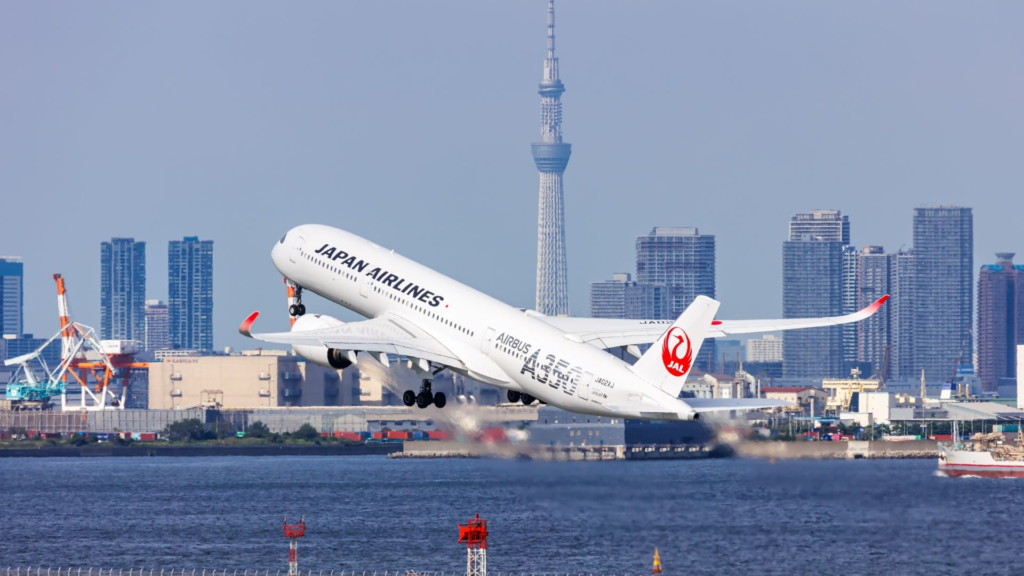
Japan Airlines has a large and diverse fleet of commercial aircraft that it uses to serve long-haul odysseys to Europe and North America, high-demand domestic routes, and everything in between. According to present fleet data made available by ch-aviation, the Japanese flag carrier and 

In this article, we will dive deeper into the data to take a closer look at the different planes that make Japan Airlines and its diverse daily operations tick. We will also consider the future of the Japanese flag carrier’s fleet, and the implications of its outstanding orders for both widebodies and narrowbodies.
Narrowbodies


On the narrowbody side of things, Japan Airlines currently flies 46 examples of the 
For JAL’s 737s, the domestic layout has 20 five-abreast business class and 145 six-abreast economy seats, while, internationally, they have 12 four-abreast business class and 132 economy seats. Going forward, the carrier plans to modernize its narrowbody fleet with orders for 38 Boeing 737 MAX 8 jets and 11 examples of the Airbus A321neo. Commenting on the latter order, Yukio Nakagawa, JAL’s SVP of Procurement, explained that:
“We will accelerate the introduction of state-of-the-art and fuel-efficient aircraft to provide our passengers with excellent service and reduce emissions. This additional introduction of Airbus aircraft will further deepen our partnership.”
Widebodies

When it comes to widebodies, Japan Airlines already has both Airbus and Boeing designs at its disposal. As far as the former manufacturer is concerned, the Japanese flag carrier has 10 A350-1000s aged 1.4 years old on average in its fleet, as well as 16 A350-900s that have a mean age of 4.8 years old. It previously had a 17th, but this aircraft was written off after a fiery collision with a Dash 8 while landing in Tokyo in January 2024.
Meanwhile, JAL’s Boeing main widebody twinjet family is the 787 Dreamliner, with the airline presently operating 23 787-8s and 22 787-9s. However, these aren’t its only US-built twin-aisle aircraft, with further representation coming in the form of 27 767-300ERs (including three freighters) and 10 777-300ERs.
One of the main things that makes Japan Airlines’ widebody fleet stand out from the crowd is the fact that its Boeing 787 Dreamliner family aircraft have just eight seats per row in a 2-4-2 layout, instead of the usual nine-abreast 3-3-3 setup. Going forward, it has orders for 10 more 787s and 25 more A350s.
Regional Aircraft


Regional aircraft also play an important role at Japan Airlines, with its only turboprops coming from Franco-Italian manufacturer 
These aircraft are configured in all-economy layouts, but this is not universally the case for the Embraer regional jets that the Japanese flag carrier also currently flies. Indeed, while JAL’s Embraer E170s from the E-Jet family, as pictured above, have 76 economy class seats onboard, the 95 seats on its larger E190s are spread across two classes. Specifically, there are 15 three-abreast business class seats (2-1), and 80 (2-2) in economy.
The E170 is the more numerous variant, with 18 examples compared to the E190’s 14, but it is also the more senior of the pair, at 13.8 years old on average. Contrastingly, the E190s come in at a mean age of just 8.4 years old. All of these aircraft, across both variants, are flown on a wet lease from J-Air.
source