


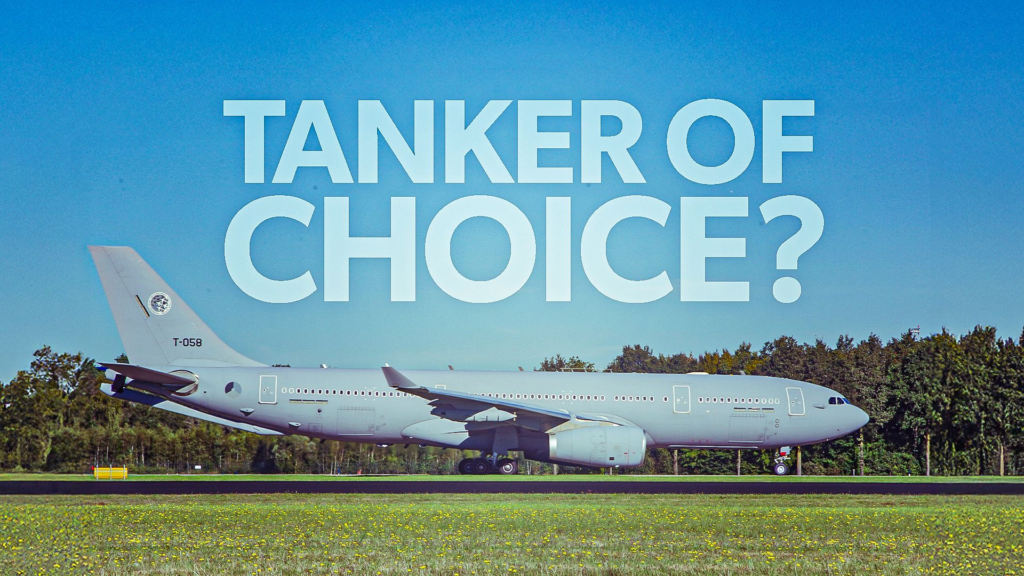
The Airbus Airbus A330 Multi Role Tanker Transport (MRTT) has slowly become the default freight of choice for many global air forces, as it is a capable plane that can be used to refuel combat and non-combat aircraft, haul troops and cargo, and serve as a surge capacity outlet for when operators are in a state of crisis. An aircraft built from the proven Airbus A330-200 airliner and converted in Getafe, Spain, the MRTT blends the reliability of a top-shelf commercial aircraft with military-grade mission systems. The aircraft features a fly-by-wire refueling boom, under-wing hose-and-drogue pods, mission avionics, and a flexible cabin and cargo hold. This combination delivers unusually high fuel offload with the lifting capabilities of a true widebody.
The aircraft is capable of hauling hundreds of passengers, palletized freight, or roll-on medical modules without sacrificing its performance as a tanker. This makes it a workhorse for major coalitions like NATO. Europe’s pooled Multinational MRTT Fleet keeps NATO aircraft fully fueled across long distances, with the RAF’s “Voyager” sustaining global deployments, while launch customer Australia ultimately proved the jet’s utility in Pacific operations. Orders now sit in the mid-80s and deliveries in the mid-60s, demonstrating that Airbus is leaning into demand while preparing an A330neo-based MRTT+ replacement, all while customers continue to demand more units of the capable and popular tanker. For defense ministries, the value proposition offered by this aircraft is relatively straightforward, as one airframe lowers overall risk and simplifies training and support. For Airbus, the jet is a sticky, long-lived defense program anchored on the company’s strong commercial backbone.
An Overview Of The Airbus A330 MRTT


At its heart, the Airbus A330 MRTT is a long-range version of the Airbus A330-200 that features military capabilities. Fuel is stored in the aircraft’s existing wing and center tanks, requiring no major structural shifts. The aircraft’s lower deck remains fully available for freight, and it can haul up to 27 standard LD3 containers or eight NATO pallets. A widebody cabin accounts for roughly 250-300 troops, all while capable of converting into a medical evacuation aircraft at a moment’s notice. While in tanker mode, operators can use the fly-by-wire Aerial Refuelling Boom System (ARBS) or Cobham hose-and-drogue pods to service probe-equipped receivers in the same sortie.
The flight deck features full integration of military systems, improving crew coordination and reducing scheduled workloads across the board. The published MRTT roadmap adds Link-16 evolution and wideband satellite communications, all of which support automatic air-to-air refueling operations. The aircraft is not just a gas station in the sky but also a modest battle-management command hub.
From an operational perspective, this flexibility emerges in the aircraft’s dynamic mission packages. It can support extending the fighter jet range multiple times over and can easily pivot between day-to-day refueling operations and strategic airlifting, with aeromedical evacuations reserved for exceptional circumstances. The aircraft anchors NATO’s tanker fleet, while augmenting the national capabilities of non-NATO allies like Singapore, South Korea, and the United Arab Emirates.
A Deeper Look At The Development Of The A330


The launch of the Airbus A330 MRTT took place over a decade ago, and the aircraft program has continued to develop since then. The aircraft was originally launched as a modified Airbus A330-200, with airframes using a dedicated conversion line at Getafe. Australia became the launch customer for the type, and the first KC-30 flew in 2007 before entering service in 2011 after a protracted qualification campaign that wrung out boom and hose systems across multiple different receiver types. The United Kingdom’s Future Strategic Tanker Aircraft program followed through a long-term private-financing contract with the AirTanker consortium, which fields 14 Voyagers and institutionalizes a service-based model for everything from training to maintenance and aircraft availability management.
The European pooling of demand for the model is what truly led this program to maturity, with a multinational fleet under an NSPA agreement expanding as new members eventually joined. Industrial learning effects have been significant, with Airbus saying that conversion now takes around one year from end-to-end, allowing the manufacturer to support around five MRTT deliveries per year, and the company has studied higher rate climbs if demand continues to grow.
The next step in this development process will be the Airbus A330 MRTT+, an A330neo-based evolution of the family that is slated for first deliveries later in the decade. This program has successfully matured from a single-nation launch to a standardized, exportable capability with a clear path towards an upgrade that was built on a commercial airliner’s economics and military mission system.
A Look At The A330 MRTT’s Technical Specifications


There are hard figures which back up the A330 MRTT’s appeal to operators. The maximum amount of fuel that the aircraft can carry is around 111,000 kg (245,000 lbs) in standard tanks. Published mission data shows that the jet can fly around 1,000 nautical miles (1,800 km) and offload up to 70 tonnes of fuel in just one hour, orbiting closer to the battlefield with even more on-station fuel and time capabilities. The aircraft typically cruises at Mach 0.82, with a service ceiling of around 41,500 feet (12.6 km).
The aircraft’s range with a maximum payload is impressive, although ferry ranges are obviously much larger. In the cargo hold, the aircraft can easily transport up to 27 LD3s or eight 463L NATO pallets, and the main deck converts between 300-seat troop lifting capabilities and a medical evacuation setup. Two-crew flight decks, fly-by-wire controls, and an integrated refueling console improve overall situational awareness. Here are some additional specifications for the aircraft, according to the manufacturer Airbus:
|
Category |
Airbus A330 MRTT Specifications |
|---|---|
|
Non-fuel payload |
45,000 kg (99,000 lbs) |
|
Empty weight |
125,000 kg (275,600 lbs) |
|
Maximum takeoff weight (MTOW) |
233,000 kg (514,000 lbs) |
The aircraft is powered by either the Rolls-Royce Trent 772B or the General Electric CF6-80E1A3, aligning with overall civil Airbus A330 support pools. The aircraft’s architecture incorporates overall satellite connectivity, with A3R automation in order to reduce tanker-receiver workloads. Across the board, these features let one widebody perform as a tanker and a flying ICU, all without bolted-on tanks that steal away cargo volume.
What Is The Aircraft’s Strategic Purpose For Its Operators?


Modern coalitions require the persistent reach that this aircraft can offer, with fighters that can stay on task and transports that can cross entire theaters, with medical lift capabilities emerging as an added bonus. The MRTT exists as a means to stitch all of these needs together. As a tanker, the aircraft multiplies overall combat air power by turning short-legged fighters into long-range assets and by sustaining maritime patrol aircraft.
As a transport, the aircraft moves entire brigades, pallets, and humanitarian cargo at an intercontinental range without the need for continued reconfiguration or sacrificing overall tanker availability. For global alliances, pooled fleets like the NATO joint fleet reduce duplication and give smaller nations instant access to higher-end capabilities. The aircraft is a common widebody platform that simplifies training, spare parts management, and certification across partners.
The aircraft is becoming a growing communications node, with the secure data links and satellite communications of a high-reliability airliner, both factors which add resilience to its overall mission command. This combines with a blend of endurance, plug-and-play interoperability, and payload that makes the MRTT a force-projection utility knife, one with equally relevant demand for rapid reinforcement or disaster responses.
What Is The Aircraft’s Financial Value To Airbus?

For Airbus, the MRTT is a durable defense franchise that is anchored on a relatively successful commercial platform. Orders are currently around 85, with 65 of these models delivered so far. This produces a long series of tail conversions, support services, training missions, and upgrades on a per-jet basis. The Airbus A330 airframes feed the line, and the conversion process is relatively simple, soaking up Airbus A330 capacity through market cycles, keeping Getafe’s military line hot.
Europe’s pool of aircraft allows for national top-ups that add to overall backlog resilience, with Saudia Arabia on its own already set to acquire four more. Meanwhile, the continued commitment to the aircraft from multiple major operators confirms a few key pieces. For starters, governments pay for the availability of the aircraft over decades, while bundling training, maintenance, repair, and overhaul, spare parts, and infrastructure, all of which are steady service revenue beyond hardware.
With demand continuing to rise, Airbus has signaled higher output of the Airbus A330 MRTT, which should ultimately widen defense margins and improve fixed-cost absorptions across the entire Airbus A330 network. In aggregate, the airline’s diversification process helps smooth Airbus’ commercial volatility while reinforcing European sovereign capabilities, making for an attractive story for investors and governments alike.
What Are Our Key Takeaways When It Comes To The Airbus A330 MRTT?

The Airbus A330 MRTT wins because it compresses three fleets into just one, without giving up cargo space to extra-large fuel tanks. It is already the de facto standard outside the United States, with strong NATO and allied adoption as well as a clear upgrade path through Smart MRTT features and the A330neo-based MRTT+.
With this aircraft, Airbus can further build out its position within the defense industry, while converting a successful commercial program into an aftermarket defense-oriented platform that the company can market. From a strategic standpoint, these kinds of aircraft help show how one type on its own can boost overall readiness and aircraft interoperability.
As orders continue to grow and production rises, the MRTT will begin to serve as the backbone of defense airlifting and refueling capabilities, especially as European funding shifts towards domestic manufacturers. We will have to keep our eyes on this program in order to chart the sales pathway forward for the A330 MRTT+.
source