


The Royal Air Force (RAF) has a total of around 30 active bases, including overseas Permanent Joint Operating Bases (PJOBs). There are four RAF airfields in British Overseas Territories; namely, RAF Akrotiri (Cyprus), Ascension Island, Mount Pleasant (Falkland Islands), and RAF Gibraltar. RAF Gibraltar is a dual military and civilian-use airport. Of these, the air force only has seven main operating bases (MOBs) within the United Kingdom.
This list will examine the largest flying Royal Air Force bases by size and consider their strategic roles. This means that RAF Spadeadam is excluded as it is a non-flying station. At some 9,600 acres, RAF Spadeadam would have been the largest. Its role is in electronic warfare for NATO and British aircrews.
7
RAF Brize Norton
Approximately 1,200 acres

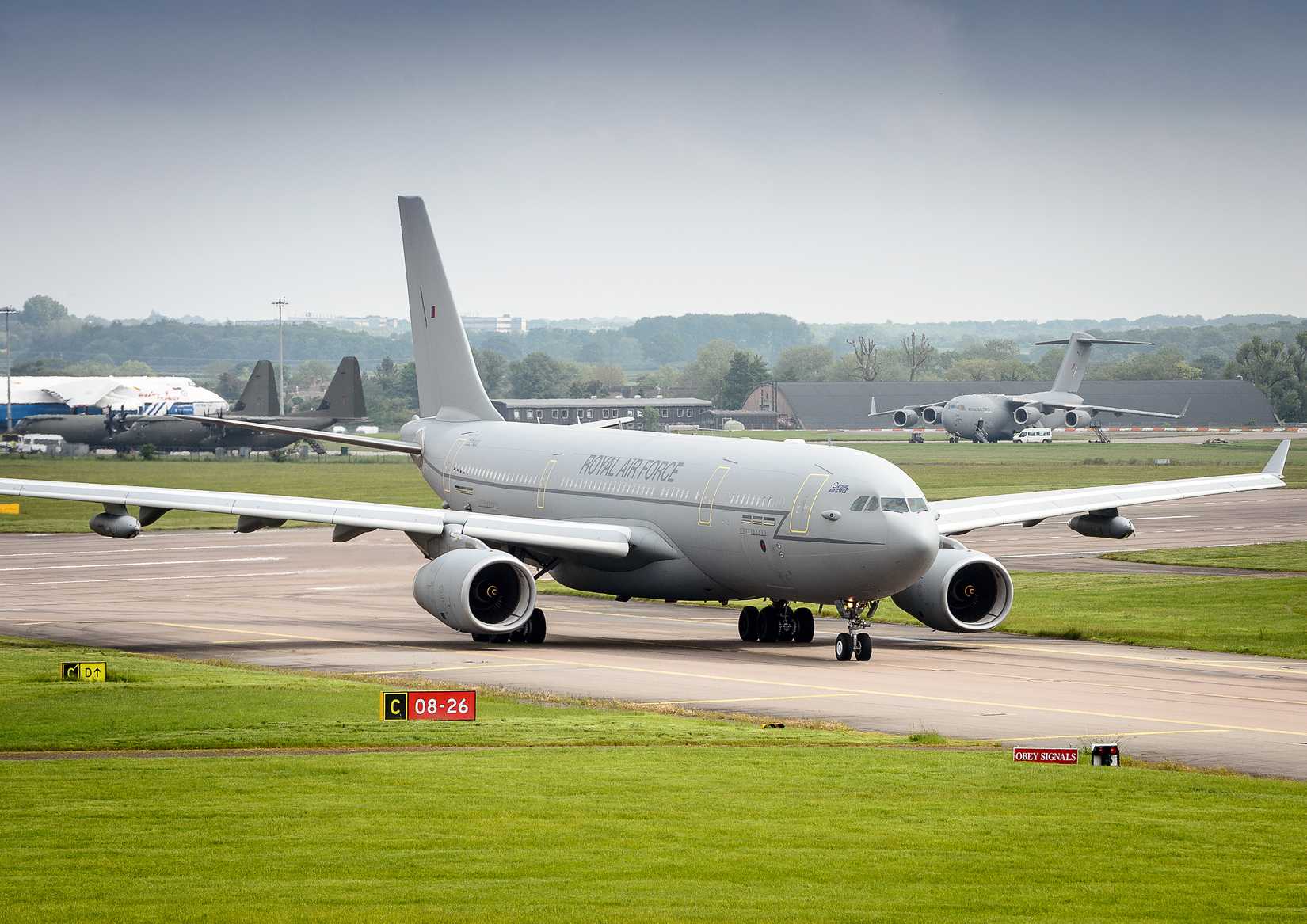
RAF Brize Norton is located in Oxfordshire, England, and is the largest RAF Station, hosting approximately 5,800 service personnel along with 300 civilian staff and around 1,200 contractors. Brize Norton is home to the RAF’s Air Mobility Force that includes its strategic and tactical transport aircraft (like C-17s and A400Ms) and aerial refueling aircraft (provided by Airbus A300 MRTT Voyager aircraft).
The Royal Air Force says, “With its mixed fleet of aircraft, RAF Brize Norton provides rapid global mobility in support of UK overseas operations and exercises, as well as AAR support for fast jet aircraft, both on operations and in support of UK Homeland Defence.” Units stationed include No. 10, 24, 30 Squadrons, and others.
Other notable squadrons at RAF Brize Norton include the 206 Test and Evaluation Squadron and the No. 1 Tactical Police & Security Squadron (1TPSS). The RAF has a fleet of 14 Airbus Voyager aerial tankers (including five operated by AirTanker), eight Boeing C-17A Globemaster IIIs, and 22 Airbus A400M Atlas transports.
6
RAF Leeming
Approximately 1,260 acres


RAF Leeming is located in North Yorkshire in the North of England. It trains, delivers, and supports UK and overseas Expeditionary Air Operations. The RAF says, “RAF Leeming is the preferred site for deployed exercises and detachments from UK and overseas units.” During the Cold War, from 1950 to 1991, Leeming was primarily used as a training base.
The Quick Reaction Force, equipped with Panavia Tornado F3 fighter jets, was based there in the later stages of the Cold War and into the 21st century. Since 2006, Lemming has been home to the deployable RAF communications cadre, the No. 90 Signals Unit RAF, as well as the No. 135 Expeditionary Air Wing. The No. 135 was established to make the RAF more deployable on an expeditionary basis.
Leeming is also close to notable training areas at Spadeadam (the largest RAF airbase), Otterburn, and Catterick. Leeming also hosts a Qatar Emiri Air Force (QEAF) / Royal Air Force (RAF) Hawk Training Squadron that operates the BAE Systems Hawk advanced trainer jet. These are used for fast-jet pilot training.


The 7 Most Remote Royal Air Force Bases & Their Strategic Roles
The RAF operates bases in the Atlantic and other locations beyond the British Isles.
5
RAF Lossiemouth
Approximately 1,400 acres


RAF Lossiemouth is the only RAF airbase in Scotland to host fighter jets; the other main RAF airbase in Scotland is Leuchars Station, which hosts RAF Reserve squadrons and Army units. There was another notable RAF airbase in Scotland, RAF Leuchars. However, this was closed in April 2015 and transferred to the British Army. It still acts as a backup airbase. In 2020, RAF Eurofighter Typhoon fighter jets operated from Leuchars as Lossiemouth’s two runways were resurfaced.
Lossiemouth is one of the largest and most important RAF installations and is one of two RAF Quick Reaction Alert (QRA) stations. These are the squadrons that scramble to intercept Russian bombers or other hostile assets approaching British airspace. They are defending the northern United Kingdom airspace. While the RAF also operates F-35s, the Typhoon remains the workhorse and is typically used to intercept Russian bombers.
Maritime patrol aircraft based there also track subsurface threats in the North Atlantic. The base supports NATO maritime surveillance over a large area. RAF Lossiemouth hosts four Typhoon combat aircraft squadrons, three Poseidon MRA1 maritime patrol squadrons, a RAF Regiment squadron, and a Royal Auxiliary Air Force Regiment reserve squadron.
4
RAF Marham
Approximately 1,650 acres

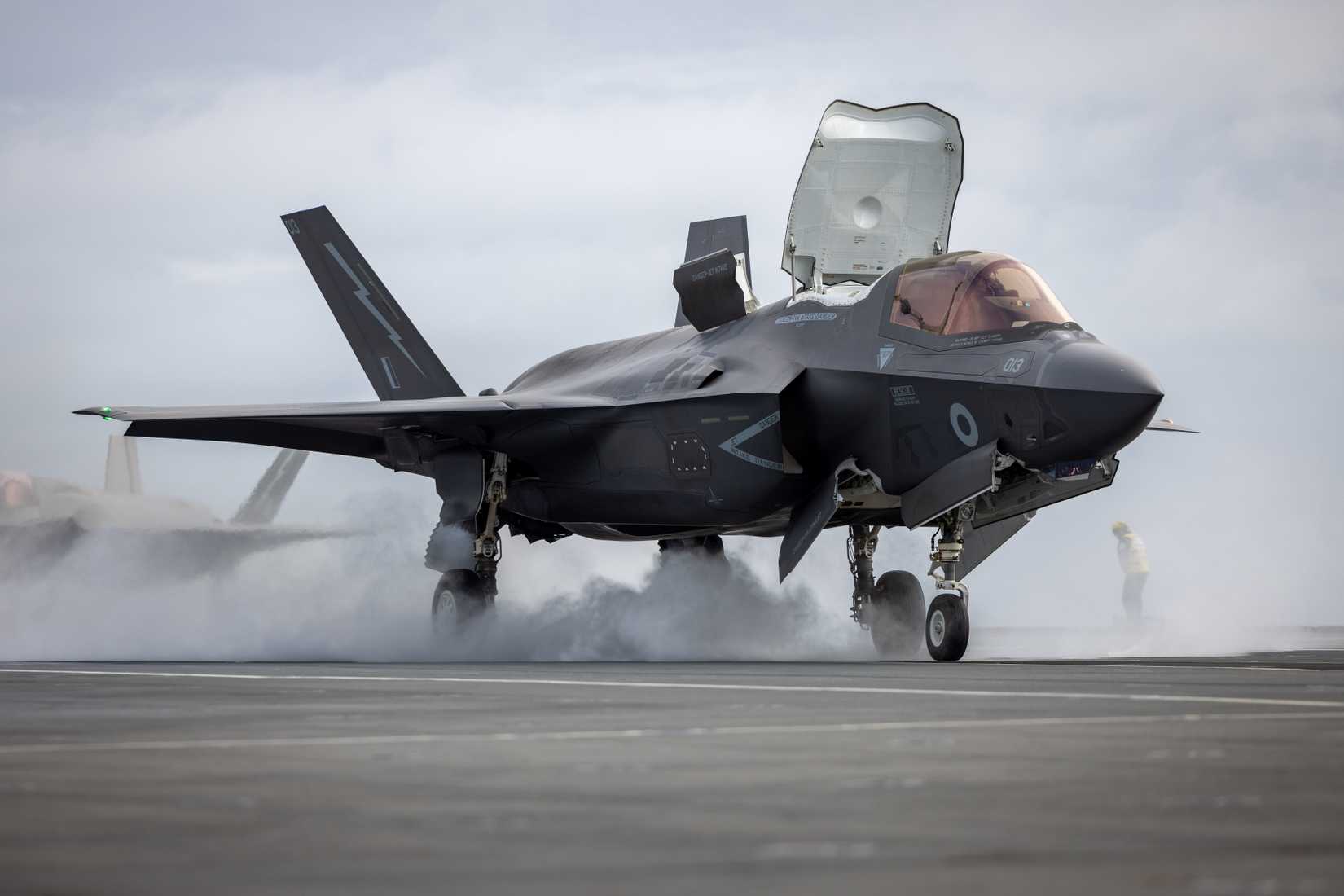
RAF Marham is notable not only for being one of the larger RAF airbases by land area, but also for being home to the Lockheed Martin F-35B Lightning II stealth fighter. While the UK has announced plans to purchase a limited number of conventional F-35As, the country has so far only procured the STOVL F-35B variant. These are shared with the Royal Navy and operate on the Queen Elizabeth Class aircraft carriers.
The UK has so far ordered 48 F-35Bs; at least 38 of these have been delivered, of which one was lost after it fell off a carrier. The UK is preparing to place the next order that will bring the inventory to 72 jets. The British program of record is for 138 F-35s. RAF Marham is the workplace of over 3,600 service personnel, civil servants, and contractors. Notable squadrons based at the airbase include No. 207 Squadron and No. 617 Squadron.
The other airbase in the UK with F-35s permanently based is RAF Lakenheath. While designated an RAF airbase, it is functionally a US Air Force base, and the USAF maintains four fighter squadrons with two flying F-35s and two flying F-15s. The two F-35-equipped squadrons are the 495th “Valkyries” and 493rd “Grim Reapers.” Each squadron operates 24 aircraft plus spares, implying the USAF is currently maintaining more F-35s in the UK than the RAF.
3
RAF Cranwell
Approximately 2,500 acres

At 2,500 acres, RAF Cranwell stands out as the largest RAF air base in the British Isles by geographic size to operate aircraft. RAF Cranwell is located in Lincolnshire, England, and is notable for being the world’s first Air Academy. Today, it continues to select and train the RAF’s next generation of officers.
RAF Cranwell is also home to RAF Recruitment, RAF Air Cadets, No 3 and No 6 Flying Training Schools, the Central Flying School, the Air Warfare School, the Tedder Leadership Academy, and the Robson Academy. Finally, it is also home to the Band of the RAF College.
Aircraft at RAF Cranwell include the Embraer Phenom T1, the Grob Prefect T1, and the Grob Tutor T1. The Grob Prefect T1 is a two-seat light aircraft used for initial elementary flying training. The Embraer Phenom T1 is a twin-engined aircraft for multimission training. It is used to familiarize pilots with jet operating and flying later aircraft.

The World’s Largest Air Forces By F-35 Numbers
How the top F-35 flyers compare.
2
RAF Akrotiri (Cyprus)
Approximately 5,260 acres


Cyprus became a British protectorate in 1978 and then a formal Crown Colony in 1925. In 1960, the Eastern Mediterranean island achieved independence, with the British retaining sovereignty over its strategic military bases on the island, collectively known as the Sovereign Base Areas. Today, RAF Akrotiri on the island is one of the most strategically located British overseas airbases.
It is an extremely busy Permanent Joint Operating Base and is “used as a forward mounting base for overseas operations in the Middle East and for fast jet training.” It is an important base protecting the UK’s strategic interests and functions as an unsinkable carrier in the Eastern Mediterranean. Akrotiri played an important role as recently as 2025, supporting the RAF efforts to intercept Iranian drones and other missions.
At around 5,260 acres, it is the second-largest RAF airbase to host aircraft. The 84 Squadron is based there with helicopters. It is common to see Eurofighter Typhoons, Voyager aerial tankers, and A400M transports operating at the base. It also provides search and rescue as well as aerial firefighting for Cyprus.
1
Mount Pleasant Complex (Falkland Islands)
Approximately 8,300 acres

After the British recaptured the Falkland Islands in 1982, they made moves to establish a more powerful and permanent military presence on the islands. Mount Pleasant Complex is the main military airbase, and it was opened in 1985 to establish a fighter and transport presence on the islands. Four Tranche 1 Eurofighter Typhoon jets, an Airbus A400M airlifter, and a Voyager tanker are based there.
The RAF says, “personnel also support a wide range of roles on the ground; from radar operators to weapons technicians in support of the Typhoons.” At 8,300 acres, RAF Mount Pleasant is the largest RAF base by land area that actually handles military aircraft. It is home to the No. 905 Expeditionary Air Wing. Mount Pleasant is seen as the cornerstone of the island’s defense. It is known for the “Death Star Corridor,” a half-mile-long hallway built to link the bases’ barracks to the mess, protecting personnel from the often harsh Antarctic winds.
Critical to Mount Pleasant is RAF Ascension Island, located on Ascension Island in the mid-Atlantic, halfway between the UK and the Falkland Islands. It is a crucial refueling point, and the No. 1 Air Mobility Wing detachment is based there. No permanent aircraft are based on Ascension Island, but it is a vital pitstop for refueling aircraft. The US Space Force also has a presence there.
source