


The drone era has triggered a burst of entrepreneurial energy. From military forces and security services to retail giants and logistics operators, pretty much everyone is investing in drones, and there is no shortage of uses and applications being developed for them.
This increase in interest in unmanned aerial systems (UAS) has been followed by a surge in the number of companies building them. Whether its industry giants or garage startups, barely a week passes without new drones of all shapes and sizes being unveiled. Drones which will all need to undergo systematic testing before making it to the market.
So, it comes as no surprise that demand for drone testing equipment and facilities is also on the rise.
What’s more, both the European Air Safety Agency (EASA) and the Federal Aviation Administration (FAA) are moving towards more standardized certification processes for drones. Manufacturers must provide regulators with verifiable data which proves their drones are able to perform reliably under a whole range of conditions.
Something that is easier said than done.
Wind tunnels are scarce and expensive, and they may not always be fine-tuned to the needs of the drone builders. Many manufacturers would just test their drones outdoors. And while this may provide a realistic testing environment, open air testing ranges can be problematic when it comes to obtaining the sort of repeatable measurements that are needed to collect data in a systematic way.
This is where a young Swiss company called Windshape enters the picture.
Founded in Geneva in 2016, in the course of a decade, Windshape has managed to carve a niche in the highly specialized market for drone testing equipment and services.
Windshape’s flagship product is a so-called “Drone Wall”. This is a physical wall covered in thousands of sensors that measure different parameters.
It is possible to create an artificial air flow in the space in front of the wall into which you can fly drones to replicate the parameters of a drone flight, which are typically very different from a high-flying aircraft.

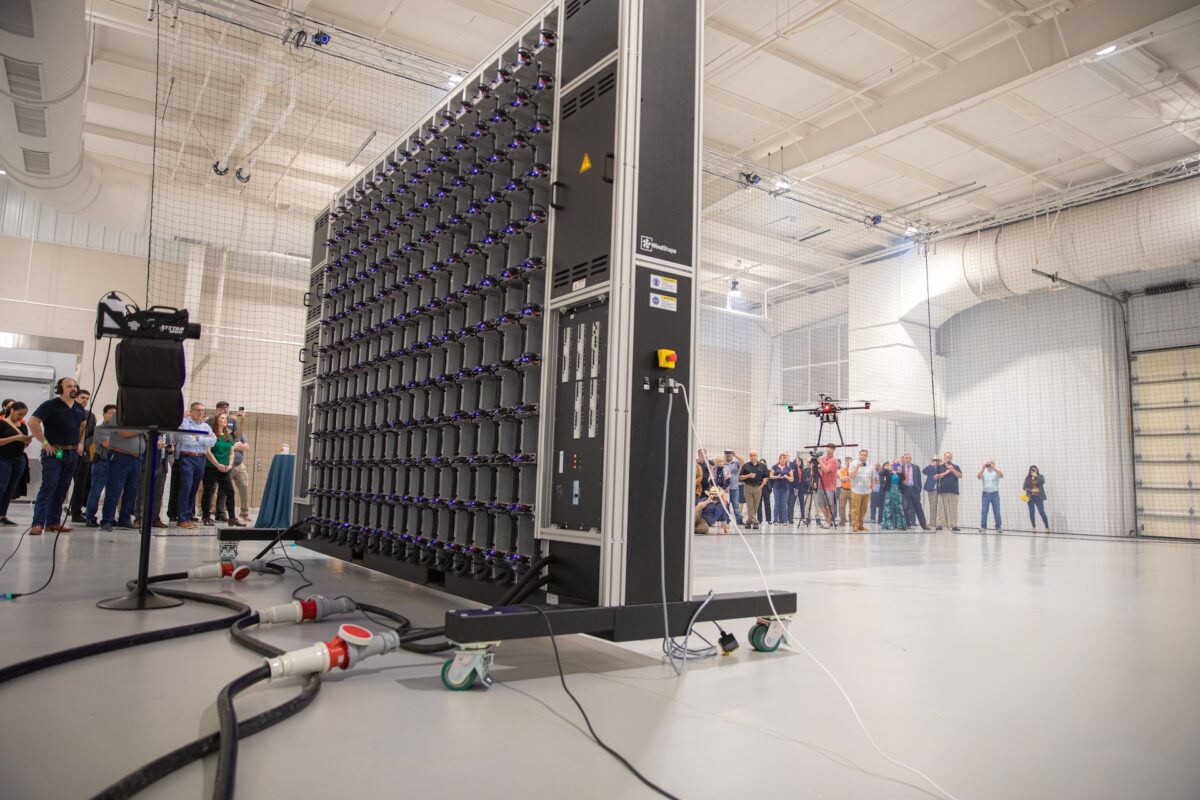
Speaking with AeroTime, Guillaume Catry, Windshape’s co-founder and CEO, how the company sold around 80 of these walls, but soon found out that not that many companies in the drone space, where startups abound, had the money to buy a wall for their exclusive use. This convinced him and his team to pivot to a “wall as a service” model.
Windshape started with an indoor testing facility near Geneva where drone manufacturers are able to test their creations in a controlled environment.
However, the explosive growth of the drone industry soon led Windshape’s founders to look well beyond their Alpine homeland.
Testing drones on Osage Nation land
It is in the wide-open spaces of Oklahoma, within the ancestral territory of the Osage Nation, one of Oklahoma’s sovereign Native American groups, that Windshape opened the first full-service, large-scale, commercially available indoor drone testing center in in September 2025.
Windshape has become the first aerospace company to move to Skyway36 Droneport & Technology Innovation Center, on the outskirts of Tulsa, Oklahoma. As the name implies, this is a research and development area set up by Osage LLC (the firm that manages the financial interests of the Osage Nation) in partnership with Tulsa Innovation Labs, Oklahoma State University, and several other local stakeholders.
The project is part of an initiative to build the Tulsa Regional Advanced Mobility (TRAM) Cluster, which has received some $40 million in federal funds to stimulate the development of a local aerospace ecosystem.
Windshape has taken over a former aircraft hangar, which has been converted into a 20,000 square-ft (1,858 meter) multi-lab facility for indoor drone testing. According to Catry, this is a one-of-a-kind facility, and the first in the world to provide all these services under one roof, including subsystem testing for drone batteries, propellers, and motors.
To do so, Skyway36 has been fitted with eight labs, which make it possible to simulate several different atmospheric conditions, such as rain and ice-cold conditions.
The focus is on civilian drones with up to three meters of wingspan. However, Facility Director Steve Cole told AeroTime that Windshape is already working to expand its scope to include drones of up to five meters of wingspan, as well as other market segments, including military drones.
And while the indoor labs are an essential part of the site’s value proposition, it is worth noting that the facility also has direct access to a runway as well as the Skyway Range. This is a 1,200 square mile territory, also within the grounds of the Osage Nation, where it is possible to perform Beyond-Visual-Line-of-Sight (BVLOS) flight testing.
Building the Oklahoma aerospace ecosystem
The availability of large testing ranges is helping Oklahoma emerge as a relevant player in the new aerospace economy.
In addition to the Tulsa range, in the northeastern corner of the state, other licenses have been granted to the Oklahoma Air and Space Port. One has been permitted in Burns Flat, western Oklahoma, where New Zealand startup Dawn Aerospace intends to test its suborbital reusable aircraft, and another has been granted to a BVLOS testing range within the land of the Choctaw Nation, in the southeast.
Oklahoma is also one of the states participating in the recently announced eIPP program, through which the Trump administration wants to accelerate the development of eVTOLs and advanced air mobility. Companies working on electric and hybrid-electric aviation technologies, such as Ampaire, BETA Technologies, and Joby Aviation, are expected to perform flight testing over the plains of this Midwestern state within the framework of this initiative.
“We have a very central location in the US, the right facilities and an industry ecosystem,” stated Cole. “Oklahoma is building one of the nation’s most advanced environments for autonomous flight and Tulsa wants to become the US drone capital.”
So, Windshape may have been the first company to move to Skyway36, but it’s likely not to be the last.
source