


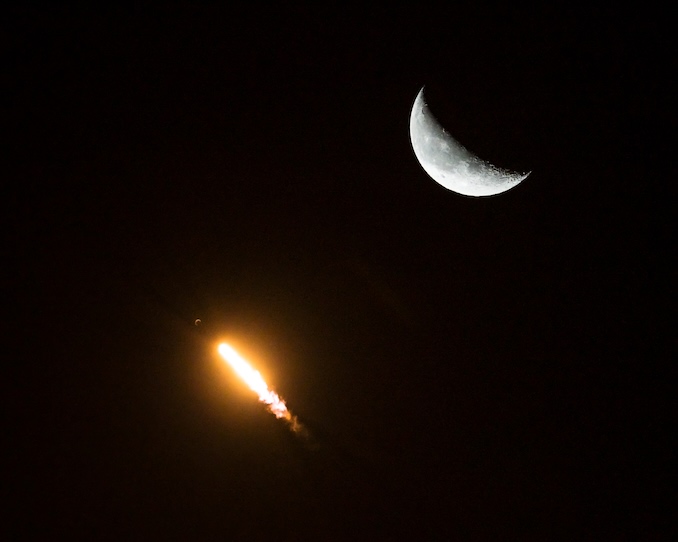
Update July 9, 6:47 a.m. EDT (1047 UTC): SpaceX confirms deployment of the Starlink satellites.
SpaceX broke another rocket reuse record Thursday morning when it launched its most-flown Falcon 9 booster for a 36th time.
It flew in support of the Starlink 10-42 mission, which added another 29 broadband internet satellites to the company’s low Earth orbit constellation. SpaceX currently has more than 10,700 Starlink satellites in orbit.
Liftoff from Space Launch Complex 40 at Cape Canaveral Space Force Station happened at 5:25 a.m. EDT (0925 UTC). The rocket flew on a north-easterly trajectory upon leaving the pad.

The 45th Weather Squadron forecast a 90 percent chance for favorable weather Thursday morning. Meteorologists said they are watching for a small interference from cumulus clouds.
“On Thursday morning, winds will be light and southwesterly, and a few offshore Atlantic showers are possible which could cause a small concern for the Cumulus Cloud Rule,” launch weather officers wrote. “Very similar conditions are expected for the backup day, as Saharan dust settles in the mid-levels and inhibits cumulus development.”
SpaceX’s most flown booster, B1067, began flying in June 2021 with the company’s 22nd Dragon flight as part of the Commercial Resupply Services-2 contract with NASA. It went onto fly the Crew-3 and Crew-4 missions as well as 24 batches of Starlink satellites.
A little more than eight minutes after liftoff, B1067 landed on the drone ship, ‘A Shortfall of Gravitas’, positioned in the Atlantic Ocean. This was the 160th landing for this vessel and the 635th booster landing to date for SpaceX.
source