


Sierra Nevada Corporation announced that two Contractor-Owned Contractor-Operated ATHENA-S jets finished testing and are now operational in support of the U.S. Army’s Aerial-ISR mission.
Sierra Nevada Corporation (SNC) has announced on Apr. 15, 2026, that both contractor and government testing of the Army Theater level High Altitude Expeditionary Next Airborne ISR-Signals Intelligence (ATHENA-S) jets has been completed. The aircraft are now ready for Contractor-Owned Contractor-Operated (COCO) service in support of the U.S. Army’s Airborne-Intelligence, Surveillance and Reconnaissance (A-ISR) mission.
The ATHENA-S milestone validates the Bombardier Global 6500 Rapid Configurable to Any Mission-X (RAPCON-X) aircraft’s design, mission systems integration and operational performance, said SNC in a press release. The ATHENA-S jets are among the aircraft paving the war for the replacement of the Army’s legacy turboprop ISR and SIGINT fleet.
Beside the ATHENA-S, there are also ATHENA-R (Radar), the Airborne Reconnaissance and Targeting Multi-Mission System (ARTEMIS) and Aerial Reconnaissance and Electronic Warfare System (ARES). Similarly to ATHENA, ARTEMIS and ARES are also part of COCO services.
We’re thrilled to announce that contractor testing and government end-to-end testing for our RAPCON-X aircraft have been successfully completed as part of the U.S. Army’s ATHENA project! https://t.co/eMgApUi4GR pic.twitter.com/6pblvsvgGV
— Sierra Nevada Corporation (@SierraNevCorp) April 15, 2026
These programs fall within the broader High Accuracy Detection and Exploitation System (HADES), allowing to test technologies and inform the requirements for the effort. On Jan. 22, 2026, the Army also issued a Request for Information (RFI) for 11 Bombardier Global 6500 business jets destined to the HADES project, for an ultimate Acquisition Objective (AO) of 14 aircraft.
ATHENA-S operational
SNC’s press release quoted the director of strategy and transformation within the Army G-2, Andrew Evans, who said the flying ATHENA platform “enables accelerated delivery of timely, actionable intelligence to commanders.” He further added that “delivering advanced A-ISR capabilities into the hands of warfighters strengthens the Army’s ability to sense, understand and respond across contested environments, preserving decision advantage for the force.”

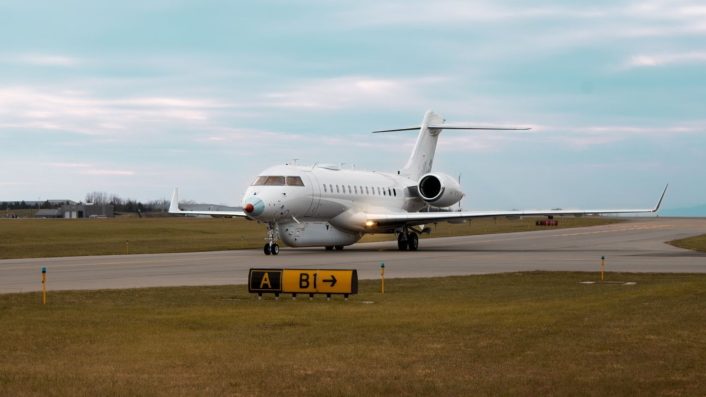
The company highlighted the Artificial Intelligence/Machine Learning (AI/ML)-enabled “processing, exploitation and dissemination tools” on the ATHENA-S. This is in harmony with the emerging ‘cognitive Electronic Warfare’ technological concept that envisages automated scanning, identification and jamming/spoofing of hostile radio/radar emissions, reducing operator and pilot workload.
… Europe and the other two to South Korea but this appears to have changed in recent months.
2/2
SNC press statement: https://t.co/gsLObs1ENL
More about the ATHENA jets: https://t.co/bm1zA2d1Ob
Photo above: https://t.co/qSxsXsIBBq
h/t @airsuperiorx: https://t.co/PqISe4PzrA
— Bizjets of War (@bizjetsofwar) April 15, 2026
SNC explained that the ATHENA-S aircraft completed testing and integration of the mission systems at its facility in Hagerstown, Maryland. This was followed by a “comprehensive series of contractor and government testing events” that “validated the aircraft’s system-of-systems performance, confirming that the integrated platform meets operational requirements for ISR collection and mission processing.”
“ATHENA demonstrates the strength of SNC’s integration expertise and our ability to rapidly deliver operational capability to the warfighter,” said Tim Owings, executive vice president at SNC. “By leveraging proven commercial platforms and integrating advanced mission systems, we are accelerating the fielding of critical ISR capabilities while informing the future architecture of the Army’s deep-sensing fleet.”
US Army Video of Integration of the High Accuracy Detection and Exploitation System (HADES) project.
HADES is the future US Army’s HALE platform for aerial ISR, SIGINT, ELINT, COMINT & deep sensing missions at altitudes of up to 70 kft using Bombardier Global 6500 aircraft. pic.twitter.com/TjejvWYnLJ— Mehdi H. (@mhmiranusa) April 16, 2026
ATHENA-S aircraft in the Philippines
Just a few days earlier, the two jets deployed to Cebu in the Philippines. Flight tracking account ‘Manila_Alert’ reported on Apr. 12, 2026, that one of the aircraft, N650RX, flying with callsign ‘LATTE18’, was over the South China Sea (SCS) a few hundred kilometers northeast of Cebu. It was joining its other sister ATHENA-S aircraft, N650SN, already at the location since early April.
LATTE18 (ATHENA-S) heading to Cebu, Philippines with stopovers in Honolulu and Guam to reunite with it’s sister, N650SN. I wonder why both ATHENA-S jets are deployed to Cebu instead of Japan or South Korea.
LATTE18, N650RX – #A88E47
(credits to https://t.co/j3Axp68Q63) pic.twitter.com/ORqxHw4n5o
— Manila_Alert (@Manila_Alert1) April 12, 2026
In fact, ‘Manila Alert’ had tracked the other ATHENA-S aircraft, N650SN, heading to the Philippines as early as Apr. 1, flying with the callsign ‘LATTE92’. Data on ADS-B Exchange showed N650SN’s activity on Apr. 10 at Philippine’s Mactan-Cebu International airport, from where it took off at 11:54 pm and landed back the next morning at 6:19 am.
Both aircraft are believed to have stopped in Honolulu, home to the Joint-Base Pearl-Habor Hickam (JBPHH), and Andersen AFB on Guam for refueling. The aircraft then flew the last leg from Guam to the Philippines.
ATHENA-R and ATHENA-S within the HADES program
The Army Theater level High Altitude Expeditionary Next Airborne ISR-Radar (ATHENA-R), and ATHENA-S (Signals Intelligence) jet platforms are part of the Army’s preparation for the High Accuracy Detection and Exploitation System (HADES). The program, which falls within the Multi-Domain Sensing System (MDSS) program, has been shaping up since 2020.
For the HADES project, the Army is trialling four different contracted Company-Owned Company-Operated (COCO) demonstrator aircraft, providing ISR, targeting and ELINT/SIGINT (Electronic/Signals Intelligence) capabilities. These preparatory programs are “bridging strategies,” as the Army had said, which will validate technologies, meet interim operational needs, and also inform the performance parameters for the HADES project.


MDSS and HADES are intended to replace the four-decade old legacy turboprop aircraft fleet of RC-12X Guardrail, MC-12S EMARSS and EO-5C ARL-M aircraft, which the Army completed divestment of in December 2025. The other two roles are the Airborne Reconnaissance and Targeting Multi-Mission System (ARTEMIS) and Aerial Reconnaissance and Electronic Warfare System (ARES).
The Product Manager for the MDSS, Eric Hughes, had previously said they would help assess “how the sensors operate on the demonstrator jets at the altitudes, speed, and ranges that HADES is expected to perform.” ARTEMIS, based on the Challenger 650 business jet, has been operational since 2020, with deployments both in the Indo-Pacific and Europe. The Bombardier Global 6500-based ARES was also deployed to the Indo-Pacific in 2022.
In 2023 the U.S. Army selected L3Harris and MAG Aerospace for two ATHENA-R aircraft, and SNC for an equal number of ATHENA-S planes. Then, in February 2025, the Army deployed the ATHENA-R to South Korea for a four-month operational assessment of the aircraft’s readiness.
In May 2025, SNC announced successfully the completion of the initial Flight Performance Handling & Qualification test of the Bombardier Global 6500 business jet in the RAPCON-X (Rapidly Configurable to Any Mission-X) airframe for the ATHENA-S.
Earlier today, the ATHENA jet did approach-and-landing training at Kunsan Air Base. The first ISR mission is expected later this week.
SCRUM06 // N291SR // #A2FAD1 pic.twitter.com/rkDQPj8bGA
— Bizjets of War (@bizjetsofwar) February 18, 2025
January 2026 RFI
The Jan. 22, 2026, Request For Information (RFI), updated over the next month before finally being inactivated by Mar. 4, sought 11 Global 6500s as Government-Owned Government Operated (GOGO) airframes. Interestingly, Breaking Defense had reported in May 2025 that the Army had halved its future HADES fleet from 12 to six airframes.
The RFI requires the aircraft to be able to operate between altitudes of 41,000 and 51,000 feet, and should maintain a ceiling of 41,000 feet while carrying 6,500 pounds of the concerned ISR and SIGINT “Mission Equipment Package (MEP)” payload.
The aircraft should also be capable of unrefueled endurance of 12 hours while carrying a minimum payload of 14,000 pounds. Structural requirements stipulate no use of composite materials for the aircraft fuselage, empennage skin and structural components, adding that “limited use of composite materials for nose cones, tail cones, pylons, fairings and radome is permissible.”
source