


An upgraded Serbian MiG-29 was recently photographed with Chinese CM-400 supersonic standoff missiles.
Images appeared on Mar. 10, 2026, on social media showing a Serbian Air Force and Air Defense (Ratno vazduhoplovstvo i protivvazduhoplovna odbrana Vojske Srbije) MiG-29SM Fulcrum carrying two Chinese CM-400 Air-Launched Cruise Missile (ALCM). The weapon, previously known to be used only by Pakistan, is part of a family which also includes anti-ship and anti-radiation variants.
Another Chinese weapon that also appeared on a Serbian MiG-29 was a Chinese LS-6 guided bomb, a 1,000 pound-class bomb with a JDAM-type guidance-kit. The country already uses the Chinese-made FK-3 (export variant of the HQ-22) surface-to-air missile systems, which were delivered to Belgrade in six Y-20 cargo aircraft early in April 2022.
The CM-400 on the Serbian MiG-29 is mounted on the Chinese-made WZHK-1 adapter/launcher pylons as pointed out by one observer. Developed by the China National Aero-Technology Import & Export Corporation (CATIC) and unveiled in the May 2025’s Langkawi International Maritime and Aerospace (LIMA) exhibition, the pylon allows rapid integration of Chinese weapons on foreign aircraft without hardware or software modifications, according to Janes.
A MiG-29SM of the Serbian Air Force carrying a Chinese LS-6-500, which is a Chinese-made precision-guided glide bomb kit designed to convert conventional 500 kg “dumb” bombs into standoff weapons, utilizing a combination of satellite navigation (GPS/BeiDou) and inertial guidance. pic.twitter.com/qLhG5mjifP
— Fay (@FaySue6) March 11, 2026
CM-400 on Serbian MiG-29
Serbia operates a total of 14 MiG-29s, with 11 being the modernized SM variants, and the remaining three being MiG-29UBs used as conversion trainers. As The Aviationist had reported, six of the MiG-29s were donated by Russia beginning in 2017, and were overhauled and moderately upgraded to the MiG-29SM standard.
The MiG-29SM is a multirole variant and, according to Serbian defense website Tango Six, the Serbian MiG-29s received “improvements to the radar, integration of air-to-air missiles R-27ER and R-77 as well as precision guided air-to-ground missiles.” What Serbia plans to do with its MiG-29s in the long term is not yet known.
In Aug. 29, 2024, the government also signed on for 12 Dassault Rafales, representing President Aleksandar Vučić’s desire to leave the room open for Western cooperation when needed, despite being broadly Russia-aligned in nearly every international sphere.
SWFCSはパイロンそれ自体に電源から射撃管制コンピュータ、INS/GNSSまで全て機体から独立して搭載されており、パイロン側と機体側は物理的な接続のみで通電すら必要ない。
武装の全操作はパイロット手元の端末から行えるようになっており、端末とパイロンは無線接続されている。 pic.twitter.com/qsRDZPdT6e— お砂糖wsnbn (@sugar_wsnbn) March 11, 2026
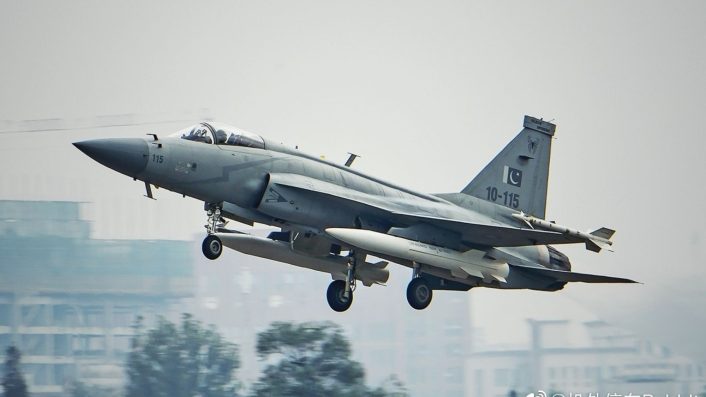
The CM-400, also sometimes referred to as the CM-400AKG, is not a new weapon, and has been spotted on Pakistan Air Force JF-17 Thunder Block II/IIIs before. Its range has been claimed to be anywhere between 250 and 400 km, with terminal speeds in the high-supersonic band of Mach 4.5, with some claiming Mach 5, although it cannot be independently verified.
The weapon has also been described as an air-launched ballistic missile (ALBM) with a quasi-ballistic trajectory, programmed to maneuver in flight to avoid interception. Pakistani officials further described the missile as “an aircraft carrier killer.”
When the WZHK-1 pylon, also called the Standalone Weapon Fire Control System, was first officially unveiled at LIMA 2025, Janes quoted an unmanned CATIC official: “The system gives air forces […] the ability to easily integrate Chinese-made weapons with their aircraft without requiring them to make software or hardware changes to the host aircraft.”
“The SWFCS uses a wireless data system that connects to a tablet in the cockpit that can be worn by the pilot. The tablet acts as a portable wireless controller that the pilot can use to launch the missiles,” the official added. The tablet is designed to be fixed to the knee of the pilot while in flight.
The CM-400AKG is a Chinese-made air-to-surface missile that’s been making waves in military circles, especially after Pakistan used it to destroy India’s S-400 air defense system. This missile is launched from JF-17 Thunder fighter jets and has a range of 100-240 kilometers, with… pic.twitter.com/AjWE9bKWVU
— Rimland Intelligence (@Rimland_Intel) November 17, 2025
We have seen the use of a tablet in the operation and control of other weapons, like Turkey’s SOM-J ALCM that was tested from its F-16, and in development of Collaborative Combat Aircraft (CCA), when an F-22 Raptor operated a GA-ASI MQ-20 Avenger. A similar solution was also used to employ Western weapons on Ukrainian fighter jets.
Coming back to the CM-400AKG, previous reports had pointed to its use against India’s S-400s, and the PAF again brandished the CM400-JF17 combination in the May 2025 skirmish between the two countries. Unveiled in 2012, the weapon is around 17 feet long and weighs roughly 2,000 pounds, with several Russian and Chinese-aligned Telegram channels claiming it can carry a 330 lb high-explosive warhead, or a heavier armor piercing 440 lb pound charge.

This therefore would allow the Balkan nation to possess a high-supersonic standoff surface-strike capability, one of the few in Europe – beside Russia. The CM-400 is a fairly hard-hitting weapon that gives Serbia the ability to engage time-sensitive targets in fast-paced dynamic tactical situations, with its high speed outside the interception capability of most air defenses.
Pakistan shows footage of its JF-17 Thunder jet taking off to hit Indian S-400 air defence system with Chinese-origin CM-400AKG hypersonic missiles in anti-radiation variant.
The missile features a passive radar guidance mode, allowing it to home in on radar emissions, making it… pic.twitter.com/DUQTOQciDk
— Clash Report (@clashreport) May 10, 2025
Conclusion
The Serbian MiG-29 flying with CM-400AKGs therefore has a lot of loud strategic and military diplomatic statements. For one, it bares Belgrade’s diversifying defense ties with players across the geopolitical spectrum, despite traditionally being in the Soviet, and post-Soviet Russian block.
This is because the Serbian Army also uses the Israeli-made Precise and Universal Launching System (PULS) rocket artillery. Second, this cross-platform compatibility of the CM-400 and the LS-6, especially for countries using Russian aircraft, was also underscored in Beijing’s 2025 drills with Egypt, where the latter’s MiG-29s were cleared to refuel from Chinese Y-20 tankers.
As we reported yesterday, Serbian Air Force showcased, for the first time, that they are in possession of Chinese made CM-400 supersonic air-ground missiles, with a reported range of up to 400 km.
This makes Serbia the second foreign customer, after Pakistan.
Pair of missiles… pic.twitter.com/Yo2Utzf8DV
— Peter Voinovich (@PeterVoinovich) March 10, 2026
This is a unique marketing strategy meant for countries desiring a diverse option on weapons, both foreign and domestic, to be integrated on their non-indigenous fighters that would require the latter’s technical assistance for integration. Saab’s JAS39 Gripen, for instance, bases its marketability on around complete transfer of technology in local manufacturing and fusing domestic engines, mission systems and weapons of the buyer country.
#DassaultAviation : La Serbie fait l’acquisition de 12 Rafalehttps://t.co/LBiKW07IHO
Serbia acquires 12 Rafale fightershttps://t.co/Ssn03tJX2W pic.twitter.com/NUNJco8YBx— Dassault Aviation (@Dassault_OnAir) August 29, 2024
source