


By Thomas Blackwood
April 23, 2026, © Leeham News: French aerospace group Safran reported “very strong” results for the first quarter of 2026 with revenue reaching €8.6 billion, up 18.8% compared to Q1 2025.


CEO Olivier Andriès told investors that the Paris-based engine maker was seeing solid momentum across both aerospace and defense, with “little to no impact” from the Middle East conflict.
No war slowdown – yet
“We’ve not seen any indication yet of any slowdown” linked to the war in Iran and the wider region, he said during Thursday’s earnings call.
“We’ve not seen any indication of any slowdown of engine removals or engine induction. We have not seen any indication of reduction of our scope, and … we’ve been very positively surprised, in fact, by the higher number in the global mix of shop visits, in the higher number of shop visits with a heavy work scope. We don’t expect any [slowdown] in Q2 as well, so we expect to have a strong H1.”
However there was a note of caution, with Andriès highlighting the impact on the supply chain and the cost of some raw materials. Cobalt and tungsten were given as two examples of materials that have seen sharp price increases.
But Andriès added: “We manage that, we have the buffer and the room to absorb that cost increase on specific raw materials.”

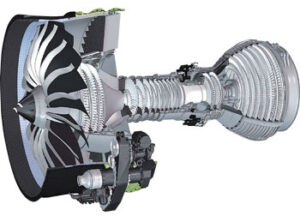
The LEAP entered service nearly a decade ago on the A320neo and on the first flight of the 737 MAX.
The generally resilient commercial aviation sector was also cause for optimism.
Andriès said that only 44 CFM56-powered aircraft were retired in Q1, with no sign of accelerated retirements despite the uncertainty triggered by the Iran conflict.
Airlines are still complaining about capacity shortages, he said, and Safran expects retirement rates to remain at historically low levels in 2026 and not pick up meaningfully in 2027.
JV partners GE Aerospace said during an earnings call earlier in the week that for the full year, the company was reducing its outlook to flat to low single-digit growth, down from prior mid-single-digit expectations.
Strong performance across the board

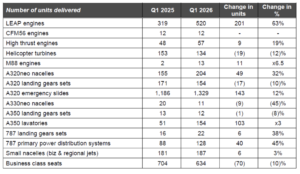
Number of products delivered on major aerospace programs. Credit: Safran
Safran’s LEAP program is continuing to perform strongly. LEAP engine deliveries reached 520 units in the first three months of 2026; 63% growth compared to the 319 in Q1 2025, and the third consecutive quarter with deliveries exceeding 500 units.
Overall, revenue in the Propulsion division was up by 33.1%, with aftermarket revenue up by 32.1% and OE sales up by 35%.
Helicopter engine revenue saw growth, though modest, primarily driven by spare parts sales, while revenue from missile propulsion systems benefited from higher delivery volumes.
Revenue in the Equipment & Defense division was up by 13.5%. There was strong demand in electronics, inertial navigation systems and guidance systems, plus aftermarket services – notably for A320/A380 and electrical systems.

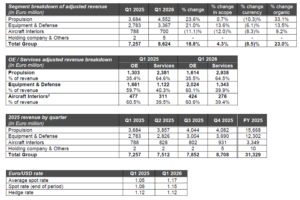
Safran revenue by division. Credit: Safran
Revenue for Safran’s Aircraft Interiors saw a 9.2% growth. This was helped by strong cabin delivery numbers and favorable pricing in business class seats, despite lower volumes (the number of business class seats delivered to customers fell by 10%).
M&A
Over the quarter, Safran completed the divestment of Safran Passenger Innovation, and has announced the acquisition of startup Symphony, a leader in resilient navigation technologies for complex and denied environments.
The group has also established a new manufacturing facility for landing-gear equipment in Morocco which is scheduled for operation in 2029, and signed an MoU with EDGE Group in the UAE for the development and production of advanced air-to-ground weapon systems.
Full-year guidance
Safran has reaffirmed its full-year 2026 guidance, projecting revenue growth in the low- to mid-teens and recurring operating income of between €6.1 billion and €6.2 billion.
The group also expects free cash flow of €4.4 billion to €4.6 billion, a figure that incorporates an estimated negative impact of around €470 million from the French corporate surtax.
The outlook assumes an increase of around 15% in LEAP engine deliveries, mid-teens growth (in US dollars) in spare parts revenue, and an increase of around 20% (also in US dollars) in services revenue.
Andriès said he had “strong confidence” in the group’s ability to reach the high end of the full year 2026 target guidance.
Related
source