


Airlines operate on very small profit margins and are therefore constantly looking for ways to cut costs. New and advanced engine technology, specialty loyalty programs, composite airframe materials, are some examples of areas where airlines have tried to improve the bottom line. But one piece of wing technology, easily overlooked by the casual traveler, has been a point of intense interest for airlines as they look to improve efficiency.
The wing of an airplane is the most important part of the design. And for the most part, large aircraft manufacturers like 


Aerodynamic Fundamentals Of Winglets


Lift. Weight. Thrust. Drag. That’s your crash course on how an airplane flies. Of course, it is more complex than that, but let’s focus on lift and drag for the purposes of this discussion. Lift is the aerodynamic force that keeps the plane in the air, and drag is the aerodynamic force that tries to slow the plane down as it flies (think air resistance). As the plane flies through the air, the air above the wing is at lower pressure than the air under the wing, creating a pressure differential. This becomes a problem at the tip of the wing, where the two regions interact with each other after the wing ends. The natural tendency for high pressure air to move towards low pressure regions causes air from underneath the wing to curl up and around the end of the wing and land on top, creating a phenomenon called wingtip vortices. If you have ever seen a plane cut through clouds and leave the cloud curling and spinning behind it (as seen in the picture above), you have seen wingtip vortices in action.
But why does this matter? When air spills on top of the wing from below, it disrupts the flow going over the wing, creating drag. This reduces the effectiveness of the wing to produce lift in the region where this disruption occurs. When there is more lift being generated by the wing, the vortices are stronger, but the drag created is stronger too. This is an aerodynamic relationship called lift-induced drag, and is the problem wingtips were created to solve. In short, a winglet is included on a wing to decrease the strength of the wingtip vortex. They accomplish this by redirecting the vortex flows to thinner boundaries rather than an abrupt one at the end of the wing. Weaker vortices mean less lift-induced drag, and results in better climb performance, weaker wake turbulence, and improved fuel efficiency.
This is what airlines are after. Fuel is one of the highest costs for airlines, and fuel efficiency is thus a significant factor for airlines to consider. Since winglets vary in design, airlines have to decide which design is best for the aircraft in its fleet. Common designs are raked, sharklet, and blended, which smoothly transition the wing into the winglet. As technology advances, new designs reach the market. The leader today, dubbed by Boeing as the most efficient winglet on any airplane, is the split scimitar on the 737.
United Debuts The Split Scimitar


In 2014,
The benefits of the split scimitar design led United to apply the technology even further. Shortly after introducing the split scimitar on its 737NG aircraft, United implemented a scimitar winglet design on its 757-200 airplanes. Today, the airline also operates an extensive 737 MAX fleet, which includes split-winglet designs as well. While similar to the split scimitar, the 737 MAX fleet uses a special winglet called the Advanced Technology (AT) winglet. It is a slightly newer design developed in-house, but it retains almost all the same design characteristics and benefits. It is clear that United found a winner with the split design, as the airline predicted immediate fuel savings of about $200 million after the new winglets were added to its fleet. The table below shows the current number of aircraft in United’s fleet with a split winglet design (excluding the 757-200, which does not have a split winglet but includes updated scimitar designs).
|
Aircraft |
737-700 |
737-800 |
737-900 |
737-900ER |
737 MAX 8 |
737 MAX 9 |
757-200 |
|---|---|---|---|---|---|---|---|
|
Amount |
40 |
141 |
12 |
136 |
123 |
113 |
40 |
Source: Cirium, United, Wikipedia


Why Did Boeing Build The 777X With Folding Wings?
The Boeing 777X’s folding wingtips are a marvel of engineering, although they also come with a range of engineering tradeoffs.
An Engineering Argument
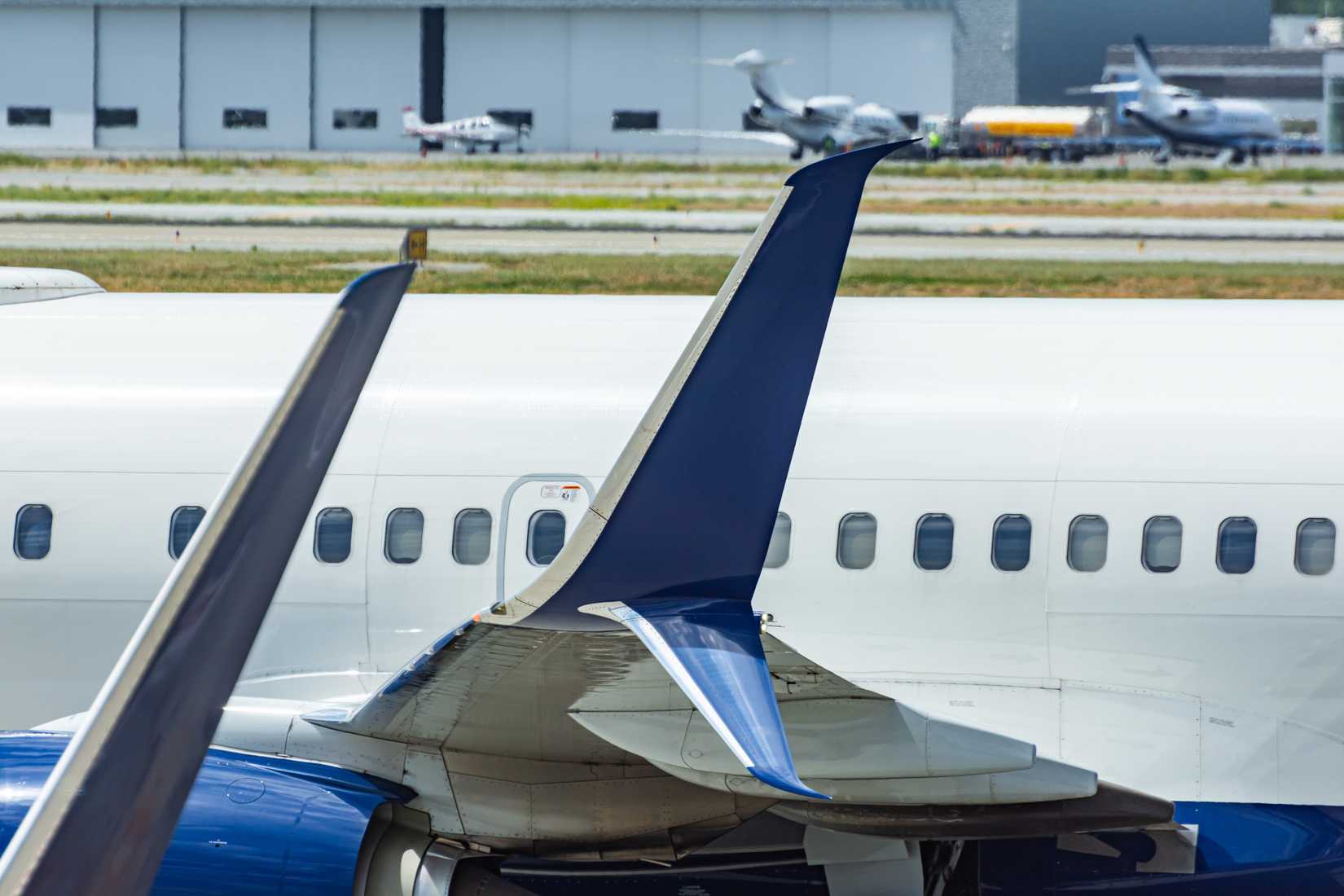
The fuel efficiency advantages of the split scimitar are enough to convince any airline to make the switch, but there is more going on behind the scenes that further supports the split design over blended. As mentioned earlier, the split winglet design reshapes the vortex flow at the wingtip more aggressively than the blended design. This leads to a larger reduction in lift-induced drag by diffusing the energy of the wingtip vortices as it attempts to spill up and over the wingtip.
An additional advantage the split design holds over a blended design is its effect on the aircraft structure. Blended winglets increase the bending moment of the wing at its root. In other words, the added lift generated by the winglet makes it more prone to flexing, adding more stress where the wing is connected to the fuselage of the plane. While this is a common behavior seen in nearly every winglet design, the benefit of the split scimitar is that it adds a secondary load path at the tip of the wing, thanks to its added strake. This distributes the mechanical loads within the wing during flight more efficiently. This improved aeroelasticity results in a more structurally sound wing design.
The following table compares the drag reduction and fuel savings of both a blended and split-scimitar winglet when compared to a 737 with no winglet. Data provided are rough estimates corroborated by many sources.
|
Blended |
Split-Scimtair |
|
|---|---|---|
|
Drag reduction |
7% |
9% |
|
Fuel savings |
3.3% |
5.5% |
The Market Follows


After United started retrofitting its 737 fleet with the new winglets, other airlines took notice. Prominent 737 operators in the US began following suit and adding the split scimitar to their fleet. Notably, 


The split design can also be seen in Airbus aircraft as well. Notably, the Airbus A320 family and Airbus A380 have split winglet designs. Although these winglets are called fence wingtips and do not have scimitar designs. Given the benefits of the scimitar, it is a valid question to ask why every aircraft does not have them. Some aircraft are simply unable to support the scimitar due to size constraints; an aircraft can be too small or too big. Furthermore, new long-range aircraft such as the 787 and A350 include elegant raked wingtips which have specific benefits for high-speed, long-range cruise.

Are Split Scimitar Winglets Really That Efficient?
How can split scimitar winglets help airlines and aircraft manufacturers achieve their ambitious sustainability goals?
Final Thoughts

At the end of the day, United’s switch away from blended winglets to newer split winglets makes a lot of sense. The benefits are numerous from both an engineering and business perspective. Not surprisingly, the competitive nature of the commercial airline business led to many other airlines adopting the same technology as well. Even though the commercial aviation industry is often criticized for a lack of innovation in airplane design, winglets are one area where there has been meaningful developments.
So the next time you get on an airplane, perhaps it is indeed a United 737NG, look out the window at the wing. The small area at the end of the wing can be unassuming, but it could be saving your airline millions.
source