


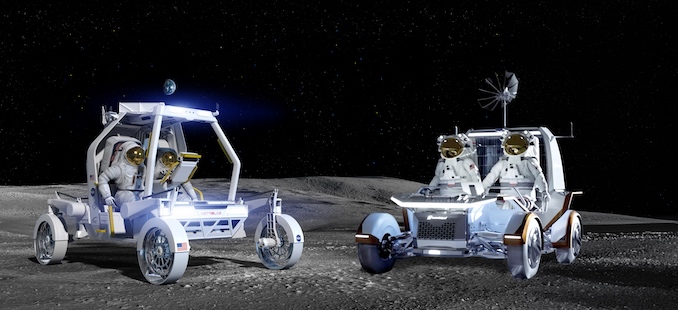
NASA’s goal of a sprawling Moon Base near the south pole of the Moon will be driven in part by its ability to move astronauts from one location to another. Right now, two companies are racing to give the agency that capability by the end of 2027.
Last month, NASA selected Astrolab and Lunar Outpost to develop lunar terrain vehicles that can be delivered to the agency next year. They are two out of the three companies who were originally competing for the LTV contract announced by NASA in 2024, which would’ve resulted in the selection of just one rover.
Instead, NASA asked the companies to come up with a simpler design that doesn’t need to potentially survive on the lunar surface for a decade, but rather something that could be ready in time for the first crewed landing of the Artemis program, which is currently scheduled for early 2028.

“Protecting for [plume surface interaction], we plan to keep the LTVs approximately 2 km away when the landers land,” said Ryan Stephan, NASA’s acting director for cargo landers. “They’ll traverse in, be able to pick up the crew, and then do missions up to like 10 km during the crewed period and then uncrewed, like Carlos said, a total of 400 km throughout the lifetime.”
Astrobotic’s offering is called the Crewed Lunar Vehicle (CLV-1) and takes learnings from the company’s future-looking Flexible Logistics & Exploration (FLEX) rover, capable of carrying humans and cargo, along with its smaller FLEX Lunar Innovation Platform (FLIP) rover.
“FLIP was always going to be a test bed for LTV, that’s why FLIP has extremely large tires because they were meant to be the LTV tires and big overpowered wheel actuators and large batteries,” Jaret Matthews, Astrolab’s CEO and founder, told Spaceflight Now following NASA’s May 26 Moon Base event.
“We’ve already obviously made a lot of progress there, and that is directly transferable to CLV. So it’s hard to say as a percentage-wise, how much work is ahead of us. There’s still a lot of work ahead of us for sure, but we have a great foundation off which to build.”

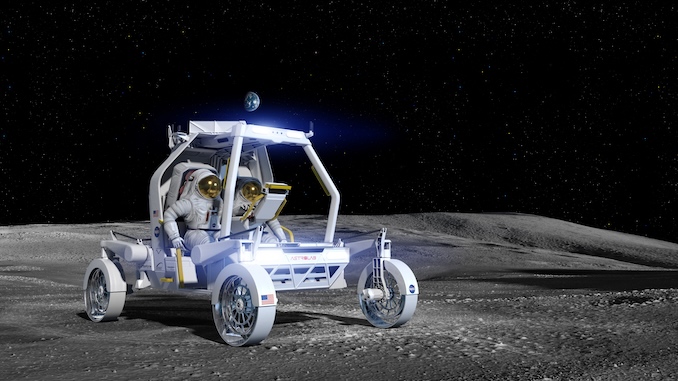
The FLIP rover is scheduled to fly onboard Astrobotic’s Griffin-1 mission, which will carry FLIP and other payloads to the Moon later this year. Both the lander and the FLIP rover are going through final environmental testing before they meet up at the Kennedy Space Center to be integrated together and prepared for launch on a SpaceX Falcon Heavy rocket.
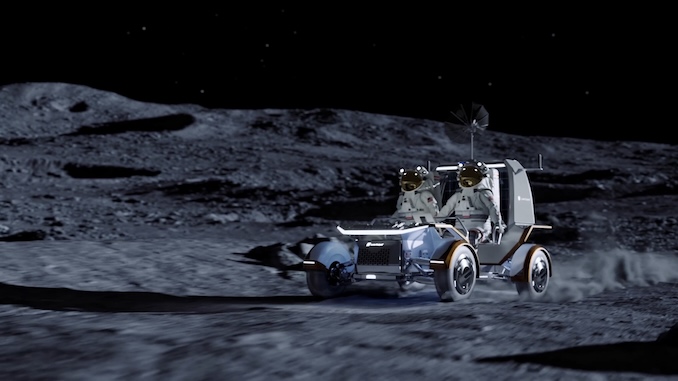
Similarly, Lunar Outpost took lessons learned from developing its larger Eagle LTV and its smaller series of robotic rovers, like the Mobile Autonomous Prospecting Platform (MAPP). The company flew one of its MAPP rovers on Intuitive Machines’ IM-2 mission in 2025 and will so again on the upcoming IM-3 mission as well as alongside astronauts on a future Artemis mission.
“So it’s the part of the Artemis Deployed Instruments Program. So much like in Apollo, where the astronauts deployed various instrument packages and suites during their mission,” said Andrew ‘AJ’ Gemer, Lunar Outpost’s co-founder and chief financial officer. “What’s really cool about, you know, our mission is it’ll be the first time that we have human-robot interaction that our astronaut crews will actually have a rover companion there on the lunar surface to help them out and help keep them safe.”
Gemer said Lunar Outpost already has a pair of static human-in-the-loop mockups of its Pegasus LTV and the team is progressing towards more developed versions.
“We’re going to continue that and extend it into full scale drivable prototypes that will eventually be used as astronaut trainers. They’ll be driving these vehicles in a representative lunar environment here on Earth, along with our digital twins and simulations that accurately represent the vehicle dynamics in the lunar environment and under lunar gravity,” Gemer said.
“And parallel to all of this, we’ll be building and qualifying the flight hardware. So going through our standard lunar mobility qualification processes, all arriving at a successful delivery to NASA in November of 2027.”
Matthews said one of the critical challenges that these landers and rovers need to overcome is the ability to survive the harsh cold that comes with being in total darkness on the Moon, which can be around negative 400 degrees Fahrenheit. The company’s FLIP rover is designed to survive for 100 hours of lunar night conditions and the CLV-1 is slated for 150 days of darkness.
“In both cases, our approach is to essentially have a lot of onboard energy storage, so a lot of battery capacity, and use that capacity to keep things just warm enough while hibernating through the night. And the second tactic we use is to turn down our radiator,” Matthews said.
“We have a radiator that rejects heat from the avionics in the daytime, but if you just let the radiator continue to radiate throughout the night, you’re going to lose a lot of heat. So our approach is to actually cover up the radiator with our solar arrays. We’re doing this both on FLIP and on CLV to limit the amount of radiation we have throughout the night.”
The New Glenn-sized elephant in the room
While both companies continue to make progress on their new LTV designs, a big potential hurdle exists in their ability to reach the Moon.
In the original competition for the LTV contract, the companies (Astrolab, Intuitive Machines, and Lunar Outpost) were required to procure their own path to land on the Moon. Astrolab and Lunar Outpost selected SpaceX’s Starship as their ride and Intuitive Machines chose its own Nova-D lander.
However, in this new procurement, NASA decided that it would take the reins on securing the launch and landing side of the equation and selected Blue Origin to do both. It would launch the LTVs on top of its Blue Moon Mark 1, flying on a New Glenn rocket.

The May 28 explosion of the New Glenn intended to fly the NG-4 mission destroyed Blue Origin’s only operational launch pad and put their launch schedule on ice. The company’s CEO, Dave Limp, said during the VivaTech conference last week, that the company aims to resume launching New Glenn rockets from Cape Canaveral Space Force Station in Florida by the end of the year.
Limp added that the first launch of a Blue Moon Mk.1 cargo lander, previously planned to launch later this summer, would instead fly in early 2027. The lander relies on New Glenn because its the only rocket that flies with a seven-meter-diameter payload fairing and it can provide fuel to the lander at the pad.
In an interview with Spaceflight Now earlier this month, Carlos García-Galán, the Program Executive for NASA’s Moon Base program, said avoiding anomalies like this is part of why NASA ultimately wants the landers and payloads flying for Moon Base missions to become agnostic of launch vehicles.
“This anomaly was kind of a wake-up call to the fact why it’s so important that we achieve this vision of operations. And on New Glenn specifically, the team is definitely focused on, number one, understanding what happened, rebuilding the infrastructure, and get back to nominal operations,” García-Galán said.
“We will be in the process of doing that in parallel. We’ll be looking at different options for Moon Base and Artemis on how we can continue our mission without significant delays.”
source