


KYIV, Ukraine — Lithuania, a NATO state bordering Russia and Belarus, bought 48 Merops interceptors from American manufacturer Perennial Autonomy on April 22, becoming the latest NATO country to buy into the $15,000 per-shot counter-drone system.
The pilot purchase, made without competitive bidding, follows earlier Merops deployments and training with Polish and Romanian forces along NATO’s eastern flank.
The system is an example of a new crop of drone countermeasures marketed under an ultra-low-cost mantra that promises to even out a longstanding imbalance in air defense: Intercepting aerial threats like drones is exponentially more expensive than launching them.
It’s a brave new world for arms vendors, especially in the West, nursed on lavish defense budgets over decades. A price point advantage is no longer measured in millions of dollars below the competition, but in mere thousands.
Merops is “capable of intercepting Shahed, Gerbera, and other similar targets,” Lithuanian Defense Minister Robertas Kaunas said, according to national broadcaster LRT – a claim the manufacturer, Perennial Autonomy, confirmed to Military Times, saying Merops has already successfully engaged both target types in combat.
The American-made system saw its first official combat confirmation last month, when Army Secretary Dan Driscoll told Congress that Merops had been used to down Iranian Shaheds aimed at U.S. troops in the Middle East.
The Army bought 13,000 Merops interceptors in eight days after Iran began launching drones at U.S. positions in late February, Driscoll said in April 16 testimony.
The Pentagon turned to Merops after burning through hundreds of Patriot missiles defending against Iranian Shaheds – each Patriot costing more than $3 million, drawing down stockpiles Ukraine has long depended on for its own air defense.
“They protected U.S. troops,” Driscoll told lawmakers, defending the $15,000 unit cost as a fraction of what a Shahed costs to produce. “We will make that trade all day long.”
Merops is built by Perennial Autonomy, the secretive defense startup former Google chief executive Eric Schmidt launched in 2023 as White Stork, according to Forbes.
The company rebranded to Project Eagle in February 2024, and again to Perennial Autonomy, and pulled in former Pentagon innovation chief Will Roper alongside engineers from Apple, SpaceX and Google.
Merops’s closest peers are Ukrainian drones – which are cheaper, have been in combat longer, and are already winning NATO buyers of their own.
Schmidt set out to build attack drones, but was soon convinced by his Ukrainian hosts that defensive interceptor drones – built to take out incoming drones mid-air, minimizing ground damage – were the best investment. Ukrainian forces first deployed Merops as a Shahed interceptor in June 2024, and Poland and Romania have since fielded it along NATO’s eastern flank.
Ukrainian air defense, which averaged roughly 90% interception rates of incoming Russian drones and 80% of cruise missiles in March, has taken the spotlight worldwide as Iranian Shaheds and other unmanned air and ground vessels have caused hundreds of American casualties and billions in damage to US military assets since the war in the Middle East kicked off over two months ago.

Typical Ukrainian-built interceptors run $1,000 to $3,000 a unit and have downed thousands of Russian Shaheds since 2024, with kills logged through Ukraine’s Mission Control battlefield system.
Merops has logged more than 1,000 Shahed-type intercepts in Ukraine since combat testing began in mid-2024, Militarnyi reported. The Pentagon has yet to disclose a Middle East engagement count or per-target success rate.
No interceptor system holds a clear edge, said Stanislav Gryshyn, co-founder of Ukrainian interceptor maker General Cherry.
Their drones ranked first among Ukrainian producers in enemy kills in March, with units logging 11,473 confirmed hits – 5,800 more than the previous month – the highest absolute growth in effectiveness of any tracked system in the period, according to Militarnyi.
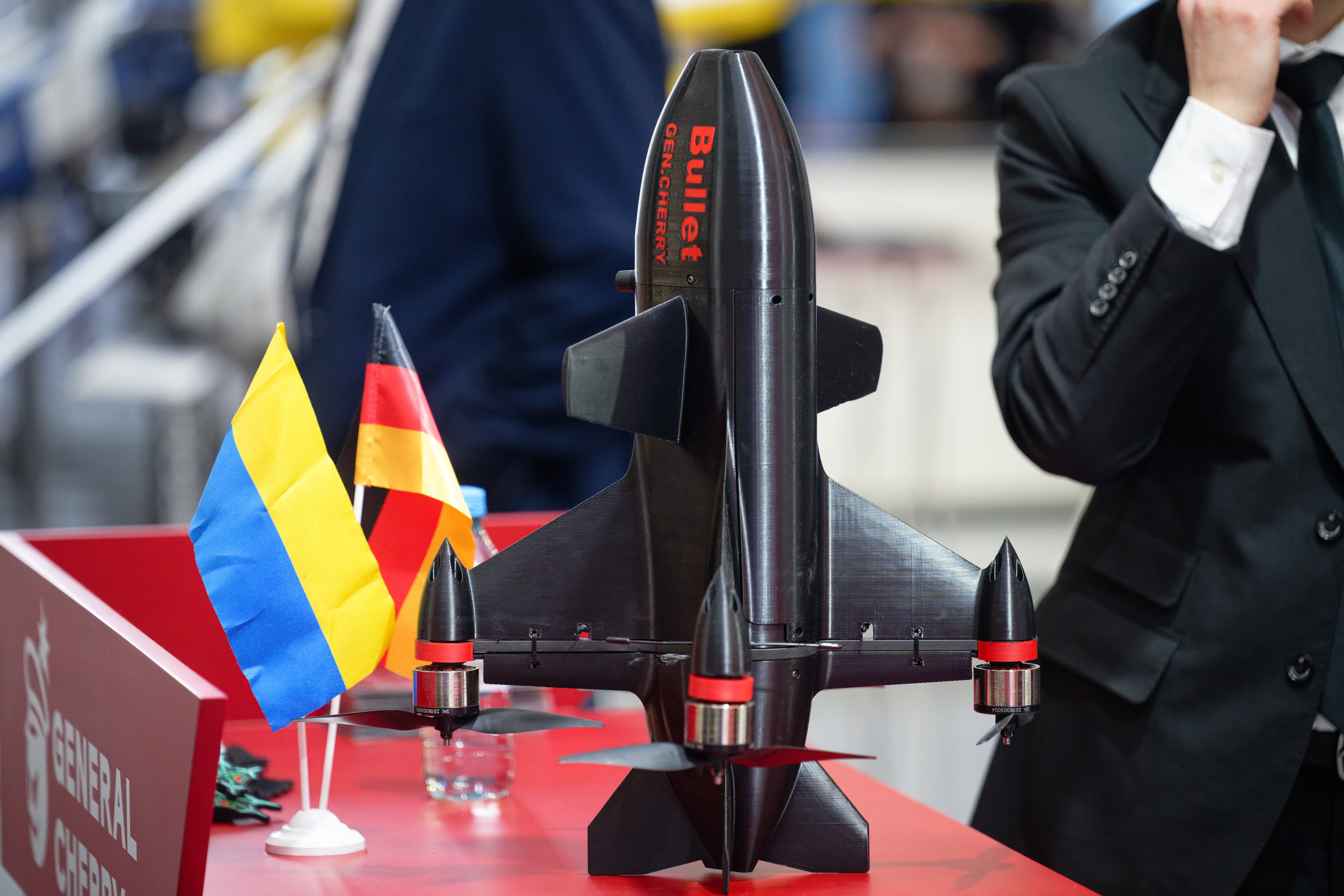
The company’s jet-powered Bullet interceptor recorded 3,296 visually confirmed kills in February alone, verified through Ukraine’s Delta battle-management system, Gryshyn told Military Times.
“Anyone claiming one product is better in all respects is either lying or misunderstanding the market,” Gryshyn said.
Four Ukrainian-built interceptors dominate the Shahed-killing fleet: SkyFall’s P1-SUN, Wild Hornets’ Sting, the Ukrainian-British Octopus, and General Cherry’s Bullet.
The Army has deployed roughly 20 Merops complexes to one Middle East site staffed by more than 100 soldiers, about 10 complexes to a second site, and 1,000 armed and unarmed interceptors across the two locations, according to Business Insider. The Surveyor interceptor is flown with an Xbox controller, the publication reported.
Perennial Autonomy also makes the Bumblebee V2, a multirotor FPV interceptor already deployed in Ukraine, on a separate $5.2 million Pentagon contract, according to Calibre Defence.
Bullet works differently. The jet-powered interceptor tops 300 kilometers per hour, climbs to 6,000 meters, and runs on a four-person crew – driver, operator, navigator, communications – Gryshyn told Military Times.
“The guidance system predicts the target and reacts at high speed,” Gryshyn said. “The operator confirms via FPV goggles, and the system completes the intercept.”
Production is the bottleneck. Ukraine has scaled interceptor manufacturing through three parallel channels, with output in the first four months of 2026 already surpassing all of 2025, Defense Minister Mykhailo Fedorov said April 27.
“Our task is to ensure a stable supply of interceptors to the military and to protect Ukrainians from Shahed attacks,” Fedorov said.
General Cherry can currently scale to 100,000 drones a month and is still expanding its manufacturing capabilities, Gryshyn told Military Times.
The company signed production deals in March and April with New Hampshire-based Wilcox Industries and Croatia’s Orqa, seeding distributed NATO production lines.
The Pentagon has committed more than $600 million to counter-drone procurement since the Iran war opened, including $350 million for CENTCOM in the first 30 days, DefenseScoop reported.
Drone spending will run “conservatively, $54 billion” in fiscal 2027 – “closer to $74 billion” once counter-drone programs are added, Defense Secretary Pete Hegseth told the House Armed Services Committee on Wednesday in his first congressional appearance since the Iran war began.
Competition for those dollars is fierce – and Ukrainian manufacturers are already strong players.
SkyFall’s Shrike 10 Fiber, submitted through U.K. partner Skycutter, took first place in the opening round of the Pentagon’s $1.1 billion Drone Dominance program – a four-round competition of strike drones between 25 companies at Fort Benning, Georgia, aiming to field more than 300,000 low-cost drones for U.S. forces – with two of the top six finishers Ukrainian-designed.
No equivalent open competition exists for interceptor drones like Bullet. Merops side-stepped the traditionally slow procurement process by getting fast-tracked through the Army’s G-TEAD program, which aims to provide troops with “combat‑credible capabilities at the speed of war,” the U.S. Army said last month.
Now, Merops has been flagged as a transition candidate for a program of record under Project Manager Close Combat Systems, the step from prototype to sustained acquisition.
Even at scale, the Pentagon’s floor is Ukraine’s ceiling.
Merops could drop to $10,000 a piece at scale, Driscoll said. Ukrainian-built interceptors are already well below that price point.
The directive from Kyiv, Fedorov said in an April Telegram post, is to defeat Russia by “degrading its economic capacity” – and price asymmetry is the lever. Russia launched a record 6,663 drones at Ukraine in April, averaging 222 a night, according to the air force.
A defense engineered for that volume cannot run on $15,000 systems, a lesson Ukraine has learned and is now beginning to sell abroad.
“When you need to shoot down 60 Shaheds at once, you need $2,000 systems, not $15,000 complexes,” Gryshyn told Military Times.
Ukraine asked the Pentagon last August to help scale interceptor manufacturing. Washington declined.
Kyiv is opening the market on its own.
Zelenskyy unveiled an arms-export framework April 27, citing up to 50% surplus capacity in parts of the defense industry and naming the Middle East and Persian Gulf, Europe and the Caucasus as target markets. Ukrainian forces get first claim on production; surplus goes abroad.
“The export of Ukrainian weapons will become a reality,” Zelenskyy said last week.
source