


After arriving in late March, twelve A-10C Thunderbolt IIs from Michigan’s 107th Fighter Squadron successfully departed RAF Lakenheath on Apr. 8 towards the U.S. Central Command region.
The twelve attack jets arrived at the base, home to the U.S. Air Force’s 48th Fighter Wing, on Mar. 30, 2026 as TABOR 71-76 and TABOR 81-86. They were then joined by six more A-10s from the Idaho Air National Guard the following day, these aircraft then departing on Apr. 2. The twelve Michigan birds attempted to continue their journey on Apr. 3, but all jets returned to Lakenheath shortly after launching due to unforeseen scheduling and diplomatic clearance issues with their support tankers.
#USAF United States Air Force – Coronet East
Boeing KC-135 Stratotanker 2x#AE0656 58-0102 – BORA 25#AE0486 62-3542 – BORA 35
+ TABOR 71-76 6x “MI” A-10s
+ TABOR 81-86 6x “MI” A-10sTwo KC-135s departed Glasgow Prestwick this morning on Coronet East 032, dragging 12x A-10… pic.twitter.com/AWqYgRlxei
— Armchair Admiral 🇬🇧 (@ArmchairAdml) April 8, 2026
For today’s successful attempt, friend of The Aviationist and aviation photographer Stewart Jack was at the fenceline to capture the departure. Using the same TABOR callsigns in two cells as when they arrived, the first cell received fuel support from KC-135 Stratotanker 58-0102, callsign BORA 25, and the second cell from KC-135 Stratotanker 62-3542, callsign BORA 35.

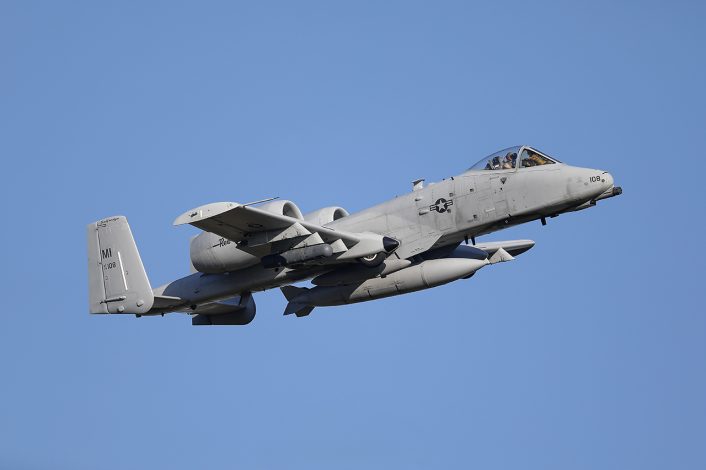
As we noted in our article on the A-10’s new probe and drogue refueling modification, the KC-135 remains the only tanker in the U.S. inventory cleared to operationally refuel the A-10C Thunderbolt II. Trials with the KC-46 Pegasus are ongoing, having previously been hampered by the A-10 struggling to properly engage with the tanker’s boom to allow fuel to flow. Compared to other fighters in the U.S. inventory, the A-10’s ideal refueling altitude and speed are much lower, owing to the aircraft’s vastly different flight characteristics. Adding hose and drogue refueling, then, would allow the A-10 fleet to instead make use of C-130 based refueling aircraft which are more compatible with the A-10’s requirements.
Under the aircraft, we can see the A-10s sporting the typical centreline fuel tank as well one MXU-648 cargo pod – commonly known as a travel pod – under each wing. The jets are also carrying targeting pods, specifically LITENING targeting pods, on the starboard wing.
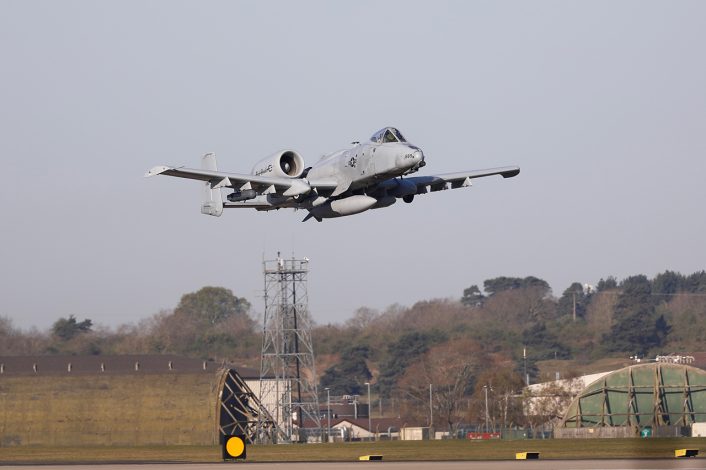
The departure of TABOR 71 and TABOR 81 flight means all A-10s that have recently arrived in the UK have now departed. After having been full of forward deployed fighters for many weeks, RAF Lakenheath is now hosting only a handful of visiting F-15E Strike Eagles and F-22 Raptors – these airframes apparently having experienced technical issues preventing them from departing with the rest of their units.
Notably, despite these apparently additional A-10s heading into theatre, the F-22s that had stopped at Lakenheath for several weeks instead departed back to the U.S. rather than heading further east. This probably indicates the changing requirements in the conflict as air defences are suppressed more and more each day. Even in cases where Iranian air defences have succeeded, these have apparently used infrared guided surface to air missiles rather than any radar guided systems – meaning the F-22’s stealth characteristics are not as firmly in play.

A huge chunk, in total almost fifty aircraft, of Lakenheath’s permanently based fleet are deployed to the Middle East with the U.S. Central Command (CENTCOM). This includes F-15E Strike Eagles as well as F-35A Lightning IIs. One of the base’s F-15s, marked as from the 494th Fighter Squadron, was downed over Iran last week – spawning a huge rescue operation for the aircraft’s WSO which, while ultimately successful, caused the destruction of even more aircraft. More LN tail aircraft were lost in a friendly fire incident to a Kuwaiti F/A-18 in early March.
The A-10’s Role in Operation Epic Fury
In the earlier days of Operation Epic Fury, the Warthog carved out a relatively low key position in the U.S. order of battle as they tackled Iranian-backed militias in Iraq and Syria. These attack runs utilised precision guided weaponry like the Advanced Precision Kill Weapon System (APKWS II) as well as the jet’s signature 30 mm GAU-8/A Avenger rotary cannon.
A-10 pilot with a heavy finger on the trigger during a strafing run targeting Iranian-backed PMF militia in Iraq. Probably the longest ever burst I’ve heard. pic.twitter.com/8wwLqmbZXO
— Woofers (@NotWoofers) March 27, 2026
As the war progressed, and Iran’s anti-air capabilities were degraded further, the A-10 began heading closer to the frontlines of the battle. Deep strikes are still reserved for more survivable platforms, but the A-10’s long loiter capability has been used to provide patrols over the Strait of Hormuz to counter the threat of Iranian fast attack craft (FAC) and other waterborne assets.
Subsequently, A-10s were involved to some degree in the search mission for the crew of the downed F-15E, which resulted in one airframe taking a hit severe enough for the pilot to elect to ‘punch out’ of the airframe once they managed to get back over friendly territory in Kuwait. The abandoned aircraft was left to crash into the ground.
After many attempts by the U.S. Air Force to retire the A-10, usually blocked by Congress, the conflict with Iran may have now demonstrated a new niche for the Warthog that could see it operating for a significant period yet. Certainly, the development of the refueling probe modification seems to indicate a more lasting presence in the U.S. inventory.
Many thanks as always to our friend Stewart Jack for sending these images to use. You can find him on Facebook and Instagram.
source