


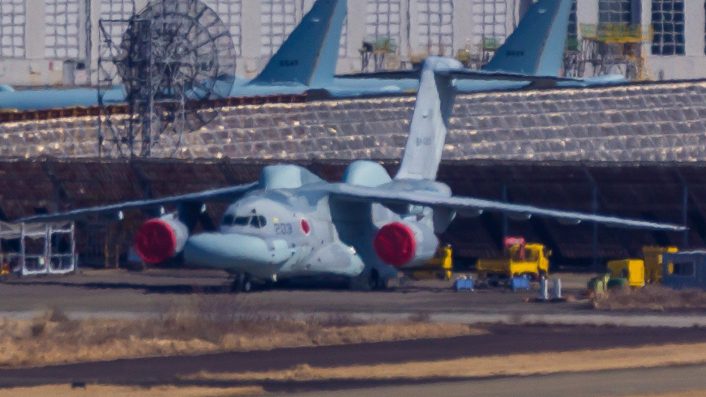
Japan’s Aviation Development and Testing Group has released official photos of the JASDF’s EC-2 Stand-Off Jammer aircraft which was first spotted last month at Gifu Air Base.
The Japan Air Self-Defense Force’s Aviation Development and Testing Group has released the first official photos of the new EC-2 Stand-Off Jammer aircraft, providing a close-up look at the platform. The aircraft was first spotted in February 2026 at Gifu Air Base, where it was caught at a distance in the background of a photo showing a Kawasaki P-1 maritime patrol aircraft taking off.
The EC-2 is the latest in a number of Japanese aircraft with unusual modifications, and has been in development since 2021. The new photos confirm that the aircraft is indeed the former C-2 18-1203, the first production aircraft, as we mentioned in our previous report here at The Aviationist.
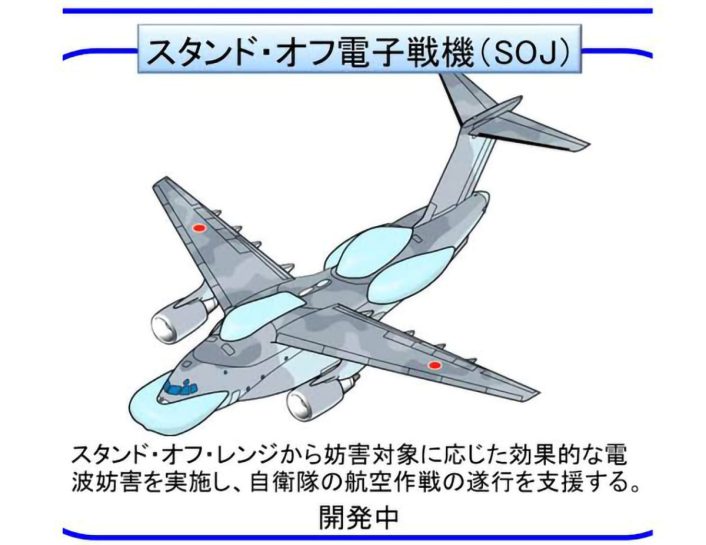
The secretive aircraft has so far been shown only in a rendering by the Ministry of Defense, with these being now the first official photos of the actual aircraft. The new platform will replace the unique EC-1 which has been in service since 1986.
未確認地上物体#岐阜基地#飛行開発実験団 pic.twitter.com/ZrwkmWeAUx
— 航空自衛隊 航空開発実験集団 (@jasdf_adtc) March 12, 2026
The EC-2 is the second specialized variant of the C-2, after the RC-2 signal intelligence (SIGINT) aircraft flew for the first time in 2018. The aircraft, the type’s second prototype 18-1202, was modified with similar, but smaller, bulges compared to the ones of the EC-2.
The EC-2 SOJ
The new EC-2 Stand-Off Jammer (SOJ) is a derivative of the Kawasaki Heavy Industries (KHI) C-2 transport aircraft. The aircraft has been modified with a bulbous nose – similar to the EC-1’s nose – as well as two large bulges on the top of the fuselage, while two more should be located on the sides of the fuselage between the wings and the horizontal stabilizers.


The EC-2 is being developed to disrupt an adversary’s electronic warfare (EW) capabilities while still flying outside of the threat’s range. The Japanese Ministry of Defense previously said the aircraft will be used to support counter air operations in conjunction with other tactical assets.
Details about the program are currently limited, and only found in the MoD budget documents, which mention ¥41.4 billion have been allocated to the development. This is included in a larger ¥508.6 billion investment to strengthen intelligence collection and analysis capabilities.
The development of both the EC-2 and RC-2 platforms is specifically mentioned as part of the MoD’s effort to “Improve capabilities to gather electromagnetic information necessary for electronic jamming and electronic protection” and “Develop necessary equipment to constantly and continuously gather, process, and analyze information especially on military trends in the vicinity of Japan.”

The aircraft will replace the unique EC-1, which has been in service since 1986, but in a larger fleet. In fact, while the EC-1 program resulted in a single aircraft, the EC-2 fleet will include four aircraft, according to MoD budget documents.
The program is divided in two phases, focusing on the integration of the new capabilities and their refinement, respectively. Among the equipment there will be components inherited from the EC-1, such as the J/ALQ-5 electronic countermeasures (ECM) system and advanced radio wave measurement systems.
The aircraft is expected to be operated by the Denshi Sakusengun (Electronic Warfare Operations Group) at Iruma Air Base, the same which operates the EC-1 and will in future also operate the RC-2.

Kawasaki C-2
The C-2 is a long range twin-engine transport aircraft designed by Kawasaki to replace its earlier C-1 transport aircraft. The aircraft is, like its predecessor, a homegrown Japanese design, which flew for the first time in January 2010 and entered service six years later in 2016.
While smaller than other four-engined jet transport aircraft like the C-17 Globemaster III, the C-2 is significantly larger than the C-1 it replaced or the other twin-engine military jet cargo aircraft, the Embraer C-390. The aircraft is roughly equivalent in capacity to the Airbus A400M, but offers a higher cruise speed, service ceiling, and increased range.

The C-2 is capable of transporting 110 people and can fly for about 7,600 kilometers (4,100 nmi) with 20 tons of cargo or 4,500 km ( 2,400 nmi) with a payload of 36 tons. The aircraft is also able to take-off in 500 m from semi-prepared runways.
The C-2 uses General Electric CF6 turbofan engines which are widely employed in both civilian and military service. These are notably used also by Japan’s KC-767 tankers, though the newer KC-46s instead use Pratt & Whitney powerplants.
source