


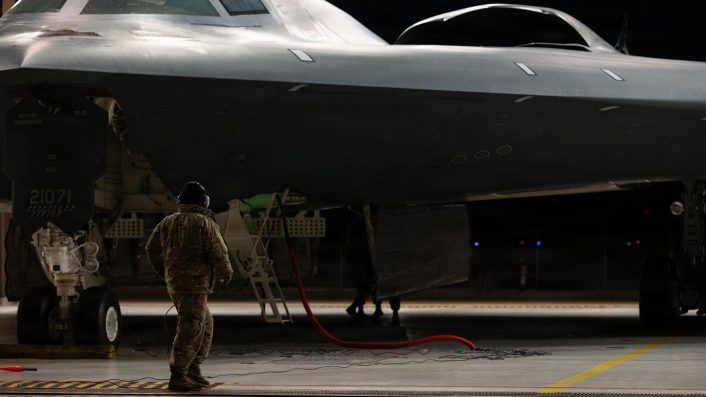
Images released by CENTCOM show B-2 stealth bombers preparing to launch for a mission over Iran last week, with multiple unknown white patches added along the wings’ leading edges.
The U.S. Central Command has released new photos of the B-2A Spirit stealth bomber, one of the assets that, albeit constantly flying as part of Operation Epic Fury, has been rarely shown to the public since the start of the hostilities with Iran. The bombers are currently flying round-trip missions from the U.S., contrary to the B-1B Lancer and B-52H Stratofortress bombers that have also been forward-deployed to RAF Fairford in the UK.
According to the info on the DVIDS network, the photos were captured on Mar. 17, 2026, although only released a week later on Mar. 24. At a first sight, the photos would not appear out of the ordinary, as they show the bombers during pre-flight checks before departing for a strike mission.
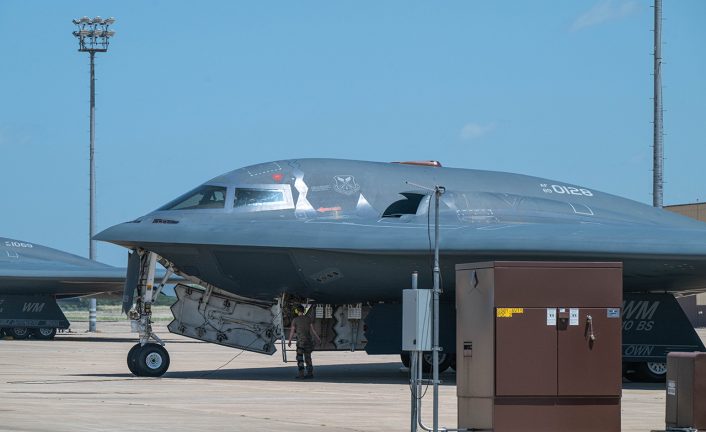
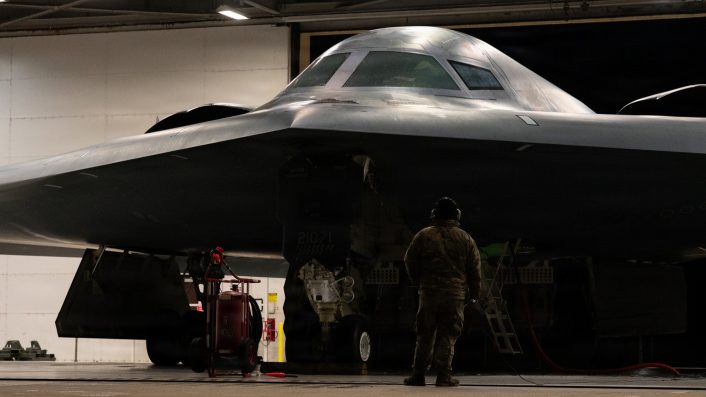
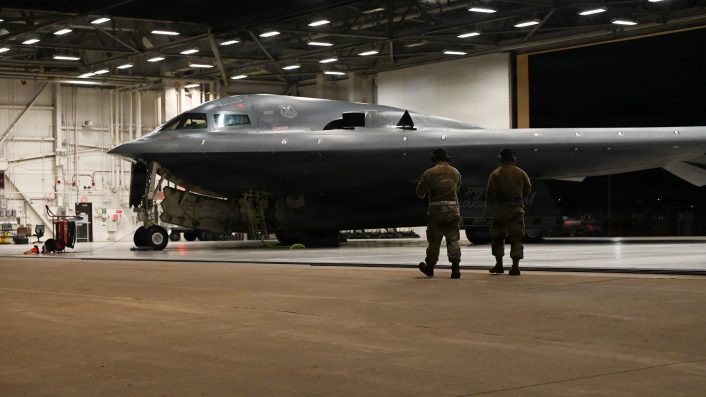
However, as The War Zone noted, the photos show a puzzling feature. In fact, multiple white patches can be seen at different points along the wings’ leading edge, both on the top and bottom.
The patches, which appear to be all of the same dimension, are made of a white rectangle with black borders. These can be seen on two different bombers, Spirit of Mississippi and Spirit of Louisiana, which could be identified by the markings on the landing gear’s doors.
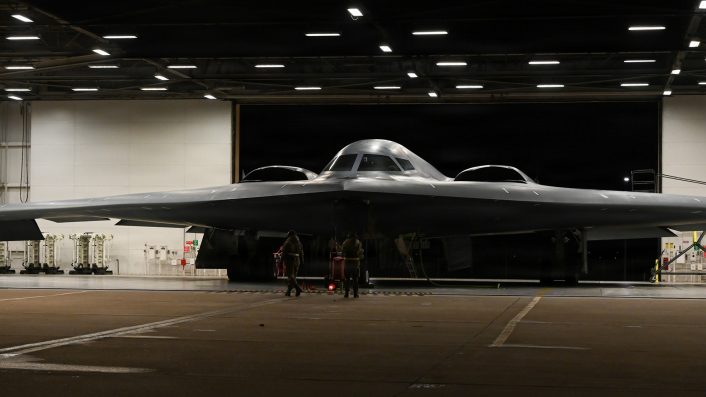

The installation of these patches does not appear to be exactly the same. Specifically, at least nine couples of these patches can be seen on the port wing of Spirit of Louisiana, with at least 11 more on the starboard wing, while an estimate cannot be made for the other bomber, although they do not seem to be fully symmetrical.
The function of these patches is unclear, and this has led to various possible explanations discussed by users on social media.
What they could be?
At a first sight, these patches immediately resemble fiducial markings used on test aircraft. The function of these markings is to allow the identification of some aircraft parameters from known points on the airframe while analyzing photos and videos.
However, these present some differences, as they usually are white circles overlapping a black square and with a black dot in the middle. The fiducial markings would make sense on the B-2 used at Edwards Air Force Base, California, for the testing of the new capabilities being integrated.

On the other hand, these would be out of place on a jet being employed in combat, less alone two. The B-2 is covered by a special Radar Absorbent Material (RAM) coating to preserve its low observability, and any disturbance on the surface, such as could be these white patches, would degrade the stealthiness.
This brings us to the second possible explanation, radar reflectors. The B-2 Spirit does not use removable radar reflectors such as the ones used by the F-22 Raptor and F-35 Lightning II.
The B-2’s low observability has always been a highly praised aspect of the bomber, and it would be unlikely for the U.S. Air Force to renounce to it. This is especially true as the other non-stealth bombers – the B-1 and B-52 – are also being used over Iran, and would thus be ready to replace the B-2 in missions where stealth is not required.
At the same time, as the Iranian electromagnetic battlespace becomes less dense after almost a month of strikes, it would make sense if the U.S. wanted to mask the bomber’s real radar cross-section (RCS). The presence of a lower number of electromagnetic emissions in the area would in fact make easier possible efforts to isolate and characterize the B-2’s “signature.”
Another reason for which patches could appear on an aircraft could be repairs, which on the B-2 could be either to address airframe damage or erosion of the coatings. The coatings require constant care to avoid a degradation of the low-observability, especially if the bombers are being intensively employed in high-tempo operations.
The fact that two aircraft feature the same patches in the same positions, however, appears unlikely in the event of repairs. The probability of damage or erosion being in the same spots on two different airframes is slim.
Alternatively, the patches might not be related to repairs but rather to installation of new kit, such as sensors or antenna arrays. As already mentioned, the B-2 Spirit is undergoing new upgrade efforts to keep the platform operational and relevant for the foreseeable future while the new B-21 Raider is fielded.
Among the most recent announced upgrades are new communication capabilities to significantly improve the data transfer time for real time mission planning data, low observable materials to enhance its radar cross section signature and upgrades to improve the B-2’s situational awareness in a highly contested environment. Another parallel upgrade effort is the Spirit Realm 1 (SR1), which involves the integration of an open mission systems architecture, new software, sensors and weapons to further enhance the B-2’s survivability and combat capability.
Notably, the Spirit has recently flown with the Adaptable Communications Suite (ACS) 4.0, the most recent version of the system already present on the B-2. The details about the installation of the system are classified, and is thus not possible to verify whether the patches could be related to this upgrade.
Additionally, given the ongoing combat efforts, it is unlikely that new equipment has been installed in a short timeframe and immediately employed in operational missions. Not only this would mean taking possibly unnecessary risks, but it would also prevent airframes from being used in operational mission while work is done.
In fact, the B-2A Spirit fleet is notoriously small, with only 19 airframes in service. Of these, at any time two are undergoing the lengthy Programmed Depot Maintenance (PDM) at Plant 42 in Palmdale, California, further decreasing the available fleet.
Another possibility being floated online is the addition of new markers to aid air-to-air refueling operations. That possibility, however, seems unlikely, especially if we consider that during training boom operators are taught specific reference points for each aircraft they will refuel.
source