


One of the Hürjet prototypes was spotted while flying with underwing weapon pylons, possibly hinting at TAI’s intention to pitch the jet in the highly competitive light attack aircraft market.
An image of a Turkish Hürjet prototype emerged on May 19, 2026, flying with underwing weapon pylons, suggests a weaponized variant might be in the works. The picture was captured by aviation photographer Enes Ötken and posted on his Instagram page.
The location can be assumed to be the Türk Havacılık Ve Uzay Sanayi Anonim Şirketi/Turkish Aerospace Industries’ (TUSAŞ/TAI) facility northwest of Ankara. The image surfaced following claims emerged earlier this month that a combat variant is in development.
This indicates a steady progress towards a light attack version of the indigenously developed advanced jet trainer, competing in a tight market dominated by other products like the South Korean KAI T-50 and its light fighter FA-50; the Boeing T-7A Red Hawk; the Italian M-346A Master; and the Russian Yak-130M.
What the image shows
The tail number on the airframe carrying the pylons is TUS-A003. This is the same airframe that flew with a new light and dark gray paint scheme on Nov. 21, 2024.
The airframe has a flight data probe (pitot tube) on the nose and, considering both the landing gear and the speedbrakes are deployed, it was captured while landing after a test flight. We can also see what appears to be two cameras placed in a v-pattern behind the landing gear, possibly to observe and record the vibration and impact the pylons have on the wings.
The Hürjet is currently reported to be in its serial production stage, and four prototypes are currently flying, with TUS-A003 being one of them. TurDef has claimed that the aircraft will soon be integrated with the MURAD family of Active Electronically Scanned Array (AESA) radars, as well as the Gökdoğan beyond visual-range and Bozdoğan within visual-range AAMs (Air-to-Air Missiles).
Primarily, the jet will replace the Turkish Air Force’s (Türk Hava Kuvvetleri) older T-38 Talon jet trainers, of which the service operates 68 airframes, as per the 2026 World Air Forces report. Regarding the pylons on TUS-A003, little information is available, and no statement has been released by TAI.
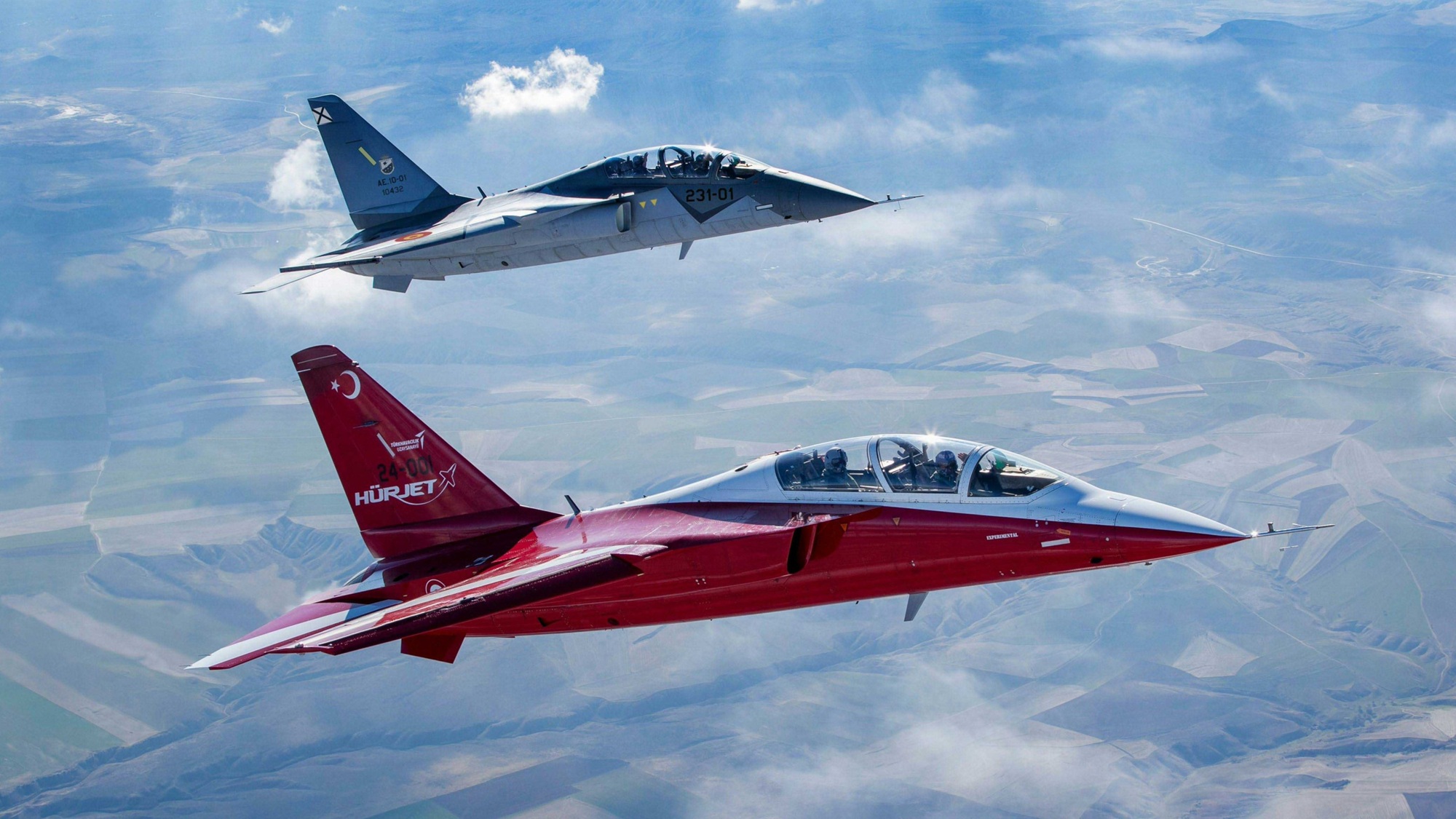
Turkish and Spanish Hürjet fleets
The Turkish Air Force (Türk Hava Kuvvetleri) has ordered 12 aircraft, while the Ejército del Aire y del Espacio (Spanish Air and Space Force – SASF), the Hürjet’s first foreign customer, has signed on for 30 airframes, under the now-designated SAETA II program.
Sixty-percent of the jets will be produced locally in Spain, with an Airbus-led consortium producing many customized subsystems and components. The Hürjet will eventually replace the SASF’s existing 19 F-5M trainers.
The Hürjets would be assigned to the Ala 23 (23rd Wing) at Talavera La Real Air Base, which currently operates the F-5Ms. These are used to train pilots to fly the Eurofighter Typhoons and F-18 (Spain doesn’t use the F/A-18 designation for its Hornets).
The Hürjet would form a part of an even broader Integrated Combat Training System (ITS-C), including ground simulators, theoretical and practical instructions training aids, to better prepare TurAF and SASF aviators for future Gen. 4.5 and Gen. 5 aircraft.
HÜRJET’in hafif saldırı versiyonu da geliştirme aşamasında ve prototip aşamasında uçuş testleri zaten yapılıyor.
Bu varyantın geliştirilmesi ve sertifikasyonunun tamamlanması için ek zamana ihtiyaç duyulmaktadır.@TUSAS_TR Genel Müdürü @dr_mdemiroglu | https://t.co/3t8h8h1FH2 pic.twitter.com/isJWASgW77
— KaraKulak (@KaraKulak__) May 1, 2026
Savunmatr said that SAETA II will be split in two phases, with the first phase starting in 2028 covering the delivery of 21 aircraft, with one aircraft used as a prototype to test the Spanish parts, mission systems and avionics technologies developed by GMV, Sener, Aertec, Grupo Oesía, Orbital, and Indra. The larger ground-based training system is slated to come online in the 2029-2030 timeframe, while the second phase between 2031-2035 will see the complete fleet of 30 aircraft converted to the Spanish SAETA II standard.
The aircraft will fly with the U.S.-made GE F404 engines, at least until the TF-series of domestically-developed powerplants being made by TUSAŞ Engine Industries (TEI) are operational to power future batches.
#HÜRJET programı kapsamında, GE Aerospace ile motor tedarikine yönelik sözleşme imzaladık. ✈️
F404 motorlarını kapsayan anlaşma, HÜRJET’in seri üretim hedeflerine ve programın sürdürülebilir büyümesine katkı sağlarken, platformun küresel ölçekteki rekabet gücünü daha da ileriye… pic.twitter.com/YoBcoiVLfN
— Türk Havacılık Uzay Sanayii (@TUSAS_TR) May 5, 2026
Hürjet naval version and Turkey’s next carrier
In a January 2026 interview with SAHA İstanbul, TAI chief Mehmet Demiroğlu also shed light on the Hürjet’s naval version. The aircraft is slated to fly off the Turkish Navy’s future MUGEM carrier, which has been depicted in both official and unofficial renditions with the trainer aircraft among the platforms it will operate.
Without expanding on the specific interest of the Turkish Naval Forces in the Hürjet, Demiroğlu merely responded in the affirmative when asked if the service has contacted the manufacturer for the aircraft. He further reiterated the company’s production readiness to meet a larger order.
#HÜRJET gerçekleştirdiği düşük irtifa–yüksek hız testleriyle rüzgarını Akdeniz’in üstünde, Torosların eteğinde estirdi.
HÜRJET’in Antalya’da iki prototiple yapılan 18 sortiyle 79 test noktası eksiksiz tamamlandı ve ses üstü hızlarda kritik veriler elde edildi.
Millî imkânlarla… pic.twitter.com/VfQsy3Sh2H
— Türk Havacılık Uzay Sanayii (@TUSAS_TR) March 13, 2026
“We can say that we have entered mass production in this sense. Now, the arrival of Spain, and the fact that extra orders will be coming from the Turkish Air Force and Naval Forces, which we expect very soon, has further accelerated our mass production preparations. We are working towards a production line of a hundred units. Normally, for this type of aircraft, it’s one or two per month. We want to reach two per month as soon as possible, and then three per month. And when we talk about mass production of these aircraft, it shouldn’t be compared to the mass production of cars. Even if you produce one aircraft per month, it’s still mass production.”
Deniz Sistemleri Seminerinde, MUGEM ve TF-2000 ölçekli maketleri de sergileniyor. pic.twitter.com/NPs4YDAnQt
— Defence Turkey Magazine (@DefenceTurkey) May 26, 2025
Infographics at exhibitions have shown the future MUGEM carrier, a ski-jump Short Take-Off Barrier Arrested (STOBAR) vessel, also operating the Baykar TB3, the ANKA-3 UCAV, and the Kizilelma collaborative combat aircraft (CCA), besides the Hürjet.
A shout out to Enes Ötken for allowing us to use his photograph. You can follow him on his Instagram page for more of his work.