



In the United States, the most common way that small airports stay connected with major hubs is through service with light jets. Many of those regional jets are made by Bombardier, Mitsubishi or, Embraer. Turboprop aircraft have not been the platform of choice for decades in the US, Europe, or Asia. Recently, that trend has shown signs of a shift as the rising need for environmentally sustainable and lower-cost aircraft may make turboprops the best choice in the coming years.
The DeHavilland Dash 8, ATR 42,, and the Deutsche Aircraft D328 are among the best examples of the resurging appeal that turboprop passenger haulers are seeing in the regional aviation market. The Bombardier Dash 8-400 is on the larger end, seating 80-90, and over a thousand examples have been produced for operators all over the world. Building on the legacy of the Dornier 328, the brand new D328eco seats a modest 40, but it has already proven its capability with the US Air Force, and the commercial production line is ramping up.
The likes of Embraer’s E-Jets and the Bombardier/Mitsubishi CRJ jet series may hold the dominant market share today, but as the oldest airframes begin to retire and the economics of jet operations get more difficult, an opening arises. Now we will dive into the key factors behind the new wave of turboprop hype that is driving demand for state-of-the-art models like the Dash 8 and D328.
The Prop Case

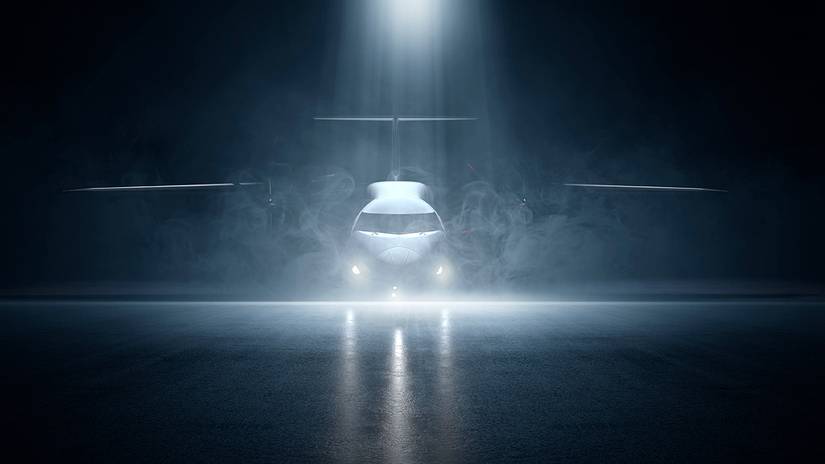
An airplane may be moved quite effectively with a propeller at the moderate speeds used for short regional flights (200 to 300 miles). It enables the engines to use a notably lower amount of fuel than the tiny jet engines seen on an Embraer 175 or CRJ-900. Since fuel is an airline’s largest single-trip expense, the difference is key on the balance sheet.


Deutsche Aircraft
Most of a regional flight is spent taxiing, climbing, and descending; the cruise portion, where the jet can stretch its legs, may last only fifteen minutes. A jet is likely to be only five or ten minutes ahead of propeller aircraft when they both arrive at the gate, which is negligible to offset the increased fuel consumption and ownership expenses.
Turboprops are also lighter and can operate from shorter runways. That gives airlines access to smaller airports with lower landing fees and lets them open routes that jets can’t serve economically. The initial cost of purchasing or renting a turboprop is also lower. Long-term maintenance costs can also be mitigated thanks to the ease and affordability of maintaining their engines and airframes. In a business notorious for razor-thin profit margins that can sink an airline, those numbers all add up to keep the bottom line in the black.
Keeping America Flying

Deutsche Aircraft
In the US, regional flights are essential for linking rural and isolated communities to large cities and the national aviation network. Hundreds of small community airports depend on regional service. With smaller, more suitable aircraft, those carriers are essential in controlling traffic at large hubs, which reduces congestion. By expanding the reach of the national transportation system, these carriers provide accessibility for more localities. In addition to bridging remote regions, regional aviation enhances the nation’s overall aviation infrastructure.
Larger airlines can expand their networks while keeping connections to low-traffic routes thanks to programs like American Eagle, Delta Connect, and United Express. An estimated $100 billion in annual economic product and one million American employees are supported by regional aviation, making it a significant economic driver. Regional aviation connects passengers to important hubs, promoting local travel, business, and tourism.

For people living in smaller towns, regional air travel provides quick access to urban amenities such as advanced healthcare and disaster relief. Regardless of the reason, regional flights drastically cut down on travel time and are often quicker and more practical than driving for short- to medium-distance travel.
Turboprops Around The World


Deutsche Aircraft
Canada is characterized by large, sparsely inhabited regions with many isolated settlements that rely on air transportation. The Dash 8-400 is especially well-suited for connecting these smaller hubs to larger ones. For their regional networks, airlines like Porter Airlines and WestJet Encore make extensive use of the Dash 8-400. Canada is home to some of the world’s busiest turboprop airports.
Turboprops are essential for improving connectivity in Southeast Asia and Oceania, regions with a large number of islands and frequently inadequate infrastructure. Indonesia, which has more than 17,000 islands, relies on turboprops extensively for flights between its islands, while the Philippines has a similar infrastructure.


Deutsche Aircraft
The wide and varied topography of Africa, which includes several “hot and high” airports that favor turboprops, further highlights the usefulness of turboprops. A number of carriers have large fleets of turboprop aircraft. Ethiopian Airlines is one of the major operators of the Dash 8 in its domestic network, for example. Meanwhile, Brazil’s extensive land territory and mature aviation network make turboprops an ideal choice for domestic flights, especially on shorter routes under 1,000 kilometers.
Australia and New Zealand use turboprops, much like in Canada or the US, to connect smaller fields with major hubs. The terrain of the two nations varies widely depending on the destination, which makes high reliability and performance under harsh conditions important. It can be tropical, “hot and high” or Alpine, depending on the itinerary.
In Europe, Norwegian Airlines uses a fleet of turboprops to navigate the difficult terrain of Norway, and Olympic Air uses turboprops for island-hopping flights in Greece. In the British Isles, turboprops are also used by airlines such as Aurigny in the Channel Islands and Loganair in Scotland. Operators in Malta and Spain’s Canary Islands provide more evidence of the aircraft’s applicability for short-distance flights across Europe.
Deutsche Aircraft D328eco

Deutsche Aircraft
The D328 combines solid speed with turboprop efficiency, making it ideal for rugged regional routes. Airlines are able to serve airports in remote cities, mountains, and islands that are inaccessible to larger jets thanks to its innovative design. It has the quietest cabin in its class with pressurization and enlarged overhead bins. While fuel consumption and maintenance expenses remain modest, cruise speeds of about 300 miles per hour make it the fastest turboprop on the market.
It is powered by the Pratt & Whitney Canada PW127XT engine and features the latest Garmin G5000 avionics in the cockpit. High reliability and low-maintenance cycles, with reduced costs per cycle, mean the plane has the lowest trip cost to operate in its class. Thomas Ahn, Chief Engineer of the D328eco at Deutsche Aircraft, remarked in a company statement earlier this May, saying:
“This is our moment to re-establish ourselves as a modern aircraft manufacturer with full system integration capabilities right here in Germany. We use advanced 3D modelling, seamless data sharing with suppliers, and state-of-the-art communication tools to enhance our development efficiency.”
The D328 is not only poised to be one of the most environmentally sustainable and affordable aircraft to fly, but its features and construction quality make it a “jack of all trades” that can support virtually any mission in the commercial, cargo, or specialized aviation markets. The plane will be competing to replace outgoing legacy models like the ATR 42 and Saab 340, matching the efficiency, capacity, and ruggedness of both in one package.


Deutsche Aircraft
Deutsche Aircraft established its plant just outside Munich, in the historic home of Dornier, Oberpfaffenhofen. The first test aircraft is being assembled by a team of 550 staff with backgrounds from 40 different nations to create a plane that can fly on 100% Sustainable Aviation Fuel (SAF-PtL). The 20-seat configuration is expected to have an impressive range of 1,772 nautical miles while the 40-seater will have a solid 621 nautical miles.
The Air Force’s Wolfhound


The main role of the C-146A Wolfhound is to support Theater Special Operations Commands by offering the US Special Operations Command the ability to deploy small teams and cargo in a flexible and rapid manner. Air Force Special Operations Command aircrews carry out airlift missions to semi-prepared airfields worldwide, which demands a rugged and reliable aircraft.
The C-146 has served in combatant commands on four continents, delivering troops and cargo on long-term deployments supporting continuous operations overseas. The aircraft has also been tailored to support medevac missions with defibrillators, cardiac monitoring equipment as well as hot and cold galley equipment. It is the first air ambulance aircraft with the capability to support Casevac and Medevac missions.
The D328 has succeeded in fulfilling the Air Force Special Operations Command’s (AFSOC) expectations since it entered service in 2011 as the Wolfhound. The airplane was even made to support intelligence, surveillance, and reconnaissance (ISR) missions and features an inflight operable door (IFOD) for free-fall parachute jumps. Deutsche Aircraft wants to transform that military track record into a launching pad for its commercial airframe to serve small communities all over the world just as well as it served the special forces.
source