


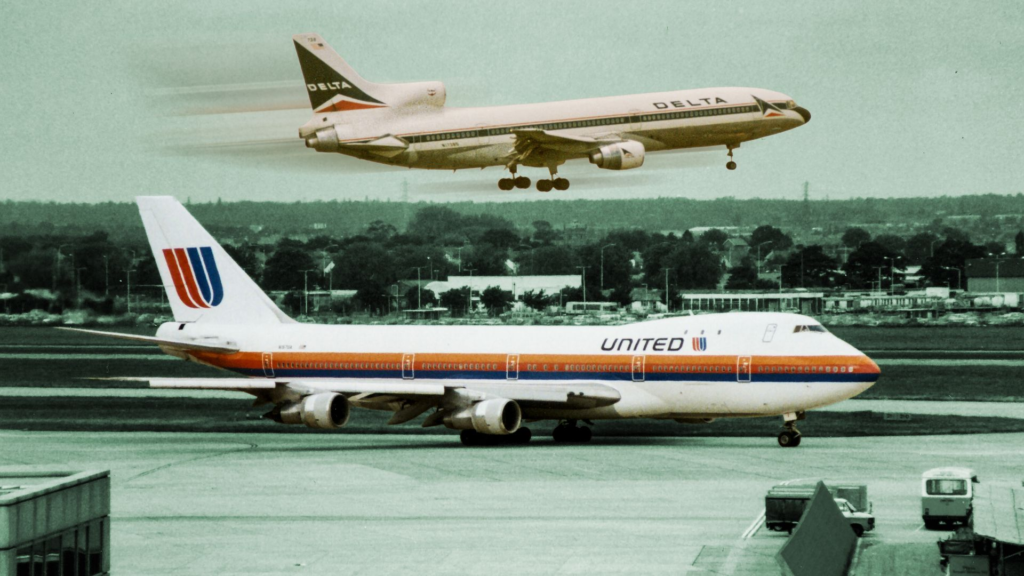
Lockheed Martin is one of the largest aerospace companies in the world, despite not producing a single commercial airliner today. This is because the firm, formed from a merger between Lockheed Corporation and Martin Marietta in 1995, is one of the largest contractors for the United States military, designing aircraft, missiles, targeting systems, ships, and more. But while Lockheed Martin has never made a commercial aircraft, Lockheed Corporation had a long history of designing and building commercial airliners.
Today, Lockheed Martin’s biggest rival is 

Success With The Lockheed Constellation


The Boeing 247 is often considered the first modern airliner, as it debuted many design elements and technologies that are taken for granted in today’s aircraft. But in the 1930s, it was Douglas with the DC-3 that took the aviation world by storm. At one point, 90% of the world’s passengers were flying aboard a DC-3 or DC-3 derivative. The DC-3 remained popular even after World War II, though it faded from prominence as a new generation of airliners debuted in the 1940s and 1950s.
Competing against the Douglas DC-4 and Douglas DC-6 was the Lockheed Constellation. These new quad-engined airliners were larger and faster than the DC-3, and the Constellation in particular was the first pressurized airliner to enter widespread service. These aircraft also had longer ranges than the DC-3, enabling long-distance flights with fewer fuel stops. The initial variant of the Constellation was called the L-049, which Lockheed developed into further variants with more range, such as the L-749.
The Lockheed L-1049 Super Constellation was a stretched variant of the Constellation, with seating for up to 109 passengers and even greater range to compete against the Douglas DC-7. Lockheed would eventually develop the Super Constellation into the L-1649A Starliner, which was one of the longest-range airliners of its day. In total, Lockheed produced over 500 Constellations for the civilian market, compared to roughly 955 civilian DC-4s, DC-6s, and DC-7s, although the military derivatives were especially successful.
Where Was Boeing After World War II


The Boeing 377 was more comfortable and luxurious than a Constellation or a Douglas, and it had excellent range for the time. Additionally, the 377 was technologically advanced and fast. However, these enormous double-deckers were more expensive to operate than their competition, and the planes were plagued by technical problems, primarily with the engines and propellers. In total, there were 13 hull loss incidents throughout the aircraft’s lifetime, giving the Boeing 377 one of the worst safety records of its time.
|
Aircraft |
Production Numbers (Civilian) |
|---|---|
|
Douglas DC-4/DC-6/DC-7 |
955 |
|
Lockheed Constellation |
517 |
|
Boeing 377 Stratocruiser |
55 |
Whereas Douglas sold over 900 commercial examples of its DC-4, DC-6, and DC-7 airliners, and Lockheed sold over 500 civilian Constellations, Boeing only sold 55 Stratocruisers primarily to Pan American World Airways, American Overseas Airlines, Northwest Airlines, United Airlines, and BOAC. After the final delivery of a Stratocruiser in 1950, Boeing wouldn’t sell a commercial aircraft for another five years, focusing instead on its military planes, such as the B-52 Stratofortress.


Why Lockheed Stopped Making Commercial Aircraft
The manufacturer used to be a leader in commercial aircraft design.
Boeing’s Resurgence In The Jet Age

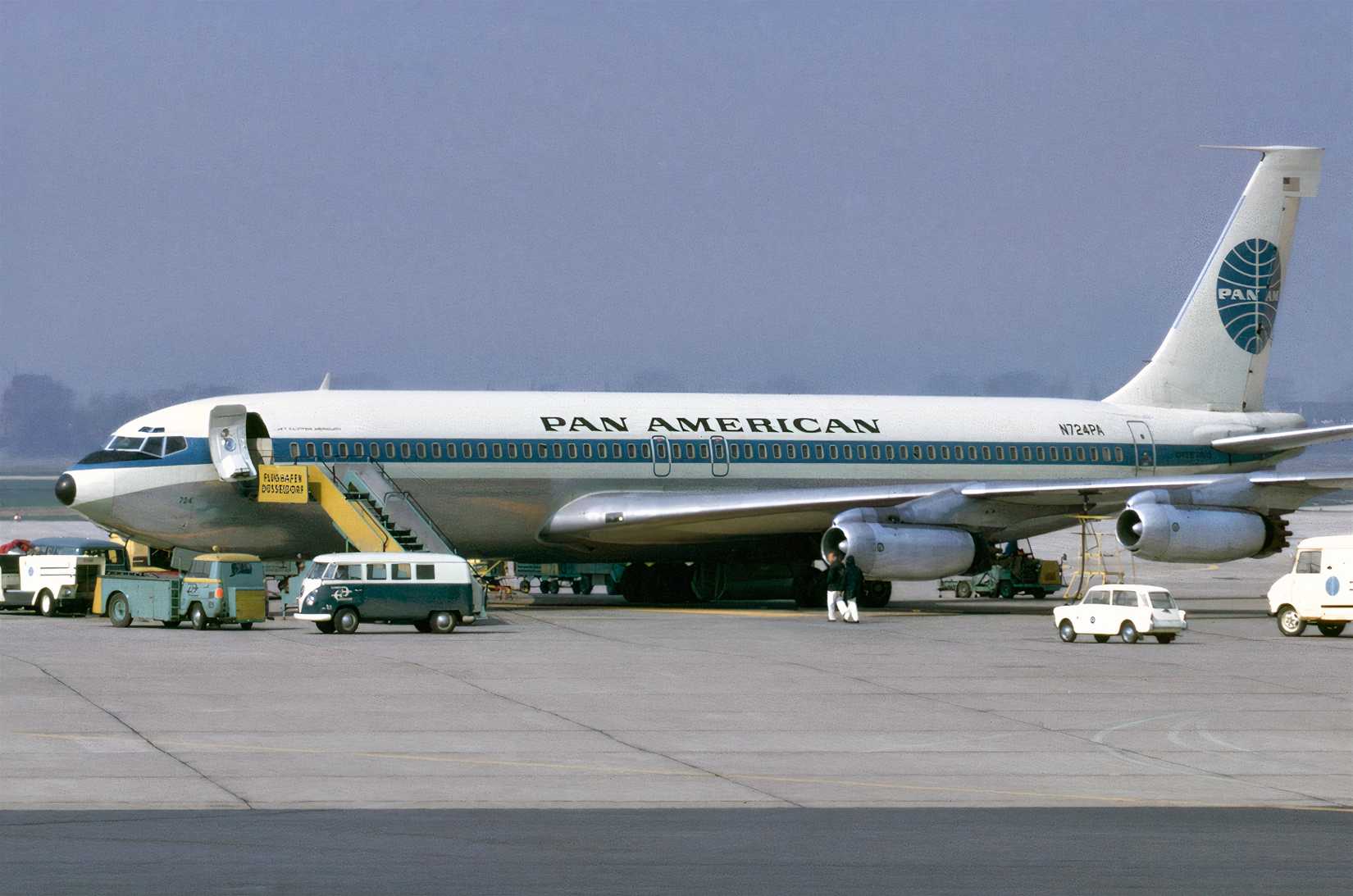
1954 saw the first flight of the Boeing 367-80, a prototype jet-powered transport aircraft. It was larger and more advanced than earlier jetliners like the De Havilland Comet, and the plane impressed airline executives as well as the US military. Boeing would go on to win a contract for jet-powered aerial refuelers derived from the Dash 80, named the KC-135, while using feedback from airlines to alter the plane’s design to create the larger 707.
The Boeing 707 was first to the market, and its fuel efficiency, range, and economics from its larger size helped popularize the concept of a jet-powered airliner. Including the shorter 720, Boeing sold over 1,000 707s, whereas the earlier Comet only sold 114 units. Douglas was pushed to respond to Boeing with the DC-8, which was also a competent airliner. However, although the DC-8 was fairly successful, Douglas would only sell 556 DC-8s.
Lockheed elected not to pursue a first-generation airliner, instead concentrating on its military division and on developing the turboprop-driven L-188 Electra. The Electra was the first large American turboprop and was particularly noteworthy for its excellent field performance, but after two high-profile crashes led to expensive redesigns, no more Electras were ordered as the aviation industry shifted to turbojet and turbofan-powered aircraft.
Getting Back In The Market With The TriStar


After the 707, Boeing developed the smaller 727 for short-range flights and the 737 for regional operations. Douglas (later McDonnell Douglas) beat the 737 to the market with the DC-9. In response to a request from Pan Am, Boeing then developed the iconic 747, a double-decker widebody airliner more than double the size of the 707. But while Pan Am was all in on the Boeing 747, other airlines were concerned with their ability to fill an aircraft of the 747’s size.
In the 1960s, American Airlines requested a twin-engine aircraft smaller than the Boeing 747 but with the same widebody design that came with improved operating economics and more cargo capacity. Boeing was busy recording steady sales with its 727, 737, and 747 programs, but Lockheed decided to respond to the challenge. It had been out of the commercial market for years, and some of its military programs were struggling financially, leading Lockheed to develop the L-1011 TriStar.
|
Lockheed L-1011 Tristar Variants |
Description |
|---|---|
|
L-1011-1 |
Base model |
|
L-1011-50 |
Conversion for L-1011-1 with higher gross weights |
|
L-1011-100 |
More fuel capacity and higher gross weights |
|
L-1011-150 |
Conversion for L-1011-1 with higher gross weights |
|
L-1011-200 |
L-1011-100 with improved performance |
|
L-1011-250 |
Conversion for L-1011-1, L-1011-100, and L-1011-200 with higher gross weights and more fuel capacity |
|
L-1011-500 |
Shrink with higher gross weights, increased wingspan, and more powerful engines to improve range |
Although American initially wanted a twinjet, regulations on twinjet operations over water greatly restricted the versatility of a two-engined airliner. With three engines, however, the Lockheed L-1011 TriStar would be able to operate any over water route while still burning less fuel than a 747, and the aircraft was significantly smaller too. As the L-1011 was its first jetliner, Lockheed also had something to prove, and decided to develop the world’s most technically advanced aircraft. However, the L-1011 wouldn’t receive the sales that Lockheed had hoped.

What Was The Point In Boeing Merging With McDonnell Douglas?
The main reason why Boeing wanted the merger and the decisions that led to the company’s current state.
The Elephant In The Room

American Airlines ultimately went with the rival McDonnell Douglas DC-10, another widebody trijet. In essence, these two companies were building virtually the same plane, with similar seating capacity and range. To keep development costs low and to get the plane out quickly, McDonnell Douglas pursued a technologically cautious approach, using technologies and design elements from its prior narrowbody aircraft projects.
Lockheed, on the other hand, chose to innovate with an advanced autopilot system that featured autoland capabilities, an innovative electrical system, and the exceptionally fuel-efficient Rolls-Royce RB211. However, problems during the RB211’s development caused an expensive two-year delay with the TriStar, and the L-1011 was also more expensive to purchase than the DC-10. As such, even with the DC-10’s infamous design issues and high-profile accidents, it sold more copies than the L-1011.
Ultimately, what really killed both aircraft projects was that the market was only big enough for one trijet widebody. Lockheed only sold 250 L-1011s, and would never recoup the program’s development costs. However, McDonnell Douglas sold only 386 DC-10s, and it too lost money on the program, in part due to lawsuits from the aircraft’s crashes. But altogether, the presence of both aircraft ensured that neither would become a true commercial success.
The Final Nail In The Coffin


While Lockheed was struggling with the TriStar, Boeing was raking it in with the 727, 737, and 747. It released the 757 narrowbody and the widebody 767 twinjet in the 1980s, but neither the 767 nor the 747 truly competed with the L-1011. What truly killed the TriStar, along with the DC-10, instead came from Europe. The Airbus A300 was a unified effort from various European countries to develop a plane similar to the L-1011 and the DC-10, but without the third engine.
A300 sales were initially slow, but after a sweet deal to loan four A300s to L-1011 operator Eastern Airlines for free in 1977, sales took off. Eastern reported a 30% reduction in fuel burn compared to the TriStars and eventually ordered 23 examples. Other airlines jumped in, and American Airlines, which originally requested a small widebody twinjet in the 1960s, became the launch customer of the improved A300-600R in 1988, eventually flying 35 examples.
Lockheed and Douglas shut Boeing out of the commercial aircraft industry after World War II, but the 707 helped Boeing leap ahead of Douglas in the Jet Age, while Lockheed backed out after the Electra. The later L-1011 didn’t directly compete with any Boeing airliner, but the presence of the similar trijet DC-10 ensured that both programs would fail. The introduction of the twinjet Airbus A300 rendered both aircraft obsolete, and Airbus would sell 561 A300s, more than both the L-1011 and the DC-10.
source