


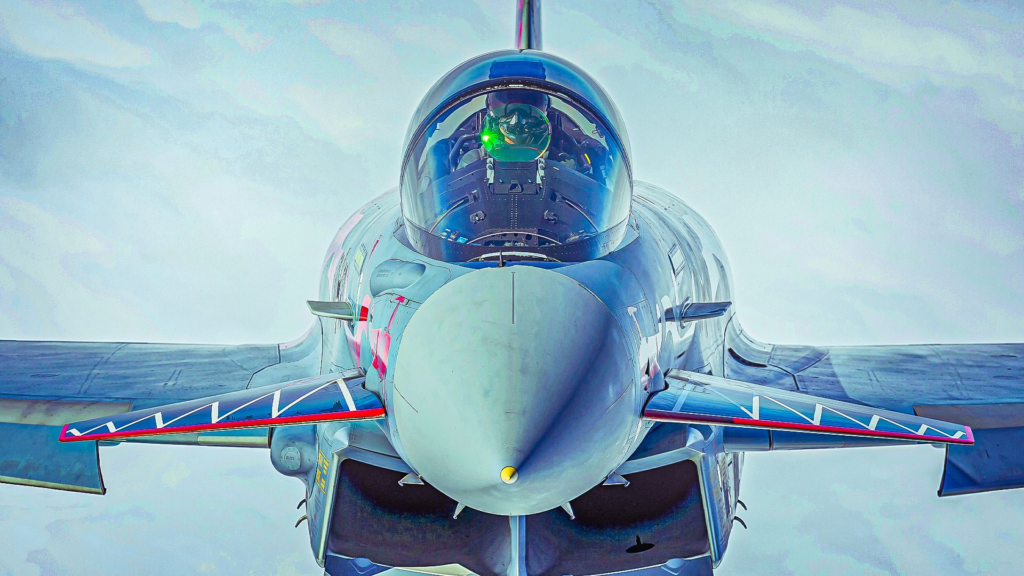
As of early 2025, a total of 613 Eurofighter Typhoons have been built and delivered. Airbus also says 680 have been ordered worldwide since the beginning of the program. Official sources have been updated to show that the total number on the order books has reached 741 to date. The production line will be busy for some years still, so there’s still plenty of time for that number to get even bigger.
The program began 31 years ago as a collective defense consortium that included Airbus, BAE Systems, and Leonardo Aerospace. These three companies and the four partner nations that they are part of have now brought the program to Tranche 5, which will likely be the final variant before the Future Combat Air System (FCAS) succeeds it.
Tailor-Made Air Power

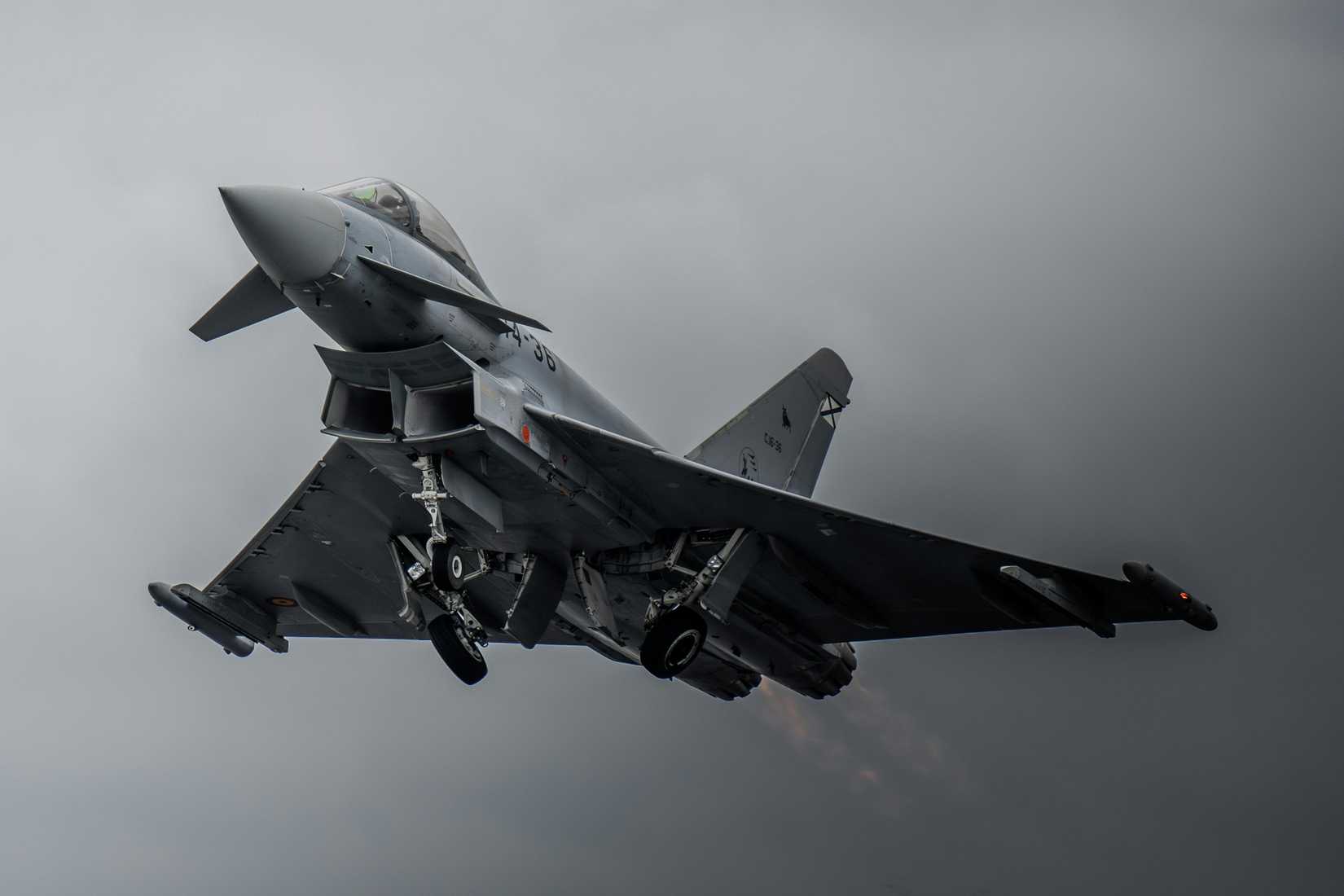
The Typhoon is a Quick Reaction Alert (QRA) interceptor, with its mission always intended to be securing European skies against aggression from potential threats like Russia. The jets’ incredibly powerful engines can launch it from a standstill on the ground to cruising at stratospheric altitudes in just 2 minutes when scrambled for an emergency sortie.
While it may not be capable of penetrating enemy airspace and executing the kind of strikes that American fifth-generation warplanes do, it was also never designed to do so and should never be called upon for such a mission in the first place. On the other hand, thanks to its exceptional performance and versatility, it has grown to become one of the finest multirole platforms anywhere in the world.
The aircraft has evolved with a much deeper weapons magazine that includes air-to-air and air-to-ground munitions, complemented by Advanced electronic warfare, digital networking, communications, and upgraded radar.
Europe’s Dogfighting Champion
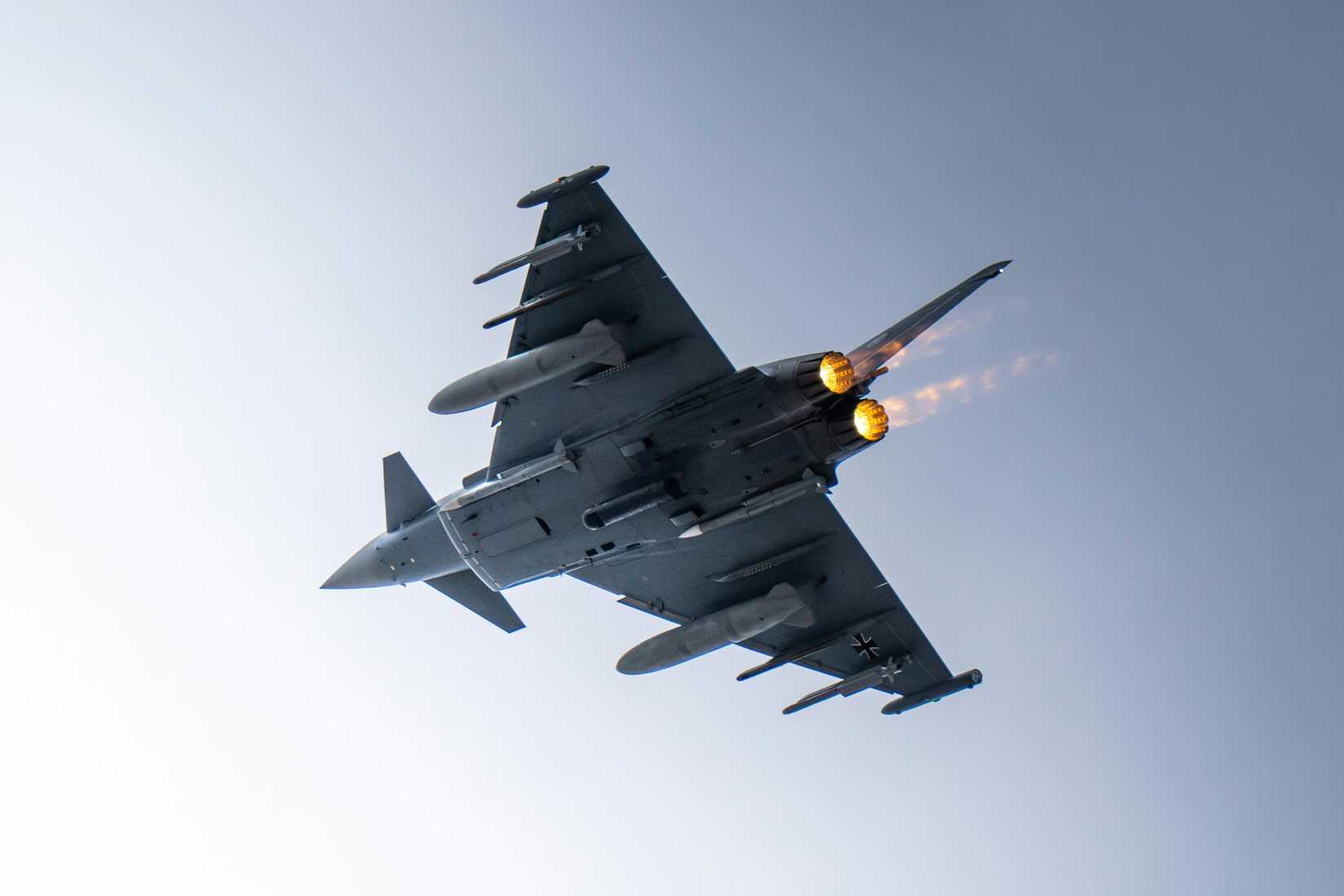
Although the Eurofighter Typhoon can never become a fifth-generation fighter, the latest and greatest iteration of the jet is one of the most capable 4th-Gen-Plus airframes in the world. Much like the Boeing F-15 Eagle, which preceded it in the 1970s, the Typhoon has evolved to a much more capable multirole platform as integrating new technology has enhanced its performance and systems across the board.
Despite the rise of 5th-Gen fighters like the Lockheed Martin F-22 Raptor, which boasts supermaneuverability as well as radar-defeating technology, the Typhoon has held its own against its rivals. The jet famously scored a kill against the new F-35 Joint Strike Fighter during an exercise in Germany between North Atlantic Treaty Organization (NATO) air forces and US Armed Forces.
The German pilot was successfully able to shoot down the F-35 in a simulated dogfight. While the real-world conditions would likely result in the F-35 using beyond-visual-range (BVR) weapons instead of meeting the Typhoon head-to-head, the exercise still shows that it is an exceptionally capable aircraft.
The Order Books


Five export customers have acquired the Typhoon in addition to the original partner nations of Germany, Spain, the United Kingdom, and Italy. Austria is the only European nation to order the fighter that is not a member of the original consortium. Saudi Arabia, Qatar, Oman, Kuwait, and Turkey have also ordered varying amounts over the past and even some pending batches.
Germany is the largest operator and the original launch customer. They also currently have the largest order that is yet to be fulfilled, which includes Tranche 5 jets. The United Kingdom has the second-largest fleet, although it has begun to retire some airframes. The UK has opted to order more Lockheed Martin F-35 Lightning II stealth fighters instead of the advanced Typhoon.
Saudi Arabia also has a large fleet that is nearly the same size as Spain and Italy, depending on whether its final order is approved or not. Turkey has yet to receive any aircraft, but it may be one of the larger operators should its order be fulfilled. Each sale of Eurofighters requires the approval of all Consortium partner nations. Germany is still reviewing the Saudi Arabian and Turkish orders.
Future Proof From Day One

The Typhoon was originally made with advanced modular avionics as well as a digital flight control system. The cockpit’s human-machine interface includes Hands-On Throttle and Stick (HOTAS), a heads-up display, glass panel instruments, and a helmet-mounted display and input. The jet is equipped with Advanced Electronically Scanned Array radar (AESA) and is capable of flying at supercruise, which makes it one of the most flexible and lethal aircraft on the battlefield.
The electronic suite on board is capable of receiving in-flight updates and in-flight bomb targeting as mission parameters evolve dynamically in real time. Although it is not a true stealth aircraft, nor can it be considered a 5th-Gen fighter, the jet’s surface is made of only 15% metal components, which gives it a much lower radar signature than other fourth-generation aircraft. It also has a very low frontal surface area, which helps reduce radar exposure.

From Tranche 1, the fighter was made to be low-maintenance. As technology has advanced, it has integrated better Advanced Health monitoring systems, which enable it to have highly efficient maintenance schedules. The engines can go 1,200 flying hours between depot checks.
The dispersal of assembly lines and life cycle sustainment facilities across all four partner nations of the consortium makes the supply chain both resilient and adaptable to the needs of the global fleet. With the program being produced by Europe’s top Aerospace companies, the quality and longevity of the fighter’s industrial base is also firmly secured.
Combat Tested And Proven
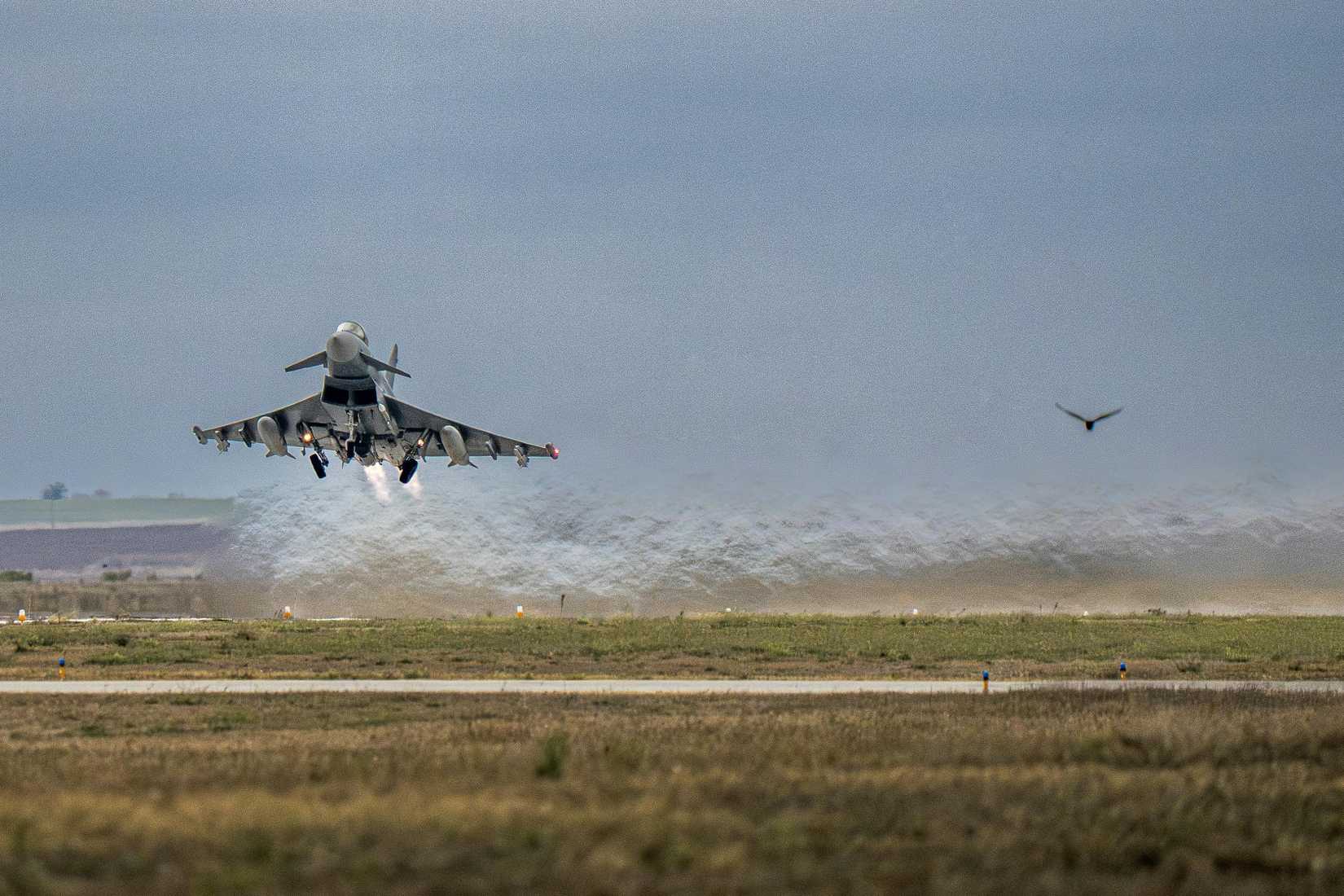
Since it first entered into service, the typhoon has been deployed in several operational theaters. It is used extensively by NATO QRA forces and on air policing missions across Europe. The fighter has also been used by Saudi Arabia throughout the Middle East for combat operations. Serving alongside American F-22 and F-35 fighter squadrons, it has proven that the aircraft’s combat capabilities will make it a vital asset and well into the 2030s, according to Defense Advancement.
The Royal Air Force (RAF) of the UK and the Italian Air Force deployed Eurofighter Typhoons to Libya in 2011. The fighters enforced a no-fly zone, conducted aerial reconnaissance, and air-to-ground precision strike missions. Disappointment marked the combat debut of the fighter jet. In 2015, the RAF would once again call upon the Typhoon and a campaign against the terrorist group known as the Islamic State (IS).


The Typhoon has continued to provide both air superiority and close air support in Iraq and Syria since 2015 as part of the air-policing operations of the RAF. The Typhoon would score its first air-to-air kill in Syrian airspace when the RAF shot down an enemy drone. The fighters also regularly intercept and escort foreign aircraft in the Baltic states, Romania, and Iceland.
The Royal Saudi Air Force (RSAF) was the first to use Paveway IV bombs from a Typhoon while targeting ISIS in Syria. The Tranche 2 fighters played a central role in the RSAF campaign over Yemen in 2015, which targeted Houthi insurgents during the Yemeni civil war.
The RSAF supported the United Nations as it attempted to de-escalate the conflict that resulted from a failed power-sharing arrangement, as the Yemeni government transitioned following the collapse of the previous regime. The coalition of forces was led by Saudi Arabia under what was dubbed “Operation Decisive Storm.”
Typhoon By The Numbers


Airbus describes the Eurofighter Typhoon as the world’s most advanced swing-role combat aircraft. It was originally conceived to modernize the air forces of the multinational consortium that began the program; however, it did evolve into much more. The fighter is powered by two EJ200 engines, which give it an incredible thrust-to-weight ratio and supermaneuverability.
The Typhoon can easily switch between missions on the fly thanks to its highly flexible sensors and weapon system. It has 13 hard points on the wings and fuselage that allow operators to equip it with a highly flexible mission payload.
The jet may not quite be able to go toe-to-toe with the F-22 Raptor, but in terms of raw performance and dogfighting ability, it is not far behind at all. The latest tranches feature state-of-the-art identification and sensor fusion capability. It is equipped with the CAPTOR-E AESA radar and the PIRATE FLIR sensor, as well as the PRAETORIAN Electronic Defensive Aid Sub System (DASS).
|
Specification |
Eurofighter Typhoon |
|---|---|
|
Wingspan |
10.95 meters (35 feet 11 inches) |
|
Length overall |
15.96 meters (52 feet 4 inches) |
|
Height |
5.28 meters (17 feet 4 inches) |
|
Wing Area |
51.2 square meters (551.1 square feet) |
|
Basic Mass Empty |
11,000 kilograms (24,250 pounds) |
|
Loaded weight |
16,000 kilograms (35,270 pounds) |
|
Maximum Take-off |
> 23,500 kilograms (51,809 pounds) |
|
Maximum external load |
> 7,500 kilograms (16,535 pounds) |
|
Weapon Carriage |
13 Hardpoints |
|
Fuel capacity |
5,000 kilograms (11,020 pounds) |
|
G’ limits |
Pos 9 to Neg 3 G |
|
Engines |
Two Eurojet EJ200 reheated turbofans |
Lockheed Martin’s 5th-Gen stealth fighters may best the Typhoon in aerial weapons, but it still features both advanced air-to-air missiles for close-combat and BVR engagements. It is also configured for air interdiction missions to execute ground attacks with targeting pods, four air-to-ground munitions, and two defensive missiles.
source