


Singapore Airlines had previously served Newark nonstop in the 2000s using Airbus A340-500s, aircraft far more fuel-thirsty than the Airbus A350s in service today. The carrier configures the aircraft used on these two routes in a special layout only featuring business class and premium economy, and the operation has become so successful that it will be refurbishing these planes with a larger business class cabin and first class. But with the extraordinary distances that these aircraft fly, these flights come with major logistical challenges, such as staffing.
Looking At Singapore Airlines’ Nonstop Flights To New York

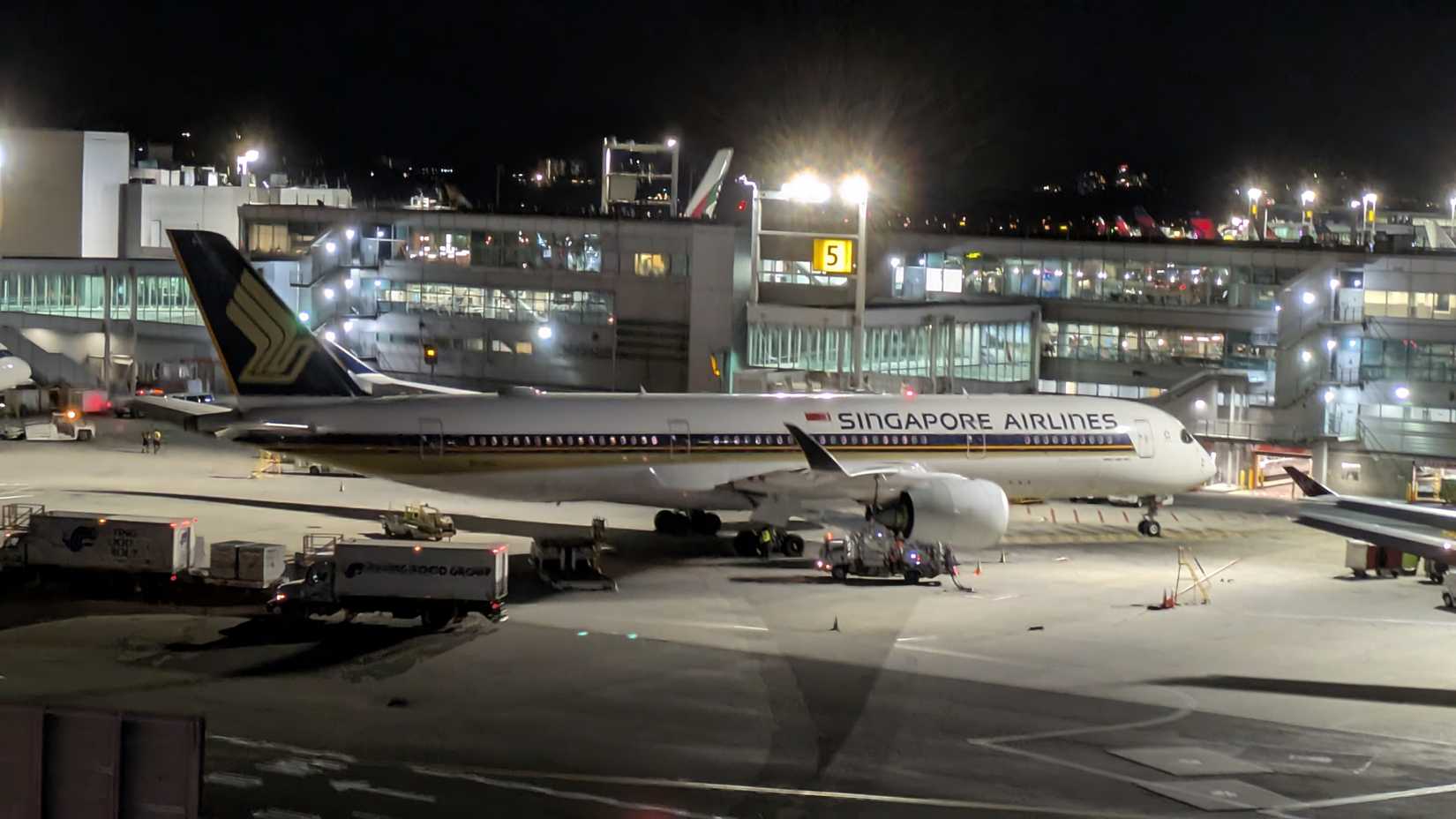
In 2018, Singapore Airlines relaunched its famous service from Singapore to 
The flight to 
Beyond the technical changes, the A350-900ULRs also come with a special configuration. Data from aeroLOPA shows that Singapore Airlines’ standard A350-900s are equipped with 42 business class seats, 24 premium economy seats, and 187 economy seats, for a total of 253 seats. The A350-900ULRs, meanwhile, features 67 business class seats and 94 premium economy seats, for a total of 161 seats. These aircraft do not feature an economy cabin, which is instead available on Singapore’s one-stop Boeing 777 service to JFK via Frankfurt.
How Staffing Works On These Flights
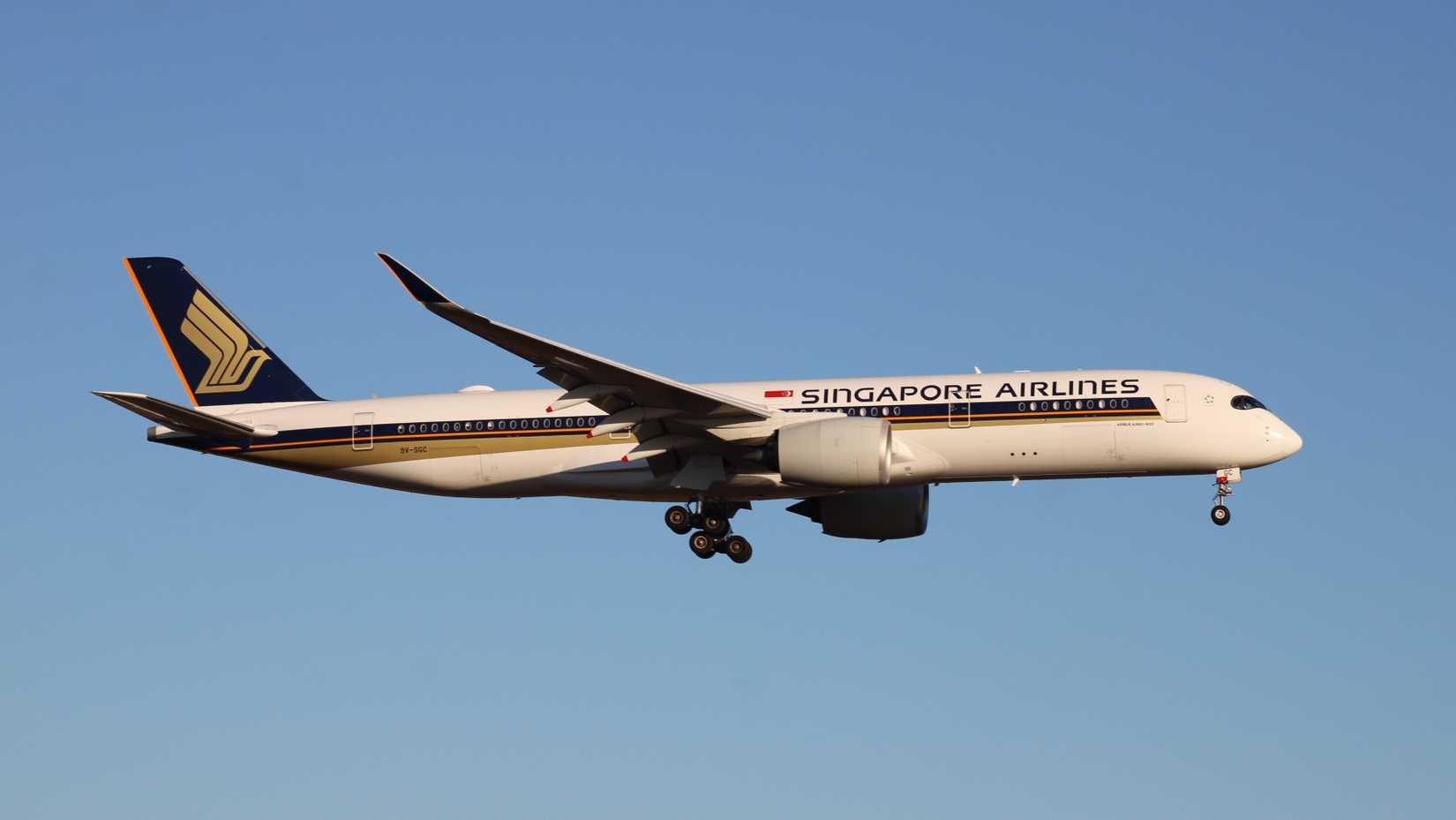
Because these flights routinely last over 18 hours, they far exceed crew rest limitations for pilots and flight attendants. The solution in the flight deck is to staff four pilots, made up of two captains and two first officers. In the passenger cabin, Singapore Airlines schedules 13 flight attendants, including the purser, to serve guests. Everyone is seated for taxi, takeoff, and landings, while only some crew members work throughout the flight. In the flight deck, only two pilots are present during cruise.
During the flight, the two sets of pilots alternate so that one set is in the cockpit while the other set rests. The same is done by flight attendants. Everyone works the initial meal service, but then afterwards, some of the crew members go into the bunks for rest, while the rest of the crew remains. The flight attendants rotate every two to three hours, with rotations carefully planned to ensure that everyone receives adequate rest. Everyone works at the very end of the flight and is seated for landing.
Despite this being the longest flight in the world, crew staffing is relatively light compared to other ultra-long-haul flights. The Airbus A350-900 is ultimately a modestly sized airliner, and the A350-900ULRs operated by Singapore Airlines are also the least-dense A350s in the world, with only 161 seats. As such, the carrier wouldn’t necessarily require as many flight attendants. Naturally, however, the crew roster is still large for the number of seats onboard in order to provide a high standard of service, given that the aircraft only features business and premium economy.


How Cabin Crew Deal With Jet Lag After Working A Long-Haul Flight
A careful balance of rest, light and water are the best actions.
Where Flight Attendants Sleep On These Flights


One of the major innovations of the Boeing 777 was the installation of crew rest areas in the aircraft’s “crown area” above the passenger cabin. This was possibly mainly due to the size of the 777’s fuselage, and this meant that airlines wouldn’t need to block seats or reduce cargo space. This was since carried over to the Boeing 787, and is also present in the Airbus A350. The smaller size of the Airbus A330 or Boeing 767, meanwhile, means that a crew-rest area would not fit above the cabin.
The crew rest bunks on the Airbus A350 are located towards the rear of the cabin. They can be accessed through a small set of stairs near the fourth set of exit doors, where flight attendants will find eight beds (the A350 is also offered with a six-bed option). This area is fairly basic, with elevated beds that feature privacy curtains. Up here, flight attendants can sleep, or they can read or use the aircraft’s Wi-Fi system and relax. Some airlines also specify the installation of video monitors to access the in-flight entertainment system, although this is a customer-specific option.
|
Aircraft With Overhead Bunks |
|---|
|
Airbus A350 |
|
Boeing 777 |
|
Boeing 787 |
Passengers can tell where the crew rest area is by looking at the center overhead bins. The rear part of the cabin does not include actual bins; instead, this is where the bunks are located. Pilots also access a seperate rest area located above the forward business class cabin, which features two beds and an armchair. Passengers can tell where the pilot rest area is located as the ceiling is lower in this area (given that the business class cabin does not feature overhead bins).
Looking Closer At Singapore Airlines’ Flights To New York

By great circle distance, Singapore and New York-JFK are 8,288 NM (15,349 km) apart. The distance between Singapore and Newark is 8,285 NM (15,344 km). As a comparison, the distance between Doha and Auckland is 7,848 NM (14,535 km), meaning that these two routes are significantly longer. Actual flight times vary depending on weather conditions, but these flights can be scheduled for as long as 19 hours and 15 minutes, with real flights routinely logging over 18 hours in the air.
The shortest flight path between the two cities goes directly over the Arctic and through Siberia, but since Russian airspace is closed, Singapore Airlines typically routes SQ21 and SQ23 over the Atlantic. The planes travel the same path as other transatlantic flights, then over Europe, Central Asia, and South Asia, before landing home in Singapore. SQ22 and SQ24 to Singapore, meanwhile, typically fly across the Pacific. Even before the closure of Russian airspace, these routings were often preferred as this allowed both flights to fly with a tailwind in the Atlantic and Pacific jetstreams.
The A350-900ULR sacrifices payload for additional fuel capacity, achieved through software tweaks and lower payloads. These aircraft rarely depart at close to the aircraft’s Maximum Takeoff Weight (MTOW) since cargo capacity is low and there are only 161 seats. While this is low, Singapore Airlines will soon cut capacity even more to make way for more premium seats. Beginning in 2027, the A350-900ULRs will be retrofitted with new interiors and will return to service with four first-class seats, 70 business-class seats, and 58 premium economy seats, for a total of 132 seats.
Singapore Airlines Vs. Cathay Pacific: Which Airline Has More Widebody Aircraft?
Despite Singapore Airlines carrying more passengers each year, Cathay Pacific operates a larger overall fleet and a larger widebody fleet.
The Future World’s Longest Flight

In 2026, Qantas will begin taking delivery of the Airbus A350-1000ULR. Unlike the A350-900ULR, this aircraft will feature an additional fuel tank and, with a higher MTOW, will be able to operate new nonstop flights between Sydney and Melbourne to London-Heathrow and JFK as part of Project Sunrise. These four routes will comfortably dethrone Singapore Airlines’ services to New York, and the success of these routes could also open other ultra-long-haul routes from Australia. In addition, this aircraft will fly Qantas’ existing route from Perth to London-Heathrow.
Unlike Singapore Airlines, Qantas will be installing economy seats on these planes, although they will feature extra legroom. In total, there will be just 238 seats, making them the least-dense A350-1000 in the world. This will be made up of six first-class seats, 52 business-class seats, 40 premium economy seats, and 140 economy seats. Although this layout is fairly spacious, it’s more orthodox than the all-premium layout of Singapore Airlines’ A350-900ULRs.
|
Origin |
Destination |
Airline |
Aircraft |
Distance (NM) |
Distance (km) |
|---|---|---|---|---|---|
|
Sydney |
London-Heathrow |
Qantas |
Airbus A350-1000ULR |
9,188 NM |
17,016 km |
|
Melbourne |
London-Heathrow |
Qantas |
Airbus A350-1000ULR |
9,127 NM |
16,904 km |
|
Melbourne |
New York-JFK |
Qantas |
Airbus A350-1000ULR |
9,015 NM |
16,695 km |
|
Sydney |
New York-JFK |
Qantas |
Airbus A350-1000ULR |
8,646 NM |
16,013 km |
|
Singapore |
New York-JFK |
Singapore Airlines |
Airbus A350-900ULR |
8,288 NM |
15,349 km |
|
Singapore |
Newark |
Singapore Airlines |
Airbus A350-900ULR |
8,285 NM |
15,344 km |
|
Doha |
Auckland |
Qatar Airways |
Boeing 777-200LR |
7,848 NM |
14,535 km |
|
Perth |
London-Heathrow |
Qantas |
Boeing 787-9 |
7,829 NM |
14,499 km |
In addition, the routing from Australia’s east coast to London and New York will be fairly standard, with little room for deviation. While Qantas’ Project Sunrise flights will be the longest in the world, the Singapore Airlines’ operations to New York will remain the most unique of any ultra-long-haul operation.
source