


VIENNA — German Defense Minister Boris Pistorius came to Canada’s CANSEC defense exhibition on Wednesday with a message that was as much political as commercial: Buy our submarines, and Germany will have your back.
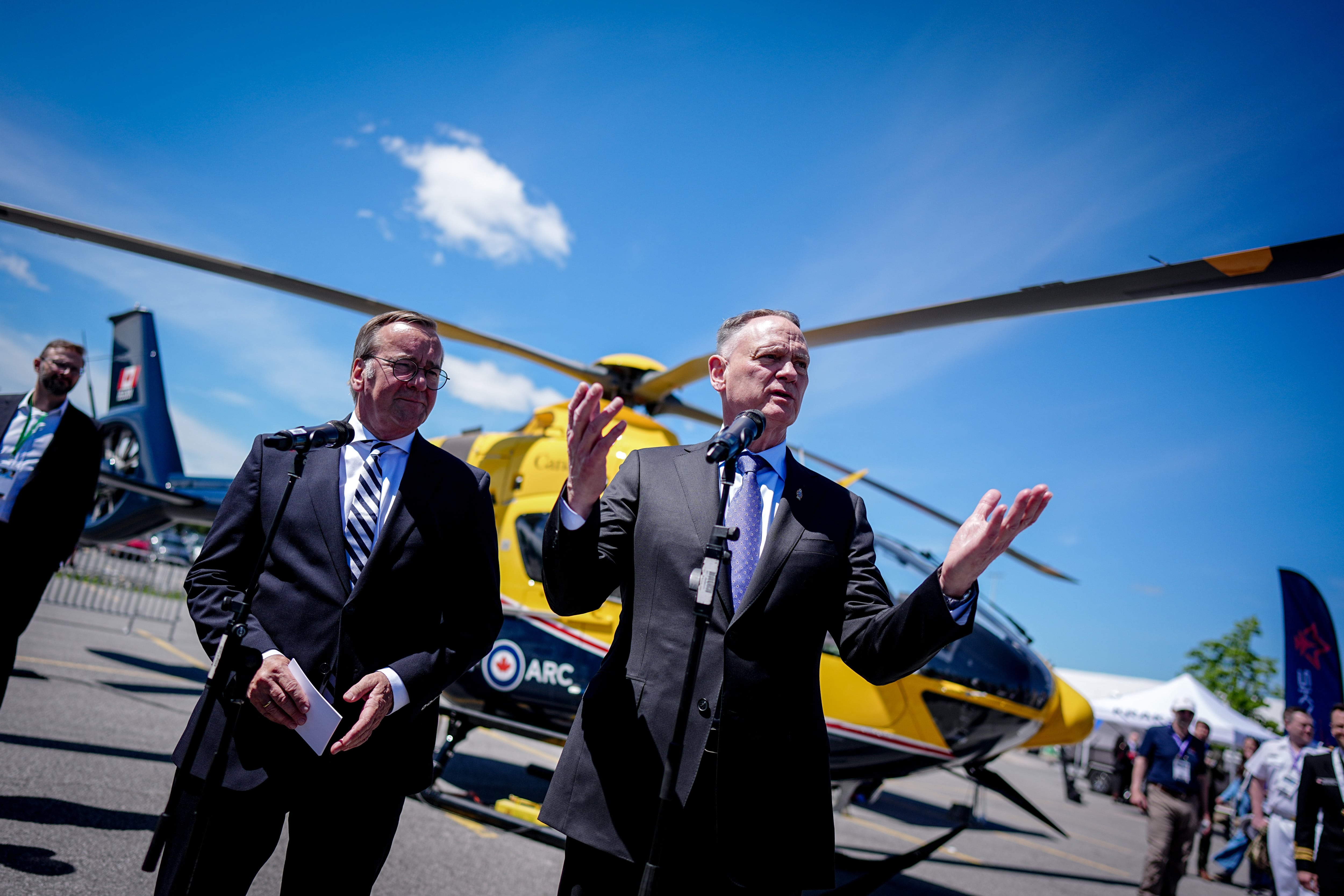
Standing alongside Canadian Defense Minister David McGuinty in front of a Franco-German helicopter fitted with Canadian engines, Pistorius made an explicit pitch for TKMS’ Type 212CD in Canada’s Canadian Patrol Submarine Project, a contract estimated at up to C$60 billion (US$43.3 billion) and among the largest defense procurement decisions in Canadian history.
“This is a very unique offer,” Pistorius said at a fireside chat hosted by the Canadian Global Affairs Institute. “Canada opting for the 212CD would mean to consistently and sustainably pursue the transatlantic path towards closer integration of our economies.”
The pitch was strikingly direct for a German defense minister. Germany has historically maintained a tradition of restraint in arms exports, with political leaders deliberately keeping a distance from commercial defense sales. That posture is shifting. Pistorius’s appearance at CANSEC was his third visit to Canada as defense minister in three years, and he arrived with an investment package, government-to-government endorsements, and detailed economic figures − a playbook far more reminiscent of France’s state-backed arms export model than Berlin’s traditional approach.

Germany and Norway submitted a joint bid for up to 12 Type 212CD submarines in March. In his public remarks, Pistorius cited figures of C$86 billion (US$62 billion) in GDP impact, C$167 billion (US$120.5 billion) in total economic output, and more than 650,000 job-years over the contract period − numbers derived from modeling commissioned by TKMS and the German government.
The German bid faces stiff competition from South Korea’s Hanwha Ocean, whose KSS-III Batch II submarine sailed to Canadian Forces Base Esquimalt in British Columbia last week in a conspicuous show of hardware diplomacy. Pistorius was pointedly dismissive. “We are not in a theater,” he told German journalists. “This is not about showing, it’s about proving experience and technology.”
But he also took the opportunity to remind Canadian listeners that Germany had been instrumental in facilitating Ottawa’s acceptance into the European Union’s SAFE defense financing mechanism.
The German-Norwegian offer attempts to counter South Korea’s main advantage − a pledge to deliver four submarines by 2035 − by reallocating vessels from Germany’s own order pipeline to put four boats in Canadian hands by 2036. Fleet interoperability across NATO’s northern flank is Berlin’s strongest substantive argument: Germany and Norway already operate or are acquiring the 212CD class. Together with Canada, there would be a NATO fleet of 24 such boats, making it “the world’s largest and most modern conventional submarine fleet,” he said.
It would also strengthen Berlin’s emergence as a key NATO player for the Arctic region. Germany previously launched a North Atlantic maritime security partnership with Norway, Canada and Denmark, and Pistorius was the first to disclose on Wednesday that Iceland is on the verge of joining the group as well.
An acquisition decision by the Canadian government is expected by early July, before the NATO summit in Ankara, Pistorius told reporters in German.
Linus Höller is Defense News’ Europe correspondent and OSINT investigator. He reports on the arms deals, sanctions, and geopolitics shaping Europe and the world. He holds master’s degrees in WMD nonproliferation, terrorism studies, and international relations, and works in four languages: English, German, Russian, and Spanish.