


The attack on Prince Sultan Air Base brings the total number of tankers damaged during Operation Epic Fury to six, with a seventh destroyed in the mid-air incident that claimed the lives of six crew members.
A recent Iranian missile strike hit Prince Sultan Air Base (PSAB) in Saudi Arabia, damaging five U.S. Air Force refueling planes on the ground, the Wall Street Journal reported , citing two U.S. officials. The aircraft were damaged but not destroyed, and no one was killed in that strike.
According to the WSJ, the refuelers are currently being repaired, although the extent of the damage is not clear. U.S. Central Command has not released any official statement on the incident yet.

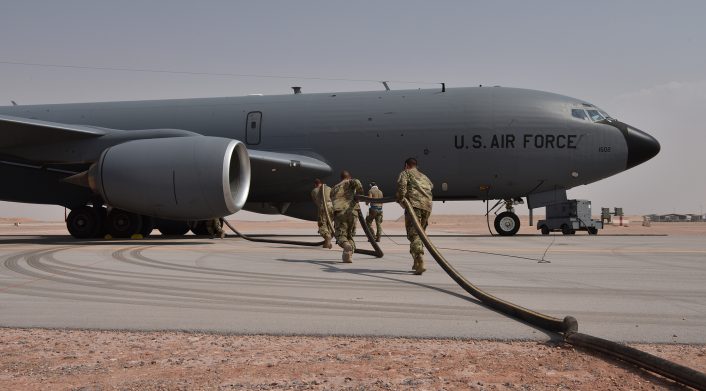
While the type of aerial refuelers damaged in the Iranian attack has not been disclosed, the most recent satellite imagery showed only KC-135s deployed at PSAB. Still, we can’t rule out some KC-46s were also there.
BREAKING: Unfortunately, as a result of a ballistic missile strike by the IRGC Aerospace Force at Prince Sultan Air Base in Saudi Arabia, five historic KC-135R/T Stratotankers of the U.S. Air Force and Air National Guard have either been damaged or destroyed. These historic… pic.twitter.com/RShCpt4fwk
— Babak Taghvaee – The Crisis Watch (@BabakTaghvaee1) March 14, 2026
The base has been targeted by Iranian air strikes multiple times recently: a U.S. service member died after being seriously injured during an attack at the Saudi base on March 1; the Saudi MOD said they intercepted five Iranian drones near PSAB on the following day.
المتحدث الرسمي لوزارة الدفاع : اعتراض وتدمير 5 مسيّرات معادية بالقرب من قاعدة الأمير سلطان الجوية. pic.twitter.com/ki4YlSChb4
— وزارة الدفاع (@modgovksa) March 2, 2026
Prince Sultan is a strategic forward operating base that is located in the Saudi interior some 600 km from the Iranian coast. It regularly hosts U.S. assets.
Prince Sultan Air Base, Riyadh, is a massive logistical complex that sits deep in the Saudi interior, roughly 600 km from the Iranian coast. That sounds like a long distance, but at ballistic speeds, a missile can cover that gap in about 6 to 8 minutes. By the time a launch is… pic.twitter.com/RdjFhOp5yO
— Air Power (@RealAirPower1) March 14, 2026
Despite the attack, the base is active, with multiple tankers tracking online during aerial refueling missions launched from there.
Not sure on the amount of tankers stationed at Prince Sultan, but air operations continue from it. Several tankers up today via online tracking. Current snapshot https://t.co/StTBA71yGH pic.twitter.com/uzPnZr6EFJ
— RivetJoint (@SpeckleBelly64) March 13, 2026
Following the report by the WSJ, Iranian media have started circulating online photos of damaged KC-135s that were not taken during the recent attack but date back to 1999; images that were immediately debunked.
Those photos are from 1999https://t.co/diIQkgOecr
— Tal Hagin (@talhagin) March 14, 2026
The news of the five damaged tankers at PSAB came in the aftermath of the tragic mid-air incident that claimed the lives of six crew members aboard a KC-135R (62-3556) of the U.S. Air Force Reserve Command (756th Air Refuelling Squadron) after it collided with another KC-135, 63-8017, which lost about 40% of its vertical stabilizer in the accident.
All Crew Members of U.S. KC-135 Loss in Iraq Confirmed Deceased
TAMPA, Fla. – All six crew members aboard a U.S. KC-135 refueling aircraft that went down in western Iraq are now confirmed deceased. The aircraft was lost while flying over friendly airspace March 12 during…
— U.S. Central Command (@CENTCOM) March 13, 2026
That’s about the top third of the tail gone. A little lower & they would have lost the rudder.
It was not an Air Refueling mishap. It was not hostile or friendly fire…this is not shrapnel damage.
From what I understand, it was a near head-on mid air collision.
Allegedly, a… https://t.co/DozLxR4RKO
— KC-10 Driver ✈️ 👨✈️ B-737 Wrangler (@MCCCANM) March 13, 2026
President Trump wrote a comment about the incident, and the way it was reported by U.S. media, on the Truth social media:
Yet again, an intentionally misleading headline by the Fake News Media about the five tanker planes that were supposedly struck down at an Airport in Saudi Arabia, and of no further use.
In actuality, the Base was hit a few days ago, but the planes were not “struck” or “destroyed.” Four of the five had virtually no damage, and are already back in service. One had slightly more damage, but will be in the air shortly.
None were destroyed, or close to that, as the Fake News said in headlines. The New York Times and The Wall Street Journal (in particular), and other Lowlife “Papers” and Media actually want us to lose the War. Their terrible reporting is the exact opposite of the actual facts!
They are truly sick and demented people that have no idea the damage they cause the United States of America.
Tanker force
According to open sources analysis more than 160 tankers have been deployed by the U.S. Air Force across the CENTCOM and EUCOM (European Command) Areas of Responsibility (AOR).
In the CENTCOM AOR, 17 KC-46A Pegasus and 62 KC-135 Stratotankers have been positioned at airfields in the Middle East as well as at Diego Garcia.
More than 40 additional tankers have also been spotted at Tel Aviv Ben Gurion Airport, Israel.
Tankers have also been rotating at airbases in Europe and the Mediterranean region, supporting other assets flying from the United Kingdom toward the Middle East.
As of June 2025, the U.S. Air Force (Active Duty, Air National Guard, and Air Force Reserve) operated 376 KC-135s and 89 KC-46As.
Commenting on the incident, a former KC-135 boom operator noted on social media that the attack underscores the vulnerability of the aging KC-135 Stratotanker fleet and urged the U.S. Air Force to accelerate the transition to the KC-46 Pegasus. Here below can find the link to his article, posted on X. It’s worth a read.
https://t.co/bxUGMKyU3a
— Campbell (@boomers_ass) March 14, 2026
Adoption of KC-46A has progressed slower than originally planned. In its fourth quarter 2025 earnings release, Boeing disclosed a $565 million loss tied to the type. The company stated it delivered 14 KC-46s in 2025 and is now targeting an increase to 19 deliveries in 2026. Under the current contract Boeing will provide 183 tankers for U.S. and international customers, although the number might soon increase as the Air Force is planning to procure 75 additional aircraft to recapitalize the aging KC-135 Stratotanker fleet.
As we reported at the beginning of this year, the cost overruns are also due to its long history of technical challenges, which included issues with the aircraft itself and the refueling equipment. These problems notably led to a temporary halt to the deliveries in 2024.
Among the most serious and enduring issues has been the Remote Vision System (RVS), which replaces the classic boom operator’s rear-facing window and controls with a new console equipped with a camera system. However, the system has suffered from many issues, leading the Air Force to classify it as a Category 1 deficiency, which represents problems that could result in loss of life or damage to aircraft.
The tanker has also experienced problems with its refueling boom actuator, which affected the stiffness and controllability of the boom during refueling operations. These issues limited the KC-46’s ability to refuel certain receiver aircraft, with a notable instance being the A-10 Thunderbolt II, and required new modifications to meet Air Force requirements.
Product quality issues involved three separate parts of the aircraft: drain masts for its auxiliary power unit (APU), a seal for its fuel manifold and a drain line that runs near the cockpit. Specifically, the APU’s drain masts showed a tendency to crack, solved with additional reinforcements.
The fuel manifold, which runs 555 feet throughout the plane, is fitted with flex couplings throughout so that it can bend in flight. However, an incorrect positioning of the coupling’s seals enabled fuel to seep out of the inner tube into the outer one, so Boeing implemented a new flex seal.
The last one was related to the AAR receptacle on top of the cockpit, specifically the receptacle drain line, which empties liquid out but is at risk of cracking and could cause fuel to leak into the cockpit. A fix has been found and is being implemented.
Structural concerns have also interrupted production. In 2024, Boeing was forced to temporarily halt KC-46 deliveries for approximately three months after cracks were discovered in the aircraft’s wing structure, requiring inspections and repairs across multiple aircraft. The pause highlighted the ongoing manufacturing challenges, complicating once again delivery schedules.
source