


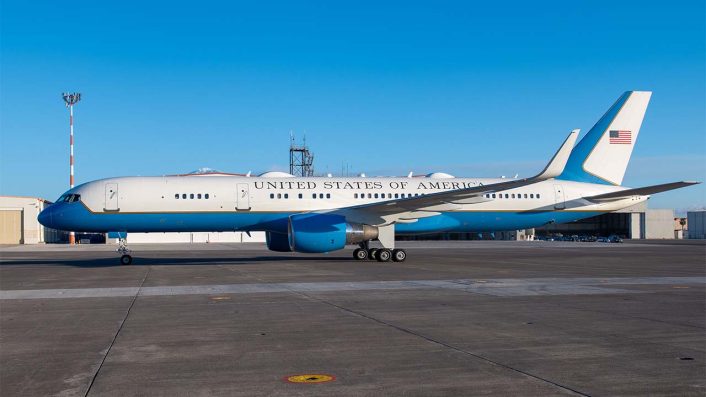
A freshly repainted C-32A shows off the livery redesign long favored by President Donald Trump, which is also due to appear on the next generation of Presidential aircraft.
Boeing C-32A 99-0003 was recently noted by aviation enthusiasts flying from Greenville Majors Airport (KGVT), where the fleet undergoes periodic maintenance overhauls and upgrades with L3Harris, in the new paint scheme. It is the first C-32 seen to sport the new colours, which comprise a dark blue underside, red pinstrip, and white upper fuselage. The U.S. flag on the tail has been exchanged for a ‘waving’ variant.
C-32A (99-0003) as VADER20 landing at KGVT sporting the new livery https://t.co/fKuTd7EObo pic.twitter.com/7cgJejavzy
— TT-33 operator (@Tt33operator) February 17, 2026
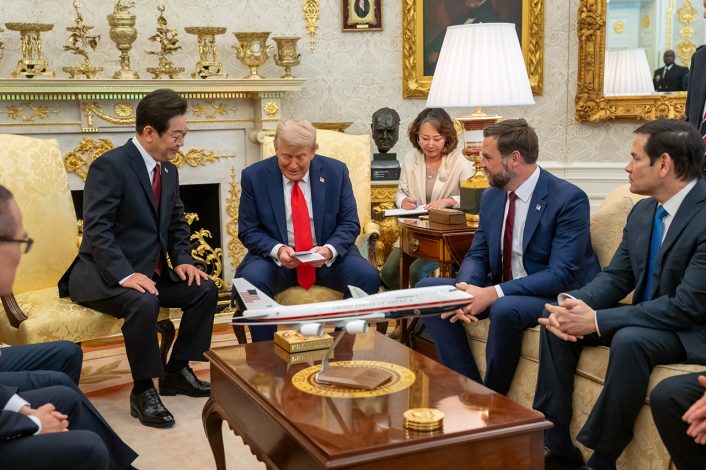
The paint scheme is based on the one unveiled by President Trump in 2019, during his first term. It was designated under that administration as the new livery for the VC-25B aircraft that will in the future serve as the primary ‘Air Force One’ aircraft, but this decision was later overturned by President Biden’s administration. No definitive comment had been made so far in Trump’s second administration to say that the decision would be reversed again, but a model of the VC-25B in his favored paint scheme has held a prominent position in the Oval Office throughout the first year of his second term.

After images of 99-0003’s new look garnered attention on social media, White House reporters apparently raised the topic with officials. Unnamed sources then confirmed to CBS News that the new livery would indeed be used not only for the two VC-25Bs currently being converted by Boeing but also on the ‘interim’ 747-8 gifted to the U.S. by Qatar. This 747-8, which will serve until the VC-25Bs are ready to enter service and then, reportedly, be retired as an exhibit of Trump’s Presidential Library, is said to be due to begin operational service in the summer of this year.
NEWS via @CBSNews: The Kennedy-era paint colors on the exterior of aircraft in the U.S. Air Force executive fleet are being replaced with new design in Trump’s preferred palette. New Trump colors will appear on donated Qatari jet and two planes Boeing is converting to serve as…
— Jennifer Jacobs (@JenniferJJacobs) February 17, 2026
The new design, regardless of any subjective opinions on its aesthetic merit, will almost certainly prove controversial in its supplanting of the iconic and long-lasting egg blue and white scheme that has been carried by a range of U.S. VIP aircraft since the Kennedy administration. Indeed, First Lady Jacqueline Kennedy had key input into the design choices for the livery, which was ultimately penned by Raymond Loewy (who also had design input on the Apollo program and for the interior of the Concorde airliner).

One of the key critiques of the new scheme, dating back to its first unveiling in 2019, is its similarity to the one carried by Donald Trump’s personally owned Boeing 757. The colour scheme is essentially a flipped version of this livery, though using blue rather than black, and the tail flag design is near identical to one previously carried by N757AF.
Former President Donald #Trump‘s Boeing 757 #N757AF was at @flyfrompti this evening while Trump held a rally in Salem, Va. and before his rally in #Greensboro, N.C. This marked the third VIP visit to Greensboro’s airport this week after JD Vance and Tim Walz. #ncpol #avgeek pic.twitter.com/BaImWoJM7E
— Joseph Navin李祖耀 (@josephanavin) November 3, 2024
Previously, it had been noted by U.S. Air Force spokespeople that the altered colours would potentially affect the thermal characteristics of some of the aircraft’s components. Darker paint schemes contribute to higher surface temperatures than lighter colours, and U.S. VIP aircraft – particularly those used for Presidential transit – boast many additional communications antennas, sensors, and other pieces of equipment which would have to be certified as compatible with the livery.
This motivation is one reason why the U.S. Air Force’s fleet of RC-135 intelligence, surveillance, and reconnaissance (ISR) aircraft still carry the same distinctive paint schemes even after so many years, and why the Royal Air Force didn’t make any changes to it for its own Rivet Joints. The problem is not insurmountable, but it does require the testing process to take place – which takes time as well as money.
Although this C-32 was the first example seen of an aircraft from the 89th Airlift Wing (AW) carrying the new paint scheme, at least two aircraft have previously been delivered variants of the same paint job to other U.S. government agencies. This includes a Boeing 737 operated by the Department of Homeland Security as well as new Gulfstream G700 Long Range Command and Control Aircraft flown by the U.S. Coast Guard.
New livery for the G700 soon to be delivered to the US Coast Guard, the same as the new Homeland Security MAX 8, a big change from the previous iconic USCG white and orange livery.https://t.co/s3MEmDRuEZhttps://t.co/QAdKD7SXUW https://t.co/d5aL9paHgZ pic.twitter.com/Lz5uqCTjKe
— Nick H. ✈︎ (@N214WN) January 22, 2026
Ageing C-32s
It’s not clear how long the C-32 will have left in the U.S. inventory, with a like-for-like 757 replacement made impossible by Boeing’s discontinuation of the product in 2004. This gap in the lineup has driven many airlines, even those which were staunch Boeing customers, into the order books of Airbus with its A321LR and A321XLR offerings. For the U.S. Air Force this foreign-made option is more complicated, especially for a ‘flag carrying’ aircraft type like the C-32.
One of the Air Force’s most recent plans is to acquire at least one Boeing 737 MAX 9, designated C-40D, to supplement the existing C-32 and C-40 aircraft while a long term option is decided on. As of last year, this proposal remained unfunded. Without funding for a new build airframe, the USAF has more recently investigated the availability of 737-700 aircraft on the used market.
The 737-700 is the base airframe for the rest of the C-40 fleet. Using civilian passenger configurations as a meter of the aircraft’s general size (military configurations would differ), its maximum capacity of 148 falls far short of the MAX 9’s 193. In comparison, the 757-200 upon which the C-32 is based can carry as many as 239 passengers in civilian service.
Many thanks to reader @Tt33operator for allowing the use of these images. You can also find them on Instagram.
source