


Despite an end to the government shutdown, the flow of air traffic across the United States cannot simply snap back to full capacity. In an update from the the Federal Aviation Administration (FAA), the volume of flights is expected to be reduced by 6% until conditions improve, as AP News reported.
The ongoing disruption to Air Service could not come at a worse time, with the holidays right around the corner. In small consolation, that number is less than the expected 10% that was projected prior to the compromise of congressional Republican and Democratic Representatives, which “reopened” the FAA.
Jump Starting US Air Travel

The reason for the lower expected capacity reduction is thanks to a rapid decline in FAA air controller call-outs now that the government is reopened, and these crucial professionals will once again be paid for their uniquely skilled and high-pressure work. Secretary of Transportation Sean Duffy did not elaborate on the current status but simply said that the federal agencies are reassessing the conditions, and no timeline is currently available for a return to normal capacity.
The FAA expressed significant concerns about projections of flight safety during the shutdown last week, which was compounded by reports of runway incursions as well as in-flight near-misses between airliners in and around major US hubs. Since the federal government placed restrictions on Airport capacity this past Friday, over 10,000 flights have been canceled.
AP News relayed this simple statement from Secretary Duffy regarding the service recovery efforts:
“If the FAA safety team determines the trend lines are moving in the right direction, we’ll put forward a path to resume normal operations.”
Gridlock Across America’s Airports


The Department of Transportation did not publicly share any specific data that revealed the exact nature of safety concerns or projected risks. In addition to the forecasted hazards and recorded incidents, there were also many pilots who reported concerns with the quality of air traffic control management and responses provided by controllers.
The FAA generated a list of 40 airports with the highest safety risks, essentially based on the volume of air traffic, to determine where capacity reductions were needed the most to prevent any danger to flyers. Naturally, all of the nation’s largest hubs, like New York JFK Airport (JFK) and Los Angeles International Airport (LAX), as well as Chicago O’Hare International (ORD), and others, are all on the list.
Photos and videos shared by staff and flyers at airports across the nation in the past weeks showed security lines stretching several times longer than normal due to staffing shortages at the Transportation Security Administration (TSA) under the shutdown.
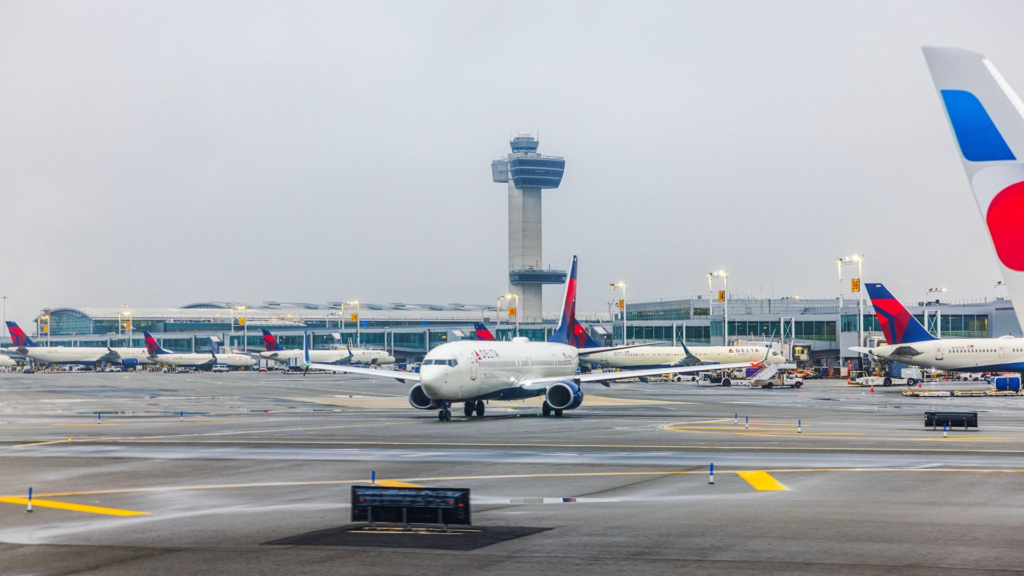
Following reductions to scheduled flights, the backup of aircraft departing became a chronic issue at many hubs. Dozens of planes were seen waiting for extended periods of time to take off after taxiing from the gate for departure.
Politics Clip American Wings

In what appears to be a pointless and futile political exercise that handicapped the entire American air network, air traffic controllers will begin to receive their back pay and normal pay now that the dramatic showdown in Congress is concluded. However, with one of the year’s busiest air travel periods only a week or two away, the ending to the debacle is too little too late.
Air traffic control (ATC) can now begin operating with normal capacity only if employees are brought back to normal Staffing levels and the badly needed infrastructure upgrades that were stalled can be completed rapidly. That is clearly impossible, and the fraught American Air Travel network, which experienced significant disruptions earlier this year without a government shutdown to compound problems, may very well be headed for a major crisis.
The FAA has been pushing for widespread infrastructure, system upgrades, and recruiting efforts to improve the quality of airspace management across the Nation, but it has not achieved a level of impact that has yielded any substantial improvements to the flow of US air traffic. That is largely due to the unstable US government dynamics that have endured for the last decade, in which vital infrastructure projects are used like playing chips in a political game.
source