


Emirates Airline has just revealed its results for the 2025-2026 financial year (which runs April 1, 2025, through March 31, 2026). Not only has the airline achieved its highest profit ever, but the Dubai-based carrier is the world’s most profitable airline for a second year in a row, once again beating Delta.
Details of Emirates’ impressive financial results
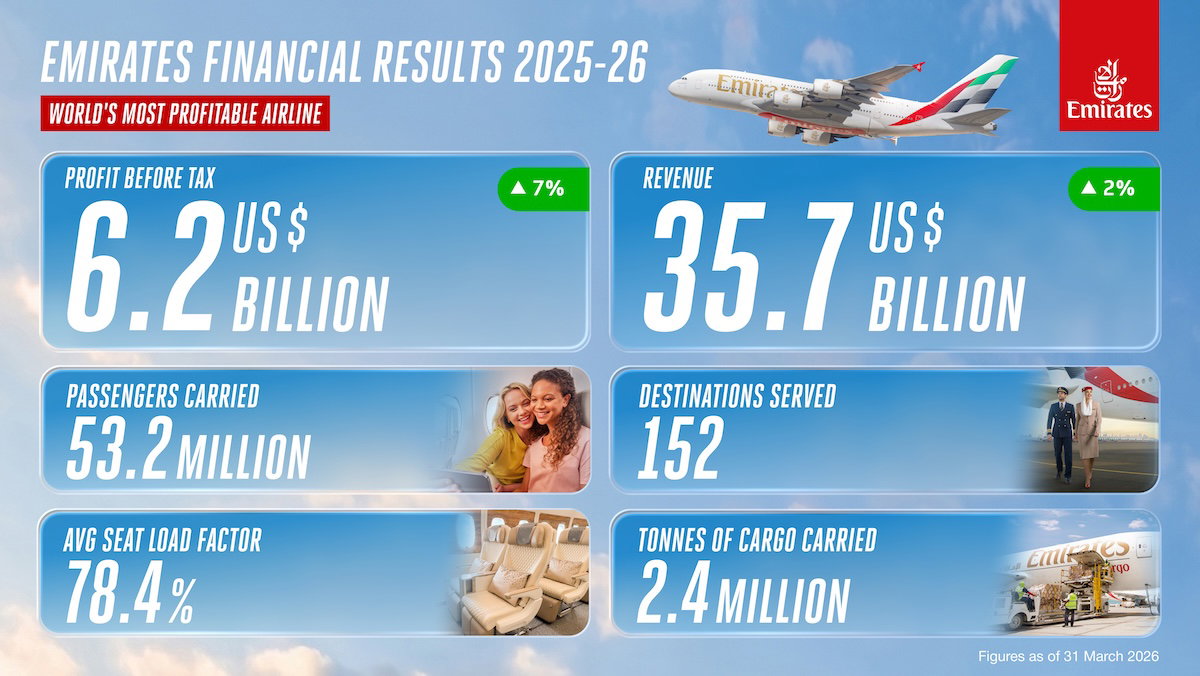
Emirates Group has reported a record $6.6 billion profit, while Emirates Airline has reported a $6.2 billion profit (compared to $6.2 billion and $5.8 billion last year, respectively), representing a 16.2% profit margin (which is unbelievably good for the airline industry). Emirates Group also includes ground handling company dnata, though I’ll be focusing specifically on the carrier’s results.
To look at some of the key figures of Emirates’ performance compared to the previous year:
- Revenue increased by 2%, to $35.7 billion
- Passenger and cargo capacity increased by 1%, to 60.6 billion ATKMs
- Passengers carried was down by 1%, to 53.2 million
- Average load factor decreased by 0.5%, to 78.4%
- Passenger yield increased by 4%, to 10.4 cents per revenue passenger kilometer
- Operating costs increased by 2%, with the carrier’s fuel bill decreasing by 7%
- Emirates Group’s total workforce was increased by 8%, to 130,919 employees

Emirates is ending the financial year with its highest ever cash balance of $15.0 billion, up 3% from last year. Furthermore, Emirates Group has declared a dividend of $1 billion to its owner, Investment Corporation of Dubai.
As you may have guessed, the upcoming financial year will likely look a lot different than the past one. And it’s incredible to see Emirates’ results despite the last month of the financial year having some really major challenges (or else I’m sure the airline would’ve done a lot better).
Here’s how Emirates CEO Sheikh Ahmed bin Saeed Al Maktoum describes these results:
“These outstanding results, despite significant challenges in the last month of our financial year, reaffirm the strength and resilience of the Emirates Group’s business model, which is rooted in safety, excellence, innovation, people and partnerships.”
“For the first 11 months of 2025-26, the picture across the Group was very positive. Strong demand for our products and services was driving revenue, and we were achieving healthy margins thanks to our sustained investments in product, people, technology and brand. Month after month, we were surpassing our targets.”
“On 28 February, military activity massively disrupted global commercial air traffic in the Gulf region, including in the UAE. Emirates and dnata quickly mobilised to support our people and affected customers, protect our assets, and ensure business continuity.”
“We are fortunate to be based in Dubai, where years of infrastructure investments and a cohesive aviation ecosystem has enabled the government to quickly secure safe corridors for commercial flights. Emirates and dnata have since gradually restored operations at DXB. Although we are still operating at a lower passenger capacity than pre-disruption, cargo operations have ramped up to support the movement of essential goods into and through the UAE.”

Yes, Emirates is now more profitable than Delta
Perhaps the most interesting thing about Emirates’ financial results for the past couple of years is that the airline has overtaken Delta as the most profitable in the world. For example, this past year Delta generated a $5 billion profit, so Emirates is about 25% more profitable.
When I write about the financial performance of the Gulf carriers, there are always questions about whether this is all just imaginary math, given that the Gulf carriers are state owned. After all, going back a decade, US airlines spent tens of millions of dollars campaigning to convince us that these are all heavily subsidized airlines that light money on fire (they’ve since changed their tune).
Yes, these results are accurate, and they’re independently audited per international financial reporting standards. However, there’s no denying that the math on some things works differently for an airline like Emirates than many other airlines:
- Emirates has had easier access to attractive financing on account of being government owned, which has allowed the airline to become what it is
- Emirates largely has lower operating costs than other airlines, given that the airline essentially has the same owner as the airport, ground handlers, catering company, etc.
I do think Emirates is “legitimately” profitable, though of course it’s not an apples-to-apples comparison to US airlines in terms of revenue vs. costs. The problem with the A380 for most airlines is that they haven’t been able to scale their operations in a way that works. Emirates has been able to scale its route network unlike any other airline.
The A380 was quite literally created for Emirates’ business model, it’s just a shame that other airlines couldn’t make it work in the same way. One has to wonder what Emirates will look like starting in the early 2040s, when the A380 is no longer in service.
For that matter, I think it’s worth pointing out that even the most profitable US airlines are only sort of profitable in terms of transporting passengers. For example, when you look at the financial results of carriers like American, Delta, and United, you’ll find that the airlines largely don’t actually make money transporting passengers, but rather earn much of their profits through their frequent flyer programs and other means. They’re lucky to breakeven in terms of the cost per air seat mile vs. the revenue per air seat mile.
Emirates is obviously just much more efficient — labor costs are lower, the airline is flying much larger planes with lower per seat operating costs, operating flights in the Middle East is cheaper, etc.


Bottom line
Emirates has reported a record profit for the past financial year, which is its fourth consecutive year of record profits. What’s particularly remarkable is that for the second year in a row, Emirates has overtaken Delta as the world’s most profitable airline.
It’s great to see Emirates continuing to succeed with its business model. The airline has scaled operations with the A380 in a way that no other airline has, and that’s a key part of the carrier’s success. Now, I imagine those increased profits will be coming to an end for the time being, given the current conflict in the region, which is sort of an existential threat to some Gulf carriers.
What do you make of Emirates’ financial results?
source