


DARPA has assigned the designation X-76 to the Speed and Runway Independent Technologies (SPRINT) project, a Bell proof-of-concept technology demonstrator for a high-speed tiltrotor.
The DARPA (Defense Advance Research Project Agency) has announced on Mar. 9, 2026, that it has assigned the new X-76 designation to the X-plane being developed as part of the Speed and Runway Independent Technology (SPRINT) program. The aircraft will demonstrate technologies enabling high-speed flight without the need for traditional runways.
The agency says the aircraft has passed a Critical Design Review (CDR) and is currently being built by Bell Textron. The company has previously released images of a scale model of the demonstrator during wind tunnel testing in 2024, as we reported here at The Aviationist.
Introducing our latest X-Plane, the X-76! ⚡
Part of a joint effort with @USSOCOM on the SPRINT program, this experimental aircraft is being built by @BellFlight to demonstrate runway-independent, high-speed flight. pic.twitter.com/hBnDzjcHAO
— DARPA (@DARPA) March 9, 2026
“Coinciding with the country’s 250th anniversary, the X-76 designation is a deliberate nod to the revolutionary spirit of 1776,” says DARPA in the press release.
SPRINT
The SPRINT program is a joint effort between DARPA and U.S. Special Operations Command. The goal is to advance technologies “that could break the long-standing military trade-off between the high speed of fixed-wing aircraft and the agile, runway-independent operations of vertical takeoff and landing platforms.”

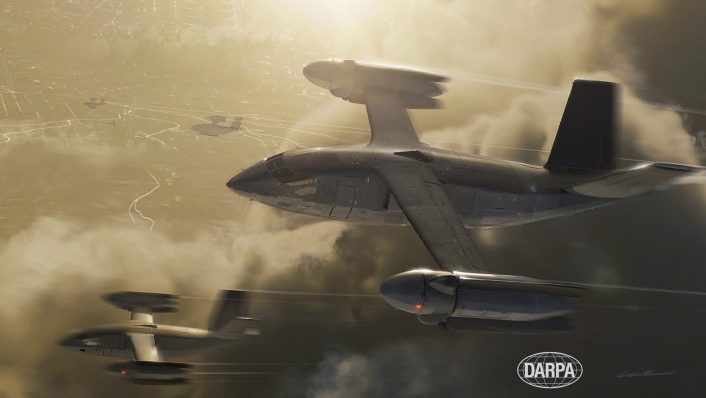
“The design, construction, and flight testing of the X-76 will drive innovative, runway-independent, vertical-lift capability with jet-like cruise performance and inform future needs,” says DARPA. The technologies that will be validated by this demonstrator can be scaled to different size military aircraft, further says the agency.
The goal of the program is to provide these aircraft with the ability to cruise at speeds from 400 to 450 knots at relevant altitudes and hover in austere environments from unprepared surfaces.
“For too long, the runway has been both an enabler and a tether, granting speed but creating a critical vulnerability,” said Cmdr. Ian Higgins, U.S. Navy, serving as the DARPA SPRINT program manager. “With SPRINT, we’re not just building an X-plane; we’re building options. We’re working to deliver the option of surprise, the option of rapid reinforcement, and the option of life-saving speed, anywhere on the globe, without needing any runway.”

The initial Phase 1A of the program was launched in November 2023, leading to conceptual design reviews. In May 2024, Bell and Aurora Flight Sciences were down-selected and awarded contracts for Phase 1B, with approximately one year to complete preliminary design work for their aircraft.
Phase 2 was launched in May 2025, and a month later Bell Textron was awarded a contract for Phases 2 and 3. The program has now shifted focus to manufacturing, integration, assembly, and ground testing of the X-76 demonstrator, ahead of flight testing during Phase 3 in early 2028.
Bell’s Demonstrator
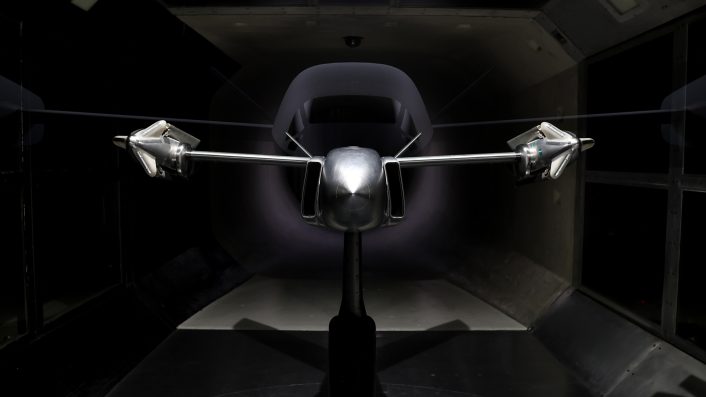
Bell has previously shown photos of the model used during wind tunnel testing at the National Institute for Aviation Research (NIAR) at Wichita State University.
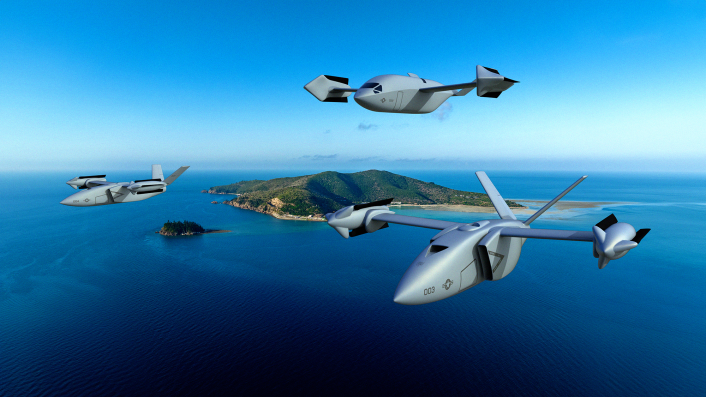
The aircraft, similarly to standard tiltrotors, has two wings with compact rotor nacelles. The main difference is what Bell has called the Stop/Fold rotor system, which features fold-away rotor blades, suggesting a significant focus on reducing drag and optimizing for high-speed and efficient airflow.
The central body appears sturdy, likely designed for stability during high-speed maneuvers or transitions. The aircraft also features two tails canted outwards, just above the engine’s nozzle.
According to Bell, the Stop/Fold system allows aircraft to fold and unfold rotors as well as rotor blades mid-flight, blending helicopter-like versatility with jet-like speed. Wind tunnel tests were described as critical in proving this concept works, as they verified the aircraft’s stability and control as it transitions through rotor folding and unfolding during flight.
source