


In the aftermath of Operation El Dorado Canyon, the Lockheed SR-71 Blackbird was sent across Qaddafi’s ‘Line of Death’ for a high-risk overflight of Libya to deliver critical battle damage assessment.
After a joint strike mission conducted by United States Air Force (USAF) and United States Navy (USN) aircraft on key Libyan targets, it was imperative to learn the effects of the attack. Post-strike reconnaissance providing battle damage assessment (BDA) intelligence was eagerly awaited by Pentagon officials, but would require crossing Qaddafi’s ‘Line of Death’, and only one aircraft had the performance and capabilities to provide such information quickly and relatively safely: the Lockheed SR-71 Blackbird.
Operation El Dorado Canyon
Libyan strongman Muammar Qaddafi had repeatedly been a thorn in the side of the United States and her allies for years, thought to be a sponsor of terrorist organizations as well as training militants to carry out terrorist acts. Qaddafi had declared territorial rights over much of the international waters of the Gulf of Sidra, daring the United States to cross his ‘Line of Death’.
The April 5, 1986 bombing of a West Berlin discotheque, known as La Belle and often frequented by United States service personnel, killed two Americans and a Turkish woman, and wounded 229 others, 79 of those being Americans. United States President Ronald Reagan accused Libya of being behind the attack, citing intelligence gathered from intercepted communications from the Libyan embassy in East Berlin and Tripoli.
Reagan ordered strikes against Libya. The operation would be known as El Dorado Canyon.

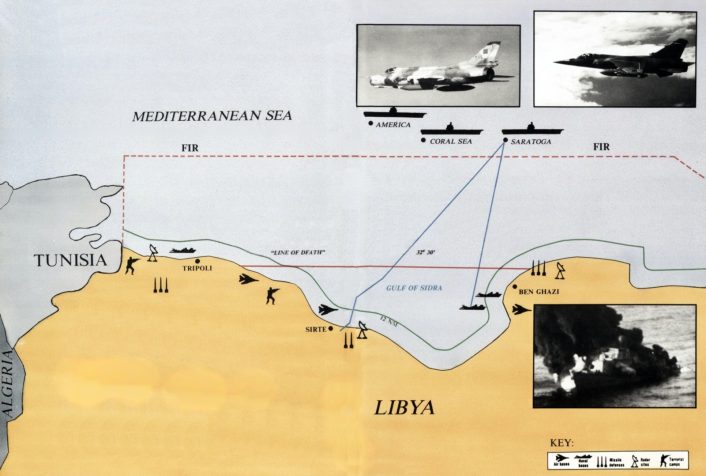
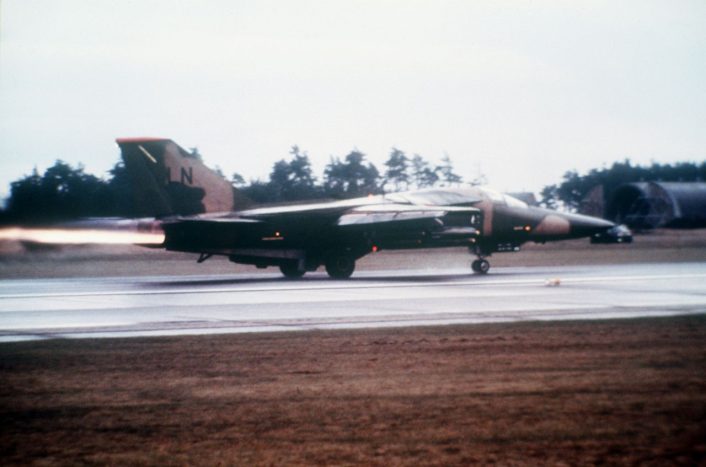
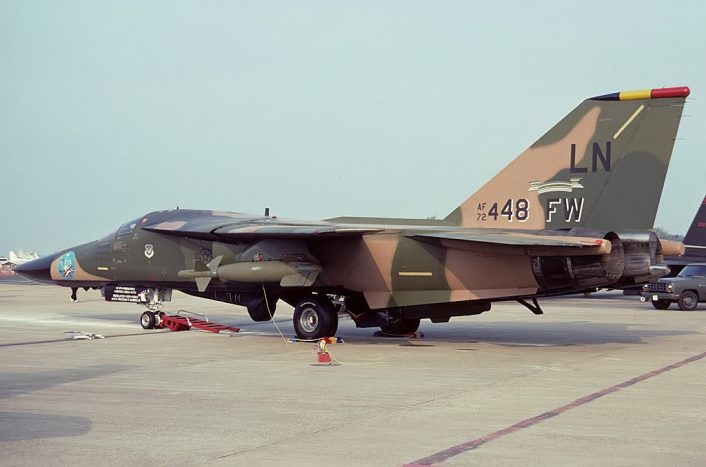
Air elements of both the United States Navy (USN) and the United States Air Force (USAF) would attack Libya on April 15, 1986. The USAF force would include 24 General Dynamics F-111F Aardvark fighter-bomber aircraft stationed at RAF (Royal Air Force) Lakenheath with the 48th Tactical Fighter Wing, along with five EF-111s from the 20th Tactical Fighter Wing at RAF Upper Heyford equipped with jamming equipment to blind Libyan radar and air defenses. Six F-111s and one EF-111 would be spares. Multiple KC-10 and KC-135 tankers would also be used for air refueling support.

Naval and Marine Corps assets would include aircraft from two carriers, the USS America (CV-66) and USS Coral Sea (CV-43). A total of 14 Grumman A-6E Intruder strike aircraft along with 12 McDonnel Douglas F/A-18, six Ling-Temco-Vought A-7E Corsair IIs , and a EA-6B Prowler would partake in the raid. Navy aircraft were assigned targets in the Benghazi area, including a suspected terrorist training camp and Benina Airfield. Grumman F-14 Tomcats provided fleet air defense.
The Air Force F-111s departed Lakenheath April 14 at 17:36 Greenwich Mean Time (GMT) and would have a lengthy flight of over 6,400 miles round-trip, logging 13 hours in the air while requiring multiple in-flight refueling sessions. British Prime Minister Margaret Thatcher had allowed the U.S. use of the base to launch the attack, however other American Allies such as France and Spain had denied use of their airspace, forcing the planes to fly all the way around Europe, needle through the Strait of Gibraltar, and dash east across the Mediterranean Sea to their targets in Tripoli. Their targets included a suspected naval terrorist training base, military aircraft at the Tripoli Airport, and a compound known as the Azziziyah Barracks containing a residence and tent frequented by Qaddafi.

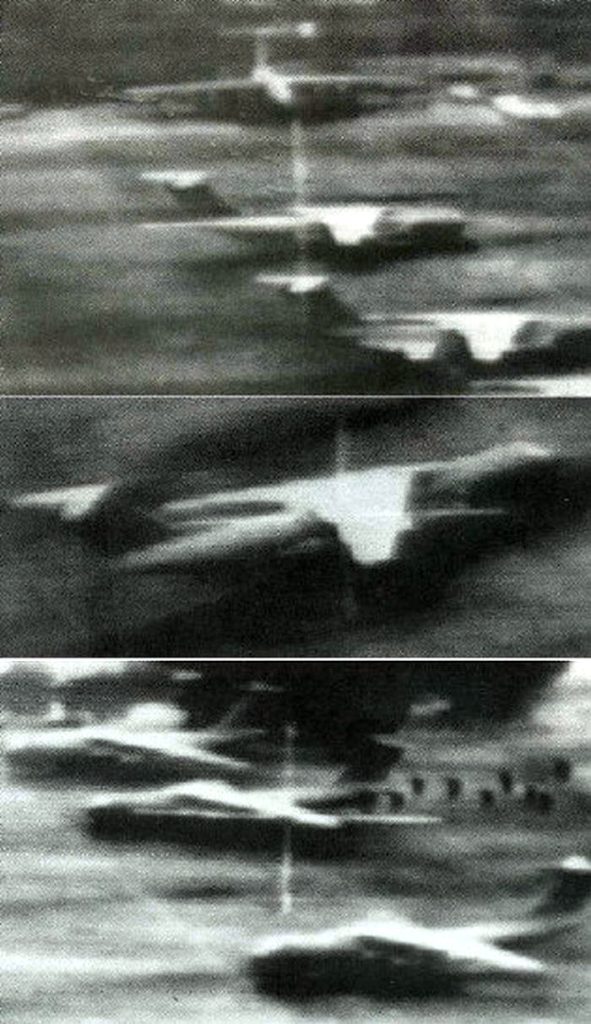
Adhering to strict Rules of Engagement (ROE), the six flights of three F-111s found Tripoli at close to midnight GMT. The EF-111 conducted electronic countermeasures while the Navy planes provided surface-to-air missile (SAM) suppression. Navy aircraft attacked the Benina Airfield and military barracks near Benghazi while the F-111s pounded the air base and Azziziyah barracks and targets around Tripoli.
All Navy aircraft returned to their carriers, one F-111 went down with the loss of both crewmen. Libya had advanced sophisticated and effective air defenses, and they were ready when the American planes arrived. Immediate results were fuzzy and getting battle damage assessment reports and photos of the aftermath of the raids was going to be a challenge.
The Need for Speed
The United States had previously secured permission to operate Lockheed SR-71 Blackbird spy planes at RAF Mildenhall beginning in 1976. On April 5, 1982 Prime Minister Margaret Thatcher announced that Detachment 4 (Det 4) of the 9th Strategic Reconnaissance Wing (SRW) would be a permanent SR-71 detachment with two aircraft assigned, allowing flights classified as ‘routine’ to be flown without British authorization, while those of more sensitive nature still fell under the restrictions requiring approval.
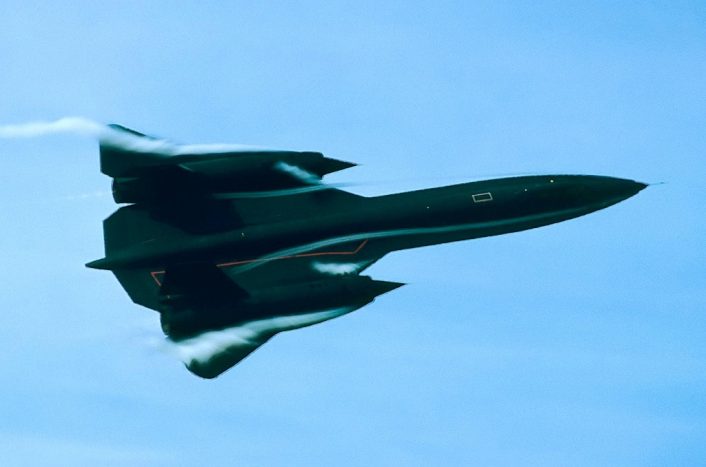
The aircraft of Det 4 would be tasked with providing reconnaissance of the damage inflicted by El Dorado Canyon. At 0500 SR-71 number 61-7980 departed Mildenhall and linked with two tankers off the southwest corner of England, topping-off the Blackbird with JP-7. Flown by Lt. Colonel Jerry Glasser and Lt. Colonel Ron Tabor, this aircraft was backed up by a second aircraft in the event of an abort or equipment failure.
SR-71 number 64-17960 would leave Mildenhall at 0615 hrs flown by Maj. Brian Shul and Maj. Walt Watson and rendezvous with tankers as they replicated the route flown by Glasser and Tabor. Shul spotted the returning F-111s approaching head-on several thousand feet below. The F-111 flight leader rocked his wings in recognition with Shul returning the salute rocking the wings of the big Blackbird.

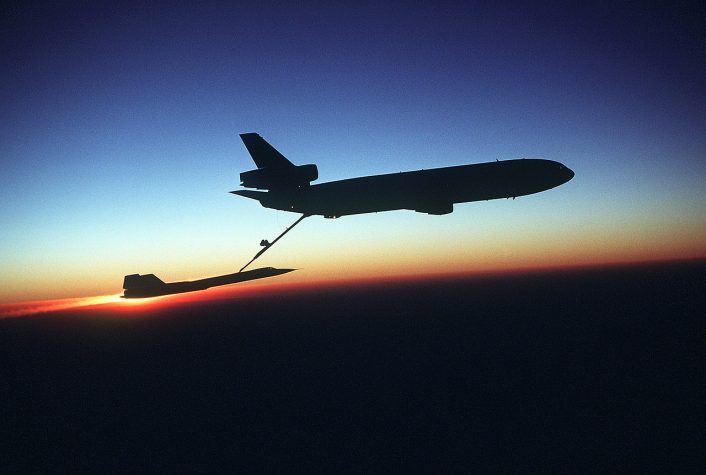
Equipped with chin-mounted Technical Objective Cameras (TEOCs) for spot coverage and an Optical Bar Camera (OBC) nose-mounted camera for coverage from horizon to horizon, the SR-71s would arrive six hours after the initial attacks by the F-111s and Navy aircraft. This meant the entire air defense network of Libya was on full alert and looking for an opportunity to even the score.
Maj. Shul records in his book Sled Driver Watson and him shooting past Qaddafi’s ‘Line of Death’ in the Gulf of Sidra at 2,125 miles per hour or close to Mach 2.8. Once over Libya and deep into Libyan airspace, the Blackbird was fired upon when nearing the final turn. The Libyans had launched SA-2 and SA-4 SAMs capable of reaching Mach 5.

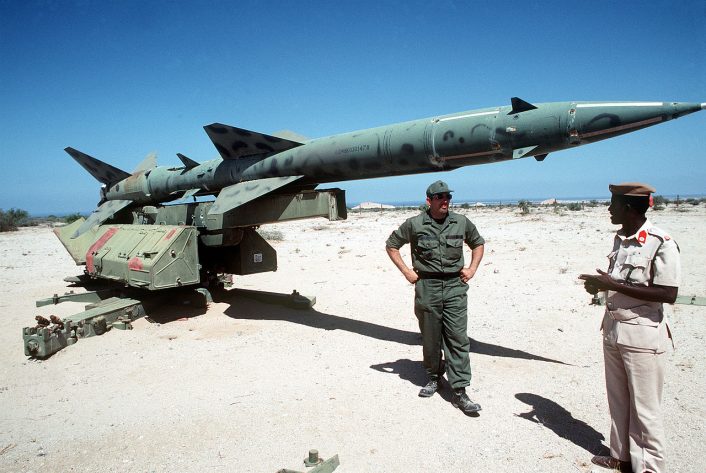
As launch signals alerted RSO (Reconnaissance System Officer) Watson, Shul increased speed and began calculating the time it would take for the missile to reach their altitude. Shul estimated they could make the final turn towards the Mediterranean and stay on course, beating the missiles. The Blackbird blasted along, the aircraft pushing past its Mach 3.2 ‘limit’.
Shull coaxes the SR-71 past Mach 3.3 then 3.45. Cresting at 80,000 ft now at Mach 3.5 and making the turn, the Blackbird heads toward the sea speeding past Tripoli, defeating any missiles fired at it. Pulling the throttles back south of Sicily, 960 refuses to slow at first and eventually overruns the tanker waiting for it near Gibraltar.
Aftermath
Additional sorties from Det 4 were carried out the following days with the same crews in order to obtain accountability for all weapons dropped. Clouds had blinded the cameras on the early attempts around Tripoli, however eventually all weapons dropped were accounted for. This time of intense reconnaissance missions had seen the first time both of Det 4’s SR-71s were airborne simultaneously.

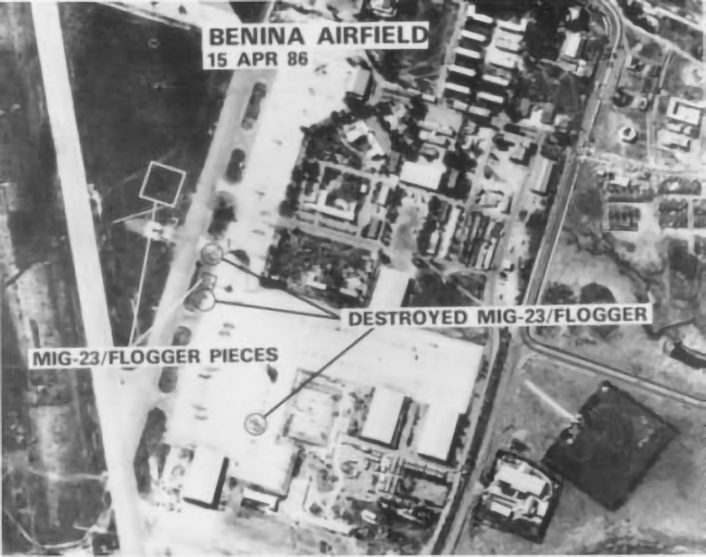
Intelligence collected by the Blackbirds demonstrated the effectiveness of the raid, with all targets being struck. At Benina Airfield four MiG-23 fighters, two Fokker F-27s, and a pair of Mil Mi-8 helicopters were destroyed by the Navy aircraft. Al Jamahiriyah Barracks was also hit.
Despite only a few of the 18 F-111s successfully dropping their bombs, the airport in Tripoli was struck with the destruction of six Il-76s, as well as a Boeing 727 and G.222. Other smaller aircraft lost included two Twin Otters, two Cessna 402s and two Cessna 152s. Qaddafi’s headquarters at Al Azziziyah Barracks and the Sidi Bilal suspected terrorist training camp were also hit.
Six F-111s aborted dropping due to technical issues or the strictness of the ROE. Seven missed their targets, causing collateral damage along with spent SAM boosters falling back to earth. One controversial bomb landed near the French Embassy, with many claiming at the time it was intentional payback for France refusing the use of her airspace for the raid.
Thirty-seven civilians were killed along with several others injured. The raid also personally touched Qaddafi with reports of the loss of an adopted daughter and damage to one of his residences. Reports even circulated that he had been injured by flying debris in the shoulder.
The SR-71 had once again proven it could conduct needed reconnaissance in the most hostile environments by utilizing its high altitude capabilities and blazing speed coupled with well-trained and brave crewmembers. Blackbirds would be called again to Libyan airspace in August 1987 in search of rumored Soviet provided MiG-29 ‘Fulcrums’, but the aircraft type was not found at that time.
source