


The Y-9FQ ‘High New 15’ made its debut at the Sep. 3, 2025, Victory Day parade in Beijing, and has now been intercepted for the first time by Japan.
A Chinese People’s Liberation Army Naval Air Force (PLANAF) Y-9FQ maritime patrol and anti-submarine warfare aircraft was intercepted for the first time on Mar. 28, 2026 by the Japan Air Self-Defense Force (JASDF) over the East China Sea. As identified by Chinese military aviation observers, the aircraft made its maiden public appearance during the Sep. 3, 2025, Victory Day parade in Beijing.
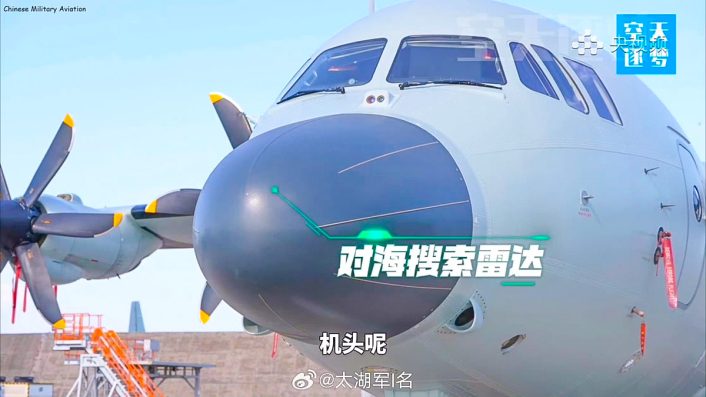
Reporting the incident on Mar. 30 on X, the Japanese Ministry of Defense’s Joint Staff released images of the Chinese aircraft captured by the pilots of the fighters that were scrambled upon detection of the Y-9FQ. The statement noted the Y-9FQ’s unique nose shape, noting this was the first time such a Chinese military special mission aircraft was intercepted.
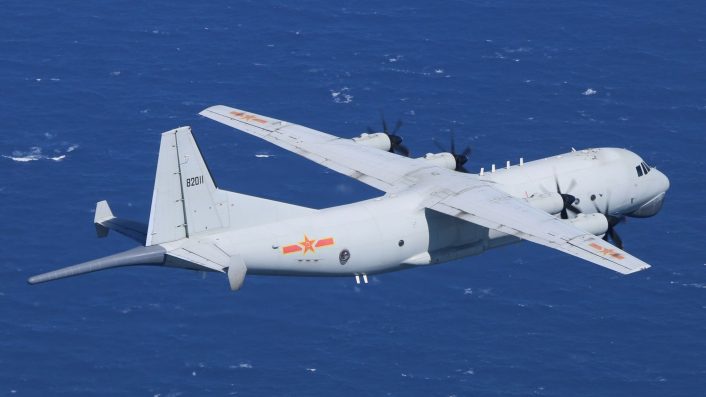
An older Y-8, appearing to be a KQ-200 ASW-MP/MR aircraft, was also spotted in the same intercept. Both aircraft share the same elongated tail-end ‘sting’ Magnetic Anomaly Detector (MAD) antenna for hunting submarines.
This follows a series of interceptions in the preceding days, with the Japanese military tracking and escorting two Russian Tu-142 ASW-MR aircraft on Mar. 27 while they transited between the Sea of Okhotsk to the Sea of Japan. Japan also reported a Russian Navy, a Balzam-class “intelligence collection ship,” travelling between the Tsugaru Strait and the Sea of Japan.
As it seems, for the first time the JASDF met one of the new Y-9FQ (High New 15) next generation ASW aircraft and they seem to be a bit surprised!https://t.co/ylYytaz0BD pic.twitter.com/5jpfBsoFuD
— @Rupprecht_A (@RupprechtDeino) March 30, 2026
However, the most provocative intercept – at least this year – remains the Mar. 17 flight of two MiG-31s armed with Kh-47M2 Kinzhal hypersonic missiles over the Sea of Japan. The MiGs were a part of a five-aircraft package including an Il-78M tanker, and two Su-30 fighters. The Japan Self-Defense Forces (SDF) were also at the time tracking a Russian Navy Udaloy-III class destroyer.
PLANAF Y-9FQ intercepted
The statement from the Japan MoD said:
“On March 28, the Air Self-Defense Force’s Southwest Air Defense Force’s fighter aircraft conducted scramble operations in response to one Chinese military patrol aircraft (Y-9) that flew over the East China Sea.
Regarding the Chinese military patrol aircraft (Y-9), flights have been confirmed in the airspace around the East China Sea and other areas in the past, but the aircraft confirmed this time has a different shape in the nose (frontmost part) compared to previous aircraft, and this is the first time the Self-Defense Forces have confirmed and announced such an aircraft.
The Ministry of Defense and the Self-Defense Forces will continue to collect information and conduct vigilance and surveillance 24 hours a day on military movements around our country, while taking all possible measures against airspace violations.”
還得是御用攝影師出品 https://t.co/TFU1yHS7IN pic.twitter.com/y2935qocCp
— 🔪飞刀🔪 (@chaoyinsukandao) March 30, 2026
The other Y-9/Y-8 ASW aircraft is distinguished by a dome under the nose and also has a longer MAD ‘sting’. As per the Chinese Military Aviation (CMA) blog, the Y-9 was rumored to have been developed by the Shaanxi Aircraft Corporation (SAC) since 2020 as a next generation ASW aircraft, before it was finally unveiled during the Sep. 3, 2025 parade.
The elongated nose is said to have an Active Electronically Scanned Array (AESA) radar capable of air-to-air, air-to-ground and synthetic aperture radar (SAR) surveillance modes.
Y-9FQ対潜哨戒機
(お互いに)よく見てる。 https://t.co/k1Nhl3s3Mk pic.twitter.com/FGlvyvoaC8— お砂糖wsnbn (@sugar_wsnbn) March 30, 2026
CMA also mentions the presence of an Electro-Visual System (EVS) under the windshield; air intakes behind the nose to cool the AESA radar; a SATCOM antenna on top of the mid-fuselage; ESM antennas on the wingtips; and new type of Missile Approach Warning Sensors (MAWS) on the front fuselage, tail and top of the rear fuselage.

The JASDF’s Nyutabaru Air Base in Miyazaki Prefecture, closest to the intercept region in the ECS, could have been involved in the scramble. It is home to the JASDF’s 305th Tactical Fighter Squadron, which operates the F-15Js.
The track released by the JMoD shows both the intercepted aircraft flying circuitous tracks in the middle of the ECS, with observers pointing out that the plane operated at the boundary of Japan’s Exclusive Economic Zone (EEZ) and was possibly tracking a Japan Maritime Self-Defense Force (JMSDF) submarine.
Close up of the 🇨🇳 PLANAF Y-9FQ (High New 15) 91 #7A438B from the 80th Victory Day Parade in Beijing Wednesday. https://t.co/9Dy73nuzuT pic.twitter.com/1YB21S5Vgh
— Evergreen Intel (@vcdgf555) September 6, 2025
Russian spy ship and Tu-95 Bear
As for the Balzam-class SIGINT vessel of the Russian Federation Navy tracked from Mar. 27 to 28, the MoD said that it proceeded “eastward through the connecting waters around the Tsugaru Strait, turned around and navigated westward through the same waters toward the Sea of Japan.” The JMSDF tracked and monitored the vessel with the JS Izushima and JS Suou vessels, and a P-3C of the 2nd Air Group.
The two Tu-95 Bears on Mar. 27, meanwhile, flew from the Pacific Ocean via the Sea of Okhotsk to the Sea of Japan, reaching as far as off the coast of Akita Prefecture. The JASDF’s Northern Air Defense Force then scrambled its jets, with the MoD releasing an image of one of the aircraft.
令和8年3月27日から28日にかけて、ロシア海軍バルザム級情報収集艦が、津軽海峡周辺の接続水域内を東進した後、反転し、同海域を西進して日本海へ向けて航行したことを確認しました。#防衛省・自衛隊… https://t.co/ezB6ZLbIp4 pic.twitter.com/pfR3jXDdFw
— 防衛省・自衛隊 (@ModJapan_jp) March 30, 2026
Conclusion
It must be noted that the base Shaanxi Y-9 is also the carrier aircraft for the KJ-500 and KJ-700 Airborne Early Warning and Control (AEW&C) aircraft, and at least five electronic warfare/electronic/signals intelligence (EW/ELINT/SIGINT) types. Both the KJ-500 and the KJ-700 also share the Y-9FQ’s elongated nose.
We have touched upon China’s massive array of special mission aircraft, especially in the airborne early warning class that also includes the new KJ-3000, the older KJ-2000, the KJ-200, the naval KJ-600 – able to operate from the CNS Fujian – and the unmanned WZ-9 Divine Eagle AEW.
Primarily, this offers redundancy in case of losses. Secondly, the presumably standardized data-linking and staple ISR and ELINT functionality among all its aircraft affords China a permanent and persistent theatre-wide situational awareness.
令和8年3月27日(金)ロシアの哨戒機(Tu-142)×2機が、太平洋からオホーツク海を経由して日本海を秋田県沖まで飛行し、これに対して航空自衛隊の北部航空方面隊等の戦闘機を #緊急発進 させ対応しました。#JASDF #スクランブル pic.twitter.com/f8xatmN60Q
— 防衛省統合幕僚監部 (@jointstaffpa) March 27, 2026
This is seen in the presence of a ventral Electro-Optical (EO) ball turret on both the Y-9s – also a feature on the P-8A Poseidon, which is the mainstay of the combined long-range maritime patrol, ASW, strike and secondary electromagnetic sensing roles in the Allied joint force.
As we had discussed in our previous report and the Kinzhal-armed MiG-31s, the sudden surge in Chinese and Russian military flights provoking Japanese and South Korean intercepts has little to do with the events in West Asia.
Russian and Chinese jets have been flying joint patrols over the region for a few years now, with the last such combined flight reported by Japan and South Korea on Dec. 9, 2025. These usually consist of Russian Tu-95 Bear bombers, A-50 Airborne Early Warning and Control (AEW&C) aircraft, Su-30 fighter jets, together with Chinese J-16 fighter jets and H-6K/N bombers.
China-Japan relations have been deteriorating lately, with Beijing on Mar. 30 sanctioning PM Sanae Takaichi’s aide for trips to Taiwan, which China considers sovereign territory.
source