


Editor’s note: Boeing spent years doing rework on the 737 MAX and the 787 after the former’s grounding following two fatal crashes and the latter’s production flaws. “Shadow factories” began the 737’s rework after the 21-month grounding was terminated in November 2020. The last of 450 airplanes was delivered in 2025. Deliveries of the 787 were suspended in October 2020; 110 aircraft needed rework. The last of this inventory was cleared in 2025. This work is also known as “Change Incorporation.” Thirty-five 737 MAX 7s and 10s have been built and await certification, which idepends on design changes that must be retrofitted once the Federal Aviation Administration signs off. Change incorporation took 3-4 months for the 787s and was measured in months for the 737s.
More than 30 777-9s have been built while this program awaits FAA certification. This, too, will require Change Incorporation. Boeing has not revealed what changes the FAA will require, although revised flight control software is known to be one element. Nor has Boeing revealed how long Change Incorporation for the 777-9s will take.
LNA’s news team explains what Change Incorporation is, how it is undertaken, and the implications for the 777-9s in inventory.
Subscription Required
By the Leeham News Team
March 18, 2026, © Leeham News: In the commercial aviation industry, building aircraft before the type certificate is formally issued is not unusual. It is an economic necessity.

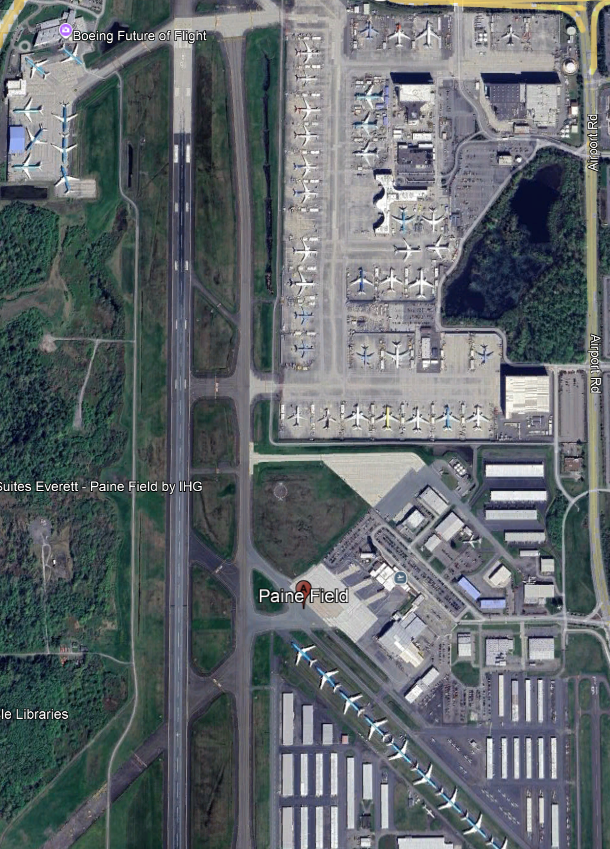
Undelivered Boeing 777-9s (among other aircraft) are lined up in open-air storage in this undated 2025 Google Earth photo of Paine Field, Everett (WA). The 777s are the “green” airplanes, though more are also painted in other colors.
Launching a production line months or years before final regulatory approval allows manufacturers to meet early delivery commitments, recoup development investment more quickly, and maintain customer relationships. But this strategy carries a profound and often underestimated technical liability: when the approved design specification continues to evolve through flight test, the already-built airframes must be brought into conformance with the final certified configuration. This is the essence of the Change Incorporation process.
The Boeing 777X program offers the most current illustration of this challenge. As of early 2026, Boeing has assembled more than 30 777-9 airframes, all built to early-production standards, while the aircraft’s type certificate is still in progress.
At the same time, the January 2024 in-flight separation of a door plug from Alaska Airlines Flight 1282—an event traceable directly to failures in Boeing’s parts removal and reinstallation process—has thrown the Change Incorporation process into the spotlight.
These two stories are connected by a single systemic thread: the consequences of inadequate configuration discipline in a complex, multi-stakeholder manufacturing environment.
source