


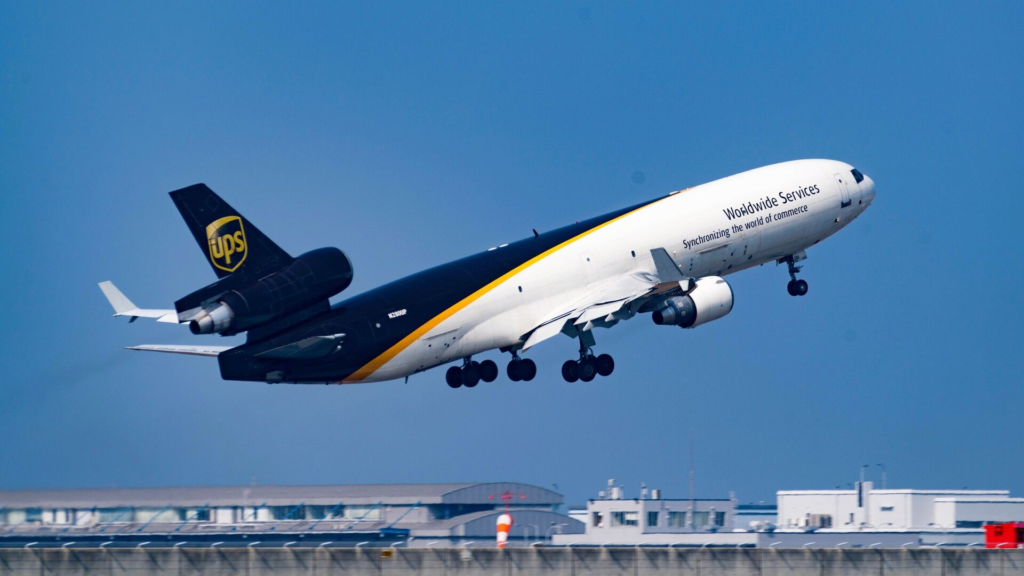
The tragic crash yesterday of UPS Airlines Flight 2976 has left nine people dead with at least another 11 seriously injured. The McDonnell Douglas MD-11 lost its No. 1 engine (left side) during takeoff from Louisville Muhammad Ali International Airport and crashed just south of the airfield at 17:13 EST.
For many, the accident appears eerily similar to the crash of American Airlines Flight 191 in 1979. Operated by a McDonnell Douglas DC-10, the forerunner to the MD-11, that aircraft also experienced a full detachment of its No. 1 engine while taking off from 

Infamous Engine Separation Accidents


Commercial jet aircraft have long been designed to survive the separation of an engine via ‘controlled failure’ systems. Fuse pins in the engine pylons are engineered to be strong enough to handle normal operational forces, but to shear off cleanly in the event of extreme, abnormal forces. This controlled release ensures the engine falls away cleanly, preventing further catastrophic damage to essential systems such as hydraulic lines, electrical wiring, or fuel lines.
However, this is not what happened with 
|
Notable Fatal Accidents Caused By Engine Separations |
|||
|
Date |
Flight |
Aircraft |
Details |
|
May 25, 1979 |
American Airlines Flight 191 |
DC-10 |
A maintenance error damaged pylon fittings, and the engine detached under takeoff loads, leading to left-wing slat retraction and loss of control. |
|
December 29, 1991 |
China Airlines Flight 358 |
747-200F |
Fatigue and structural failure of pylon mid-spar fittings. The No. 3 engine separated, hit the No. 4 engine, and destroyed the right wing. |
|
October 4, 1992 |
El Al Flight 1862 |
747-200F |
Corrosion-fatigue cracking of fuse pins and mid-spar fittings on right-wing pylons, resulting in the loss of No. 3 and No. 4 engines. |
Another notable accident due to the complete separation of an engine was China Airlines Flight 358, a 747-200F that lost its No. 3 engine shortly after takeoff from Taipei Taoyuan International Airport due to pylon fatigue. The detached engine struck and dislodged the No. 4 engine, causing massive wing damage and a crash into a hillside, claiming all five crew members.
Less than a year later, another 747-200F operating El Al Flight 1862 from Amsterdam suffered a similar separation of two engines. The No. 3 engine separated shortly after takeoff due to fatigued fuse pins, which then hit and detached the No. 4 engine. Wing and hydraulic damage rendered the plane uncontrollable, crashing into an apartment block and killing 43 people. The accident is remembered for the haunting final messages from the doomed crew:
“El Al 1862, mayday, mayday, we have an emergency! We have lost number three and number four engine, number three and number four engine! Going down, 1862, going down, going down, copied, going down.”
Engine Separations Are Survivable


Despite the grim precedents, several incidents demonstrate that survival is possible when design redundancies and crew expertise align. A notable case is Japan Airlines Cargo Flight 46E in 1993, a Boeing 747-100F freighter that lost its No. 2 engine due to fatigue cracks and severe turbulence. Fortunately, the engine sheered off cleanly, and the crew executed an emergency landing at Anchorage International Airport with no injuries to the five aboard.
|
Notable Safe Landings After Engine Separations |
|||
|
Date |
Flight |
Aircraft |
Details |
|
March 31, 1992 |
Trans-Air Service Flight 671 |
707-320C |
Metal-fatigue fracture in the pylon during cruise allowed the No. 3 engine to separate. It struck No.4 and tore it off, but the aircraft landed safely at Istres-Le Tubé Air Base with no injuries. |
|
March 31, 1993 |
Japan Airlines Flight 46E |
747-100F |
The No.2 engine and pylon detached during initial climb-out due to fatigue cracks, but the aircraft landed safely back at Anchorage with no injuries. |
|
November 7, 2007 |
Nationwide Flight 723 |
737-200 |
The No. 2 engine and pylon assembly separated from the wing during take-off. The aircraft performed a successful emergency landing back at Cape Town about 15 minutes later. |
Another example is Nationwide Airlines Flight 723, a Boeing 737-200 from Cape Town, which suffered right engine detachment during takeoff rotation due to a fatigued mounting bolt. The pilots orbited to dump fuel, managed hydraulic leaks, and landed safely back at the airport, evacuating all 112 aboard without harm.
What is notable, however, is that in these incidents the engine separation didn’t cause catastrophic damage to the wing or the aircraft systems. They also occurred at a higher altitude than American Airlines Flight 191 or UPS Flight 2976, which gave the pilots more space and time to react and recover the aircraft.
Measures To Mitigate Engine Separation Risks

Aviation authorities and manufacturers have implemented rigorous measures to mitigate engine separation risks, focusing on prevention, detection and response. These include:
- Third-generation fuse pin designs with straight bores and thicker walls to eliminate fatigue-prone features.
- Shifting to fail-safe struts with dual-side links, titanium fittings, and enhanced corrosion resistance
- Increased segregation of critical systems, routing hydraulics and electrics away from potential separation paths
- Advanced materials like composites are being used to enhance pylon durability.
- Real-time monitoring via ACARS to detect vibrations early
- Maintenance protocols now include ultrasonic inspections for fatigue cracks in mounts and bolts
However, there is always the risk of human error, and early indications are that might be a factor with UPS Flight 2976, as the No. 1 engine was being worked on immediately prior to the departure of the aircraft. Aviation Herald reports the following:
“Ground observers reported the aircraft had been delayed for about two hours for work on the left-hand engine (engine #1), the same engine #1 that separated during the takeoff run.”
This will undoubtedly be a core starting point for the National Transportation Safety Board (NTSB) investigation that has now begun. We will need to wait to see the results of that, and whether the similarities to American Airlines Flight 191 run any deeper. As one person on Aviation Herald commented: “I pray they did not use a forklift for the installation of the engine.”
source