


Following the Belgian Air Force’s announcement in March about the testing of Thales Belgium’s laser guided rockets from its F-16s, footage now shows the trials in the Counter-UAS role.
Weeks after the Belgian Air Force confirmed the ongoing integration of the FZ275 Laser-Guided Rockets on its F-16s for the Counter-Unmanned Aerial Systems (C-UAS) role, the service released on Apr. 30 footage of the tests, showing the Fighting Falcons using the rockets to swat down target drones.
While it is not known when the tests took place, Belgian Defence identified the location as Lomardsijde, off the southern part of the North Sea in the country’s northwest, and specified that the rockets used were inert. Belgian Defence said on X: “The Air Force tested at Lombardsijde a capability against medium-sized drones. In collaboration with the Land Component, the Navy, and Thales Belgium: FZ275 70 mm rockets without warhead on F-16, an effective and affordable solution against the UAS threat.”
La Force aérienne a testé à Lombardsijde une capacité contre des drones de taille moyens. En collaboration avec la Force terrestre, la Marine et Thales Belgium : des roquettes FZ275 70 mm sans charge sur #F16, solution efficace et abordable contre la menace UAS pic.twitter.com/IQcKSHANmU
— Belgian Defence (@BelgiumDefence) April 30, 2026
The Belgian Air Force operates 43-44 F-16AM/BM Fighting Falcons. It is also an F-35A Lightning II customer, with a total order of 34 aircraft, and has planned to acquire 11 more. Eleven F-35s have so far been delivered, with eight stationed at Luke AFB, Arizona, for the training of new F-35 pilots.
The test
The video released by the BAF shows one of the F-16s being used in the trial, armed with at least two seven-shot LAU-131A/A pods on the port (left-side) wing. Two different shots of that wing shows each of the pods carrying only one Thales Belgium 2.75 inch/70 mm FZ275 LGR in different tubes, suggesting the video shows multiple sorties of the test campaign.

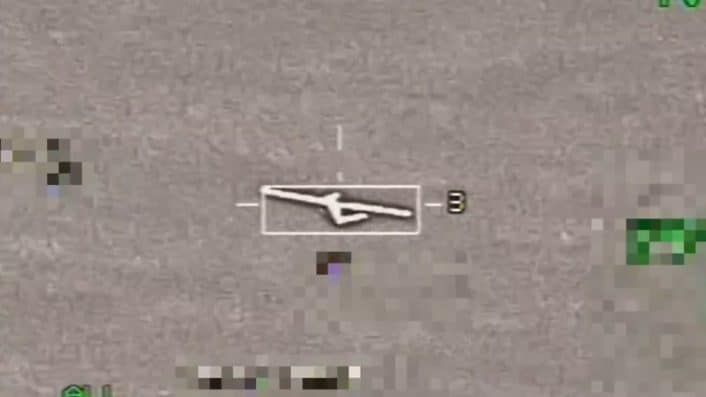
Footage from the cockpit then shows a rocket leaving one of the pods and striking an unidentified drone, as seen in the targeting pod’s infrared footage.
In the testing reported by Belgium’s Directorate General of Material Resources (DGMR) on Mar. 11, 2026, the F-16 captured at Kleine Brogel Air Base was carrying six LAU-131A/A pods, which give the aircraft a 42-round capacity. The Directorate at the time also said that the FZ275 was being tested alongside BAE Systems’ AGR-20F FALCO (Fixed Wing, Air Launched, Counter-Unmanned Aircraft Systems Ordnance) for the C-UAS role.
Tijdens recente conflicten hebben we gezien dat goedkope attack‑drones immense schade kunnen aanrichten. Klassieke luchtafweermiddelen inzetten tegen dit soort dreiging is vaak extreem duur.
— Material Resources (@DGMR_News) March 11, 2026
Lessons from Ukraine
Given that the Belgian system will primarily be used in the European theater, where the Russia-Ukraine war has thrown up its own lessons in asymmetric drone warfare, an overview of that conflict is warranted.
As we have noted in our previous coverage about larger platforms using cost-effective weapons like laser-guided rockets or on-board guns on helicopters to engage smaller asymmetric threats, the cost-asymmetry still persists. In fact, while the launching platform is worth tens of millions, the drones are less than $50,000, with some ultra-cheap ones fielded by Ukraine and Russia in the $5,000-$10,000 range.
What is believed to be the first known footage showing an F-16 fighter jet operated by the Ukrainian Air Force intercepting a Russian Shahed/Geran-type long-range OWA-UAV with the APKWS II low-cost, laser-guided anti-aircraft rockets.
Such rockets are carried in LAU-131 rocket… pic.twitter.com/JTsCsgQ7NP
— Status-6 (War & Military News) (@Archer83Able) February 17, 2026
Airbus’ Bird of Prey interceptor drone, firing the Mark-1 air-to-air missile, is a more suitable option for the European theater in case NATO countries adopt that system. It would equate the cost of both the launching platform, the weapon and the unmanned target.
Only Ukraine, with measures like traditional ground-based anti-aircraft guns, interceptor drones, and electronic warfare, has significantly brought down the cost of intercepting Russian OWA UAVs. In some cases Ukraine has even flipped the cost-asymmetry, shooting down Russia’s prized Kamov Ka-52 Alligator attack helicopter with an FPV drone, a video that emerged on Mar. 20 showed.
Moment a Ukrainian FPV drone catches a Russian Ka-52 attack helicopter.
The drone flies into the weapons mounted on the wing, likely causing a detonation. https://t.co/OPenDHBPgi pic.twitter.com/AbEqQzfG92
— Woofers (@NotWoofers) March 20, 2026
Then another video late in April showed a Ukrainian FPV destroying a Russian Mi-17 and a Mi-28 Havoc attack helicopter on the ground, in the encounter that was reported to have taken place in Voronezh, 150 km from the frontline. A recent measure was using a similar interceptor drone, the P1-Sun mounted on an older Antonov An-28 turboprop aircraft to hunt down Russian Gerans in the night.
🇺🇦🇷🇺 Ukraine destroyed a Russian Mi-28 attack helicopter and an Mi-17 transport helicopter in Voronezh, 150 km from the front line.
You can’t let your guard down in modern warfare, no matter how far you are from the enemy.pic.twitter.com/f9UjqQUZcm
— Mario Nawfal (@MarioNawfal) April 29, 2026
Ukraine too used outsized measures like APKWS-armed F-16s and French Mirage 2000s to shoot down Russian drones long-range cruise missiles. Its wholly asymmetric measures like small interceptor drones such as the Sting, launched from both the ground and the air, appear to be the main countermeasure against drones, and they have been also responsible for downing a few R-60 AAM-armed Geran-type One-Way Attack (OWA) drones.
source