


Four U.S. Air Force B-1B Lancer bombers arrived at RAF Fairford as the U.S. looks to “surge dramatically” the operations over Iran.
After the UK allowed the U.S. to use RAF Fairford and Diego Garcia for the deployment of U.S. Air Force bombers currently involved in operations over Iran, the first four B-1B Lancer bombers arrived in the UK. A first bomber arrived in the evening of Mar. 6, 2026, followed the next morning by the more bombers.
Notably, the first B-1B arrived directly from the U.S. after crossing the Atlantic Ocean, while the other three arrived after completing a mission over Iran. It is unclear if additional bombers will be deployed to RAF Fairford.
1 x USAF B-1 arrival into RAF Fairford this afternoon 🛬 pic.twitter.com/Lcq6ytHUpG
— Planes Out The Window ✈️ (@window_planes) March 6, 2026
The new development arrives after the U.S. Secretary of Defense Pete Hegseth said this week that strikes on Iran are “about to surge dramatically.” On Mar. 6, the Pentagon has also published new photos showing both B-1Bs and B-52H Stratofortress bombers during the ongoing operations, with the latter showing a full load of AGM-158 JASSM missiles.
PIKE72 B-1B landing at RAF Fairford, UK this afternoon 😎🇺🇸💪
🎥Liberty Wing UK https://t.co/Ny8b283tDK pic.twitter.com/C2JZJHjpZ5
— Thenewarea51 (@thenewarea51) March 6, 2026
B-1Bs at RAF Fairford
The arrival of U.S. Air Force bombers was expected as a number of transport aircraft , including a C-5M Super Galaxy, arrived at RAF Fairford in the previous days to move personnel and materials in support of the deployment. The first bomber, as mentioned earlier, arrived at Fairford in the evening of Mar. 6.
A fairly unique bomber mission #FreeIran
— Operation EPIC FURY —Yesterday, a total of 4x B-1B “Lancer” bombers departed the USA heading towards Europe. 1 airframe, which used the callsign “PIKE72” (86-0120 #AE6BFA) went to RAF Fairford, while the other 3 aircraft… pic.twitter.com/XMFgf2mwFv
— DefenceGeek 🇬🇧 (@DefenceGeek) March 7, 2026
The B-1B, with the callsign PIKE72, arrived alone after crossing the Atlantic Ocean. It was later confirmed that the aircraft was part of a four-ship flight, possibly acting as a spare.
The first B-1B bomber arrived into RAF Fairford this afternoon it was 86-0120 EL, a bit misty out there! 2 min video at the link: https://t.co/B2CbFbJsKi #IranWar pic.twitter.com/b2axVxBwDr
— Saint1 (@Saint1Mil) March 6, 2026
In fact, three more bombers arrived at the base in the UK after completing a mission over Iran. The B-1Bs will reportedly stay at Fairford, from where they will launch for future missions.
A total of 4 B-1B Bombers (Callsign PIKE) have now arrived at RAF Fairford in the UK to continue the Operation Epic Fury bombing campaign. https://t.co/4K2Zd3dfTa
— Thenewarea51 (@thenewarea51) March 7, 2026
The U.S. previously lamented that being constrained to fly round-trip missions from CONUS complicated the employment of the bombers over Iran, as the each mission would take up to 37 hours. Launching the aircraft from Fairford would cut in half the duration of each mission.
USAF B-1 with a flypast today checking the weather in a foggy RAF Fairford.
1 of 3 arrivals this morning 🛬 pic.twitter.com/xvfmOAS27M
— Planes Out The Window ✈️ (@window_planes) March 7, 2026
The U.S. Central Command previously mentioned that bombers are being employed to hit Iranian ballistic missile sites and command & control centers. It has been reported that the BONEs (from B-One – as the B-1s are dubbed by their aircrews) might be using 2,000 lb guided bombs, possibly GBU-31(V)3/B JDAM based on the 2,000 lb BLU-109/B bunker buster, and AGM-158 Joint Air-to-Surface Standoff Missiles (JASSM).
#USAF United States Air Force – Middle East Activity / #RAF Fairford
6 MarchRockwell B-1B Lancer 1x#AE6BFA 86-0120 – PIKE 72
Lockheed C-5 Super Galaxy 1x#AE057A 87-0029 – REACH 5038
The first of the B-1B “Bone” Supersonic Strategic Heavy Bombers has arrived at RAF Fairford… pic.twitter.com/LWaSpkDGAt
— Armchair Admiral 🇬🇧 (@ArmchairAdml) March 6, 2026
The B-1B Lancer is the U.S. bomber with the largest payload, carrying 75,000 lb (34,000 kg) in its three internal weapons bays. This payload could include up to 84 500-pound weapons such as the GBU-38 Joint Direct Attack Munitions (JDAM), up to 24 2,000-pound weapons such as the GBU-31JDAM, or up to 24 AGM-158 JASSMs.
With the use of external pylons, 50,000 pounds (23,000 kg) of additional weapons can be carried, for a total of 125,000 lb (57,000) kg. The Air Force is currently working on the integration of new pylons to further expand the payload, the new Load Adaptable Modular (LAM) pylons.
New photos
On the same day, the U.S. Central Command (CENTCOM) released on the DVIDS network new photos of the B-1B Lancer and B-52H Stratofortress bombers currently involved in Operation Epic Fury. Notably, the photos show four B-1Bs, possibly the same that later arrived at RAF Fairford, preparing to take off for a mission over Iran.
No weapon is visible in the photos, as they are only carried in the weapons bays. As usual, the bomber is equipped with a Sniper targeting pod.

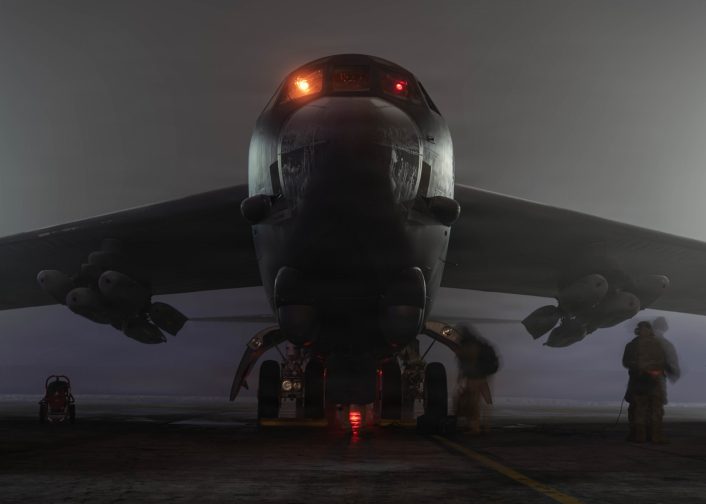
On the other hand, the photos of the B-52s, released few days earlier, clearly show the payload. The bombers are carrying 12 AGM-158 JASSM missiles on the external pylons, although it is unclear if more are being carried internally.
It’s never fair when a B-52 is involved.
“This was never meant to be a fair fight, and it is not a fair fight. We are punching them while they’re down.” – Secretary of War Pete Hegseth pic.twitter.com/JgRSgiM7jl
— U.S. Central Command (@CENTCOM) March 7, 2026
In fact, the B-52 can carry eight more JASSMs internally by using the Common Strategic Rotary Launcher, increasing the total payload to 20 missiles. This is just shy of the B-1B’s payload, which can include up to 24 JASSMs internally.
Full load of JASSM cruise missiles. pic.twitter.com/wEVOSrUWjl
— OSINTtechnical (@Osinttechnical) March 6, 2026
source