


Atlas Air, a key supplier of contracted air transport to the U.S. military, placed the largest order of any operator so far for the new Airbus freighter, which will complement their Boeing 747s, 767s, and 777s.
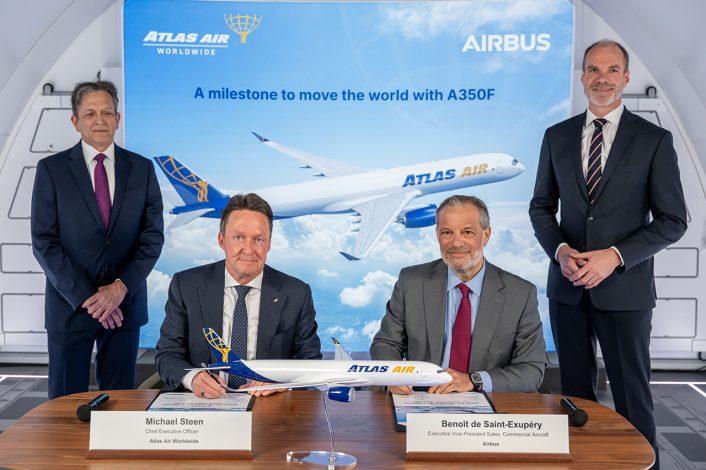
Michael Steen, Chief Executive Officer of Atlas Air, signed the deal with Airbus in Toulouse, France, on Mar. 16, 2026. Atlas Air will begin taking deliveries of its new aircraft from 2029, with the final of 20 Airbus A350Fs due in 2034. This figure will see Atlas Air operate twice as many A350Fs than the next largest operators, and also marks the first time Atlas Air will welcome an aircraft not manufactured by Boeing into their fleet.
“We are proud to become the largest customer for the Airbus A350F, securing early delivery positions for this next-generation widebody freighter platform,” Steen said. “This order reflects our commitment to maintaining the industry’s most modern and fuel-efficient widebody freighter fleet to best serve existing and new customers worldwide. The A350F is a highly capable, reliable platform, with incremental payload and range benefits, and a strong sustainability profile.”

Big news! @AtlasAirWW has placed a landmark firm order for 20 latest-generation #A350F! ✈️ As a leading outsourced aviation logistics company, this move reinforces its commitment to maintaining the most modern, fuel-efficient freighter fleet to service its customers worldwide. https://t.co/vsIXK3eaOI pic.twitter.com/ifqYxJy0AC
— Airbus (@Airbus) March 16, 2026
The Airbus A350F, the first of which is due to begin flight testing later this year, has now broken through 100 total orders. Other future operators include Etihad Airways, Singapore Airlines, Cathay Pacific, Turkish Airlines, and Air France. The freighter version, based on the A350-1000 model, builds from the huge success of the passenger variant – well over six hundred airframes are currently in service worldwide with civilian airlines and a handful of government operators.
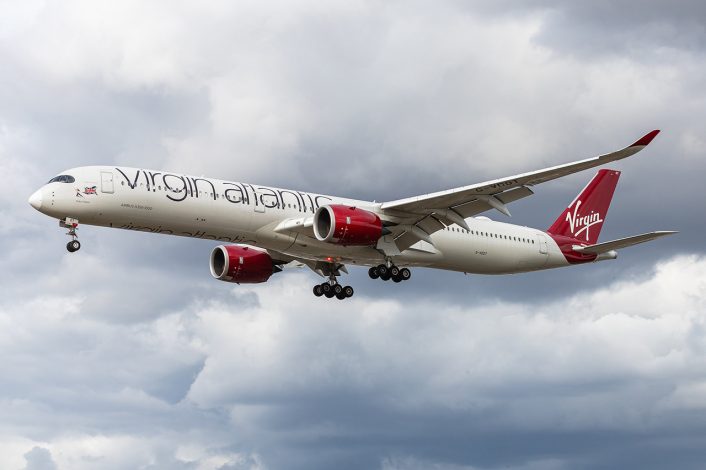
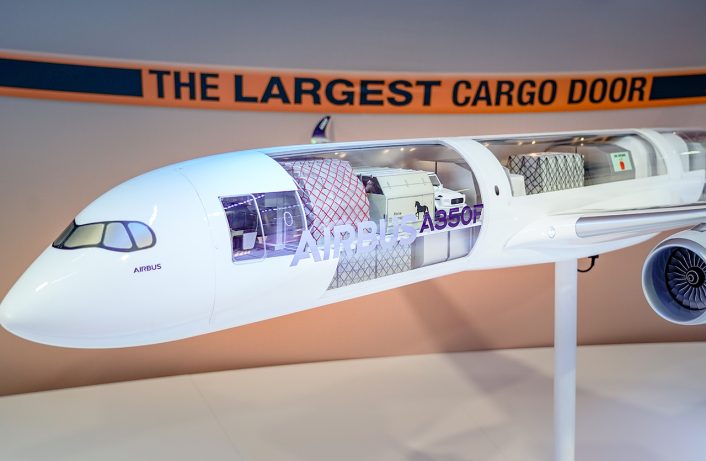
Compared to its closest competitor, the Boeing 777-8F (expected to begin deliveries from 2028), the A350F has a marginally lower total cargo capacity but boasts exceptional fuel efficiency as well as what Airbus claims is the largest main deck cargo door of any aircraft.

As with many freighter adaptations of passenger aircraft, the A350F will have two cargo decks. The belly cargo hold featured on passenger aircraft is kept as usual, in addition to the main deck cargo hold in place of the passenger cabin. Compared to the cavernous cargo holds of military transports like the C-17 Globemaster III, the split deck approach does limit the carriage of outsize cargo, but in general is a much more efficient and manageable use of the available space.
Behind the flight deck, a passenger cabin known as the ‘courier area’ is maintained with up to ten premium economy passenger seats for additional crew members, maintenance personnel, or people accompanying specific types of cargo.

Lars Wagner, CEO Commercial Aircraft at Airbus, said the company is “excited to welcome Atlas Air Worldwide, a global leader of the air cargo industry, to the Airbus family.” He adds: “Atlas Air’s selection of the latest generation A350F – the first in the US – represents a pivotal moment, cementing the A350F’s position as the preferred true all new-generation freighter for the world’s most demanding cargo operators. We very much look forward to seeing it flying in Atlas’ colours.”
This signal of confidence in the A350F given by a major U.S. operator could draw eyes from cargo operators who either currently operate or have, until recently, operated the McDonnell Douglas MD-11F. The market for replacing the ageing trijet is one that has been targeted by Airbus with its A350F offering, though major operators of the MD-11F have yet to place orders. UPS Airlines retired its entire fleet of MD-11Fs in the wake of the UPS 2976 crash in November 2025, while FedEx intends to resume operating the type from May.
Airbus reveal that payload of A350F cargo aircraft now up to 111tonnes. “Utterly perfect timing” says Airbus’ Crawford Hamilton. for new freighter with company forecasting demand for around 400 widebody cargo aircraft in Asia-Pacific over next 20 years. #SGAirshow2024 #avgeek pic.twitter.com/qDm3I1tL20
— Tim Robinson (@RAeSTimR) February 20, 2024
An expanding market in Asia is also heavily targeted. Singapore Airlines, Cathay Pacific, Korean Air, and Air China have all already firmed up orders for the A350F.
Atlas Air
Atlas Air, with a total fleet of 107 aircraft at the time of writing, is – by number of aircraft – the third largest cargo airline in the United States. Though the airline falls far short of competing with the likes of UPS and FedEx in terms of total tonnage of freight carried, Atlas Air has a firm hold on a number of lucrative specialized contracts. Contractors include Amazon Air, DHL, and Nippon Cargo Airlines.
On behalf of Boeing, Atlas Air flies the four Boeing 747-400LCF ‘Dreamlifter’ outsize cargo airlifters. These specially adapted 747s are used to ferry large aircraft parts between Boeing facilities in a similar fashion to the Airbus Beluga fleet.
You won’t find many aircraft larger than this. The Boeing Dreamlifter has arrived for #OSH23! pic.twitter.com/fRkTAC4Wis
— EAA (@EAA) July 24, 2023
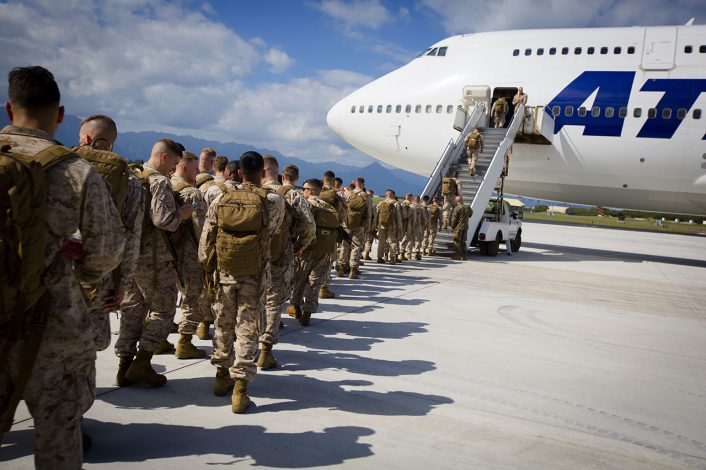
Notably, though, the airline also completes many charter flights for the U.S. Department of Defense. For these, Atlas Air utilises its extensive cargo aircraft fleet as well as its smaller fleet of passenger-configured Boeing 747s and Boeing 767s. These passenger aircraft regularly utilised to move large amounts of personnel across the U.S. or overseas to deployments or exercises, offering far greater levels of comfort than military airlifters fitted with palletised seating.
In terms of cargo, Atlas Air can be tasked with transporting everything from general supplies to entire armored vehicles and aircraft. Atlas Air 747 freighters have, in fact, been regular visitors to RAF Fairford in recent weeks in support of the Operation Epic Fury B-1B Lancer and B-52H Stratofortress bomber deployments.

As the largest current operator of the Boeing 747 aircraft type, Atlas Air boasts an array of expertise operating the iconic type, which is leveraged extensively by the U.S. Air Force. The airline trains flight crew and maintenance personnel for the U.S. Air Force’s VC-25 and E-4 fleets, and one of the airline’s 747-8 aircraft is currently being used to prepare personnel ahead of the arrival of the VC-25B and E-4C aircraft.
source