


CHAUMONT, France — The French Army’s first international drone competition felt a little like a tribute to the drone-racing scene that started it all, said a British pilot who competed in the event on a former United States airbase in eastern France last week.
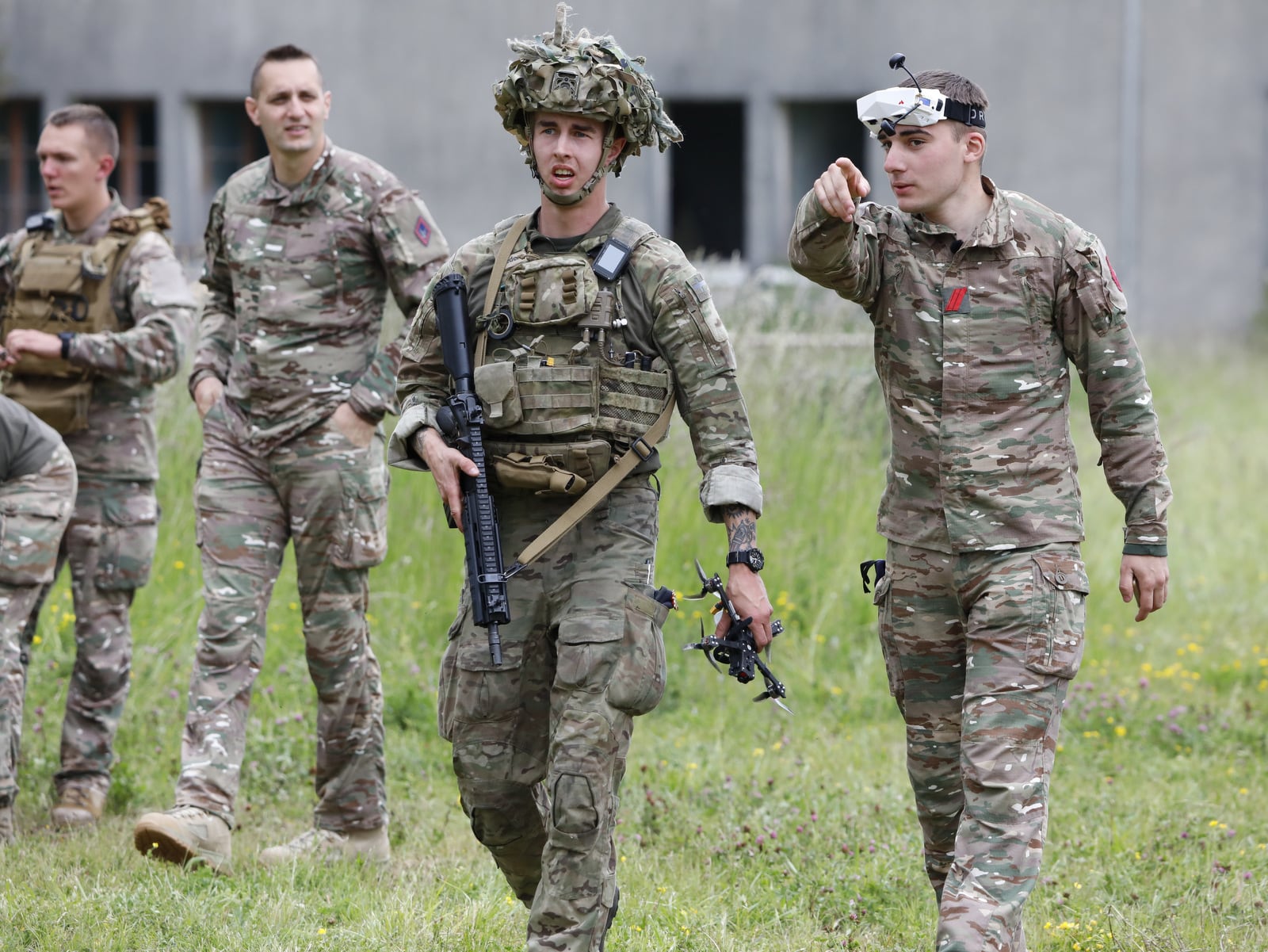
Apart from their combat fatigues, the drone pilots with first-person view goggles and joystick controllers could have been hobbyist racers, maneuvering quadcopter drones through bright yellow gates and an abandoned building. But simulated strike missions added a distinctly military edge to the two-day competition, with bonus points for hitting targets including a moving Ford pickup truck.
“Even with the British Army we do racing events, because obviously that’s where FPV has always been,” Guardsman Mark, a drone pilot in the 1st Battalion Scots Guards, told Defense News. “It’s good to see that the events here are like almost a homage to FPV racing. It’s kind of, thank you, we will take over from here into the tactical side.”
As FPV drones have become an inescapable part of infantry operations on the frontline in Ukraine, NATO countries have started to apply the lessons, at their own pace. Some teams in the two-day competition, including from the United Kingdom and Denmark, had been using FPV drones in their units for only several months, while some from France had been flying them for more than a year.
For drone pilots from eight NATO members, the competition at the Chaumont-Semoutiers airbase was a chance to see allies at work, share tactics and technical tips, and study each other’s equipment. For instructors, the event provided ideas on how they might improve training to use FPV drones in combat.
“We saw some really interesting things because, and I won’t go into details, but each team had its own small innovations in how they managed their equipment,” said Sgt. Edgar, an FPV drone pilot in the French Army’s 61st Artillery Regiment, which hosted the event at its base on the former airfield near Chaumont.

Cheap consumer racing drones flown via FPV goggles and low-latency video links were turned into weapons of war by soldiers in Ukraine, who combined them with explosive charges such as rocket-propelled grenade warheads. FPV drones now inflict 60% of the losses on the Russian army, the National Security and Defense Council for Ukraine said in January.
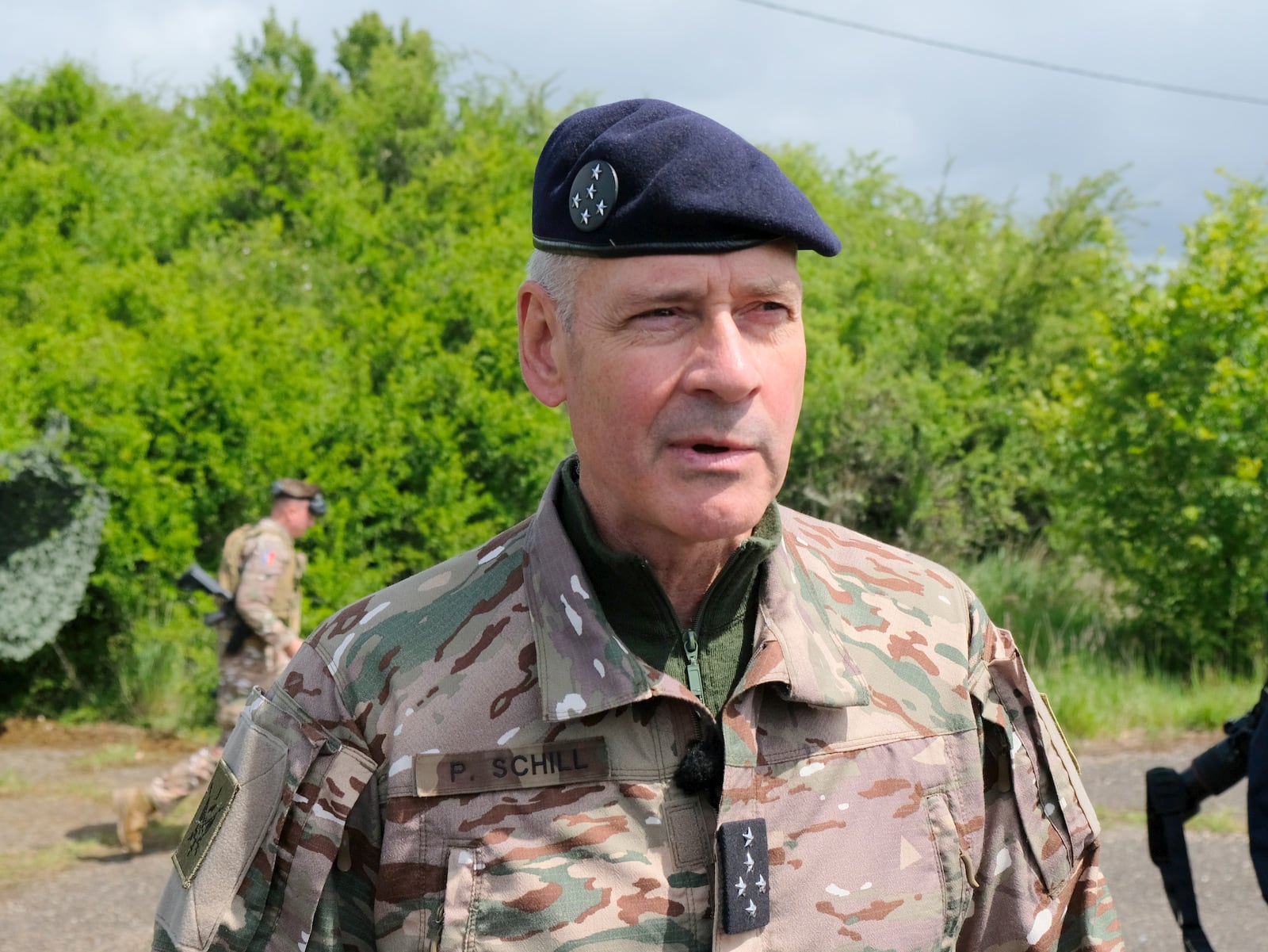
For Gen. Pierre Schill, the commander of the French Army, the challenge was an occasion to take stock of where his forces stand compared to allies. He said drones have become an “unavoidable reality,” and also a way to push the land forces towards innovating in the lowest ranks.
“You can build, for not much money, your own drone,” Schill said. “It’s a way to unleash innovation.”
Nearly 50 teams, each comprising a pilot and a spotter, took part in the International Drone Challenge on May 19 and 20, scoring points over four courses testing speed, drone control and successful strikes. Teams brought their own drones, some custom-made, others issued by their units, with the rules limiting entries to FPV drones in the 5-inch rotor class.
While many teams used similar systems and components, some pilots on allied teams used “quite different” ways to approach targets, “so it’s really interesting to be able to talk with them,” said Chief Cpl. Jean-Baptiste of the French 82nd Infantry Regiment.
Allied teams came from Belgium, Denmark, Spain, the U.S., Italy, the U.K. and Poland, with Luxembourg joining as an observer.
Chief Sgt. Aymeric of the 7th Battalion of Chasseurs Alpins — “Alpine Hunters” — kept a hand on the shoulder of pilot Chief Cpl. Clément during one of the exercises, pointing his masked teammate in the direction of the drone for the best signal.
“When I put on the mask, I no longer exist in this reality,” Chief Cpl. Clément said after completing the course. “That’s actually why it’s important to have a partner. They’re not only there to help me with my mission, but also to keep me grounded in reality.”
Buddy interaction was an area where teams used different methods, with some spotters guiding their pilots with verbal instructions rather than remaining in physical contact.
“We see different things again from Ukraine, we still learn from how they do it,” said Lance Cpl. Martin, a drone pilot from the Danish Royal Life Guards. “But definitely I’m not a one-man operation when flying. Especially if I have goggles on, I’m going to need a guy or two to keep me covered.”
Ukraine will have the capacity to produce more than 8 million FPV drones in 2026, with more than 160 companies producing the systems in Ukraine, the NDSC said in January.
Skill levels ranged widely, with French sergeant Edgar noting strong teams from the U.K. and Belgium. “This raises everyone’s game, because at the end of a lap where someone posts an exceptional time, we saw several teams approach them to ask for advice or to take a look at the equipment they had.”
Two French teams took the top spots, with the 13th Parachute Dragoon Regiment of the French special forces the winner and the 61st Artillery Regiment that hosted the competition finishing second. One of the British teams took third place.
Sgt. Luke Crossley of the U.K.’s 3 Royal School of Military Engineering Regiment, reportedly the country’s fastest military drone pilot, said that what he found most impressive was how well some of the French teams were doing with only two to five months of flying FPV systems, compared to the Belgium team and U.K. teams with up to two years of experience.
“Clearly other armies, other nations, France, Belgium, they’re getting after all this FPV drone stuff,” Crossley said. “As united nations, we are going be stronger on that battle front. Which is reassuring.”
The 1st Battalion Scots Guards has two qualified pilots with FPV drone experience who are still exploring how to use their gear, according to Guardsman Mark. He said the competition allowed him to tap into experience and knowledge from allies, including on setting up drones and programming the Betaflight control software.
NATO militaries are still figuring out procurement for FPV drones, a newer category than larger intelligence and targeting drone systems with established suppliers and procurement processes. Guardsman Mark said that while his unit receives fully assembled bigger drones, he built the smaller model used in the competition from parts.
Seeing how other forces deal with procurement was instructive, according to Staff Sgt. Shay Burnett of the U.S. Marine Corps, who teaches an attack-drone operator course at the service’s School of Infantry.
The Marines are tied to a contract for a single model of FPV drone, the Neros Archer, according to Burnett. With FPV drones so interchangeable “we shouldn’t have to be stuck to one system,” and being able to build them in-house and branch out to other models would reduce costs and make the force more effective overall, he said.
The biggest takeaway was learning where allies stand on FPV drones “and seeing how we can make ourselves better overall,” according to Burnett, who said the Marines started using the systems about 15 months ago. “It’s so new across the board. Everyone’s relatively in the same boat.”
Burnett also took home lessons from how organizers set up the trials. “We’re never going to try to get to the racing side, but we do think that the way that they had some of the things, with obstacles to get to the main target, is something we can bring back and actually start implementing.”
An officer of the Danish armed forces was keen to observe how the French organized the competition. While Denmark has previously held military competitions for snipers, infantry-fighting vehicles and battle tanks, the country wouldn’t be able to set up an event like the one near Chaumont just yet, said Lt. Col. Nicolai, head of the training department for the Danish forces.
Drone pilots also discussed training, with most agreeing that pilots need to fly regularly to keep their skills sharp. The French require potential drone pilots to train at least 20 hours in a simulator before they start flying small drones and then work their way up, said Sgt. Edgar.
Younger pilots, especially those with experience flying model aircraft or in video games, tend to take more naturally to FPV drones, though some personnel in their forties are “very quick” learners, according to the French sergeant. But the main variable remains training time, he said.
Training time for the competing teams varied greatly, said Danish Lance Cpl. Martin, who said he is one of the first in his unit to train with FPV drones, and had been flying them for only about one-and-a-half months. He said after discussing training regimes, one lesson he’s bringing home is to train intensely at the start, then allow pilots to build flying experience at a more casual pace.
“It’s been fun talking to the others to see how they’ve been doing,” Lance Cpl. Martin said. “Most of them have had FPVs for a longer time, so they had more training compared to myself. I’m bringing home how we can train, all the success and all the failures. No need to reinvent the wheel.”
Rudy Ruitenberg is a Europe correspondent for Defense News. He started his career at Bloomberg News and has experience reporting on technology, commodity markets and politics.