


A-10s armed with a mixed anti-air and anti-surface armament have been flying attack missions against insurgent groups aligned with the Iranian government in Iraq.
U.S. Central Command (CENTCOM) released three images on Mar. 15, 2026, of A-10C Thunderbolt II attack aircraft operating in an unspecified location in support of Operation Epic Fury. These are the first official visuals we have of the A-10 taking part in this operation, though their participation had been confirmed in writing by CENTCOM during the first 48 hours of the conflict.
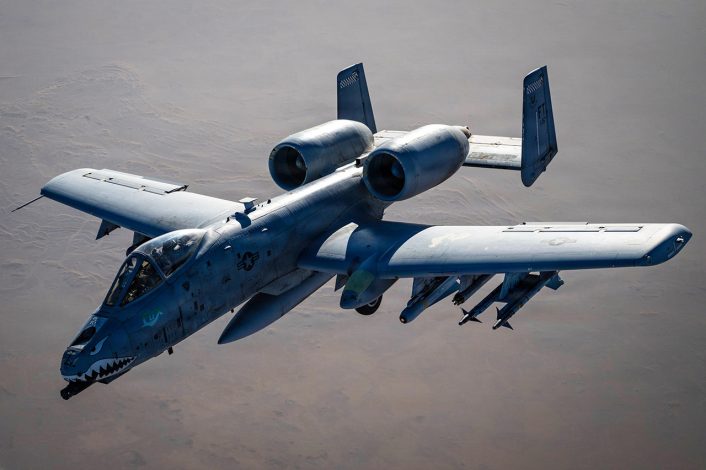
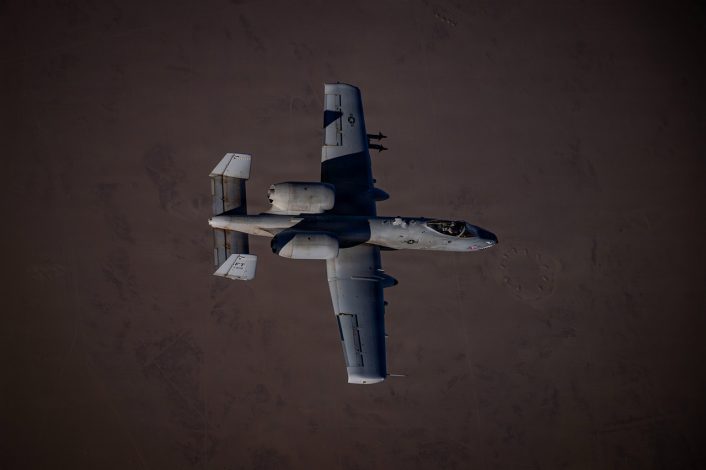
Now, with images available, we can take a look at the payloads being carried by these close air support specialist jets. In these pictures, we see the aircraft outfitted with dedicated anti-air as well as dedicated anti-surface weaponry. First of all, on the starboard wing, the A-10s are carrying a LITENING targeting pod and an AGM-65 Maverick air-to-surface guided missile. A standard 600 gallon drop tank is slung on the centreline hardpoint, as has been commonly seen during Operation Inherent Resolve missions to grant the aircraft extended range and loiter time.
U.S. Air Force A-10 Thunderbolt II’s receive fuel in-flight while supporting Operation Epic Fury. The A-10 Thunderbolt II can loiter for hours, standing by and ready to execute a mission whenever needed. pic.twitter.com/VjESHLR32Y
— U.S. Central Command (@CENTCOM) March 15, 2026
On the port wing, the jets carry another Maverick, two AIM-9M Sidewinder air-to-air missiles, and a single LAU-131 seven round rocket pod loaded with Advanced Precision Kill Weapon System II (APKWS II) guidance kit-equipped Hydra 70 rockets. A-10s have routinely been equipped with Sidewinders as a last layer of self defence against hostile aircraft, but with the increased use of small uncrewed aerial vehicles (UAVs) like the Shahed 136 as attack munitions the A-10 can now use them in a more offensive role.
The same can be said for APKWS II equipped rockets. Although the guidance kit was originally conceived as a way to increase the effectiveness of the ubiquitous Hydra 70 rocket in environments where collateral damage is a major concern, the system has now been well proven against aerial targets.

As well as permitting a much increased payload over that allowed by most dedicated air to air missiles, these weapons are also much lower in cost and therefore the economics of using them against relatively inexpensive drones is not as unbalance as with, for example, a Sidewinder. Of course, the guided rockets can also still be employed against surface targets on the same mission.
Flying over Iraq and Jordan, A-10s armed with Sidewinders and APKWS rockets can ably intercept hostile drones bound for friendly bases. It should be noted though, as the A-10 lacks its own radar, unless the drones are spotted visually or with infrared optics the pilots would most likely rely upon external means to be directed towards such targets.
The weapon we have seen in action, though, is actually the Warthog’s famous GAU-8/A Avenger 30 mm rotary cannon. Although the videos we have were taken at night, we can clearly hear the unmistakable sound of the cannon as the jet engages the Iran-backed Popular Mobilization Forces (PMF) near Tikrit, Iraq.
USAF A-10 carrying out attacks on the PMF north of Tikrit, Iraq overnight. pic.twitter.com/TEUPMFRaLQ
— Woofers (@NotWoofers) March 13, 2026
Missions over Iran
It should be stressed that no evidence available so far suggests that A-10s are taking part in any missions over Iran itself. Despite Iran’s anti-air capabilities being heavily degraded – to the point that F/A-18s have been seen using their own cannons at low altitudes against targets in the Iranian city of Chahabar without any apparent resistance – the A-10’s ‘low and slow’ combat profile makes it particularly vulnerable to mobile air defence systems like anti-aircraft guns or man-portable air defence systems (MANPADs).
U.S. Navy F/A-18 Super Hornet making a low-level strafing run with its gun over the Iranian port city of Chabahar. pic.twitter.com/7xbdt68Zsz
— OSINTtechnical (@Osinttechnical) March 15, 2026
Additionally, as far as we are currently aware, the deployed A-10 force is still flying from Muwaffaq Salti Air Base in Jordan. Other aircraft deployed to this base, known at least at one stage to include F-15E Strike Eagles, F-35 Lightning IIs and F-22 Raptors, are almost certainly being employed on the frontlines over Iran, but integrating the A-10 into these long distance sorties would be complicated.
Compared to multirole fighter aircraft, the A-10’s ideal flight and air to air refueling (AAR) parameters are slower and at lower altitudes. While the F-35’s optimum refueling profile is anywhere from 20,000 to 30,000 feet at Mach 0.80, the A-10 instead usually refuels between 15,000 and 22,000 feet at Mach 0.48. A package of A-10s, then, would need either dedicated tanker support or require existing tankers to making significant adaptions to their usual flight profiles (where they can support F-15s, F-16s, F-22s, and F-35s simultaneously, since the AAR profiles of these either overlap or are very similar).
14 U.S. Air Force tankers currently visible over various countries in the Middle East – all from Ben Gurion Airport in Tel Aviv.
There are also reports this evening of five tankers being damaged after a strike at Prince Sultan Air Base in Saudi Arabia, as per @Faytuks… pic.twitter.com/JdEKFQ8AdR
— Armchair Admiral 🇬🇧 (@ArmchairAdml) March 13, 2026
Working around these constraints is not impossible, and when performing missions over Iraq and Syria during Operation Inherent Resolve it is very likely that tankers have routinely serviced a wide variety of aircraft types during the same sortie. However, for large and complex missions assembled over long distances – perhaps also with the involvement of Israeli aircraft – incorporating these differing requirements into the sortie would eat into the fuel reserves of other aircraft and reduce the overall adaptability of the strike package.
Regardless, even if the A-10 is not flying missions over Iran itself, being available for taskings against Iran-aligned militias means the availability of other types can be better preserved. The Warthog’s days may still be numbered, but it is proving it still has significant worth in certain combat scenarios.
source