


ANA Holdings has joined a Japanese consortium selected to develop satellite and aircraft-based technology for tracking carbon dioxide emissions from space.
The project, funded through the Japan Aerospace Exploration Agency’s (JAXA) Space Strategy Fund, is led by satellite company Axelspace and includes sensor manufacturer Meisei Electric and quantum computing firm JIJ.
Together, the four companies plan to develop compact, affordable sensors that can pinpoint where CO2 is being released and absorbed, broken down by source, time, and location.
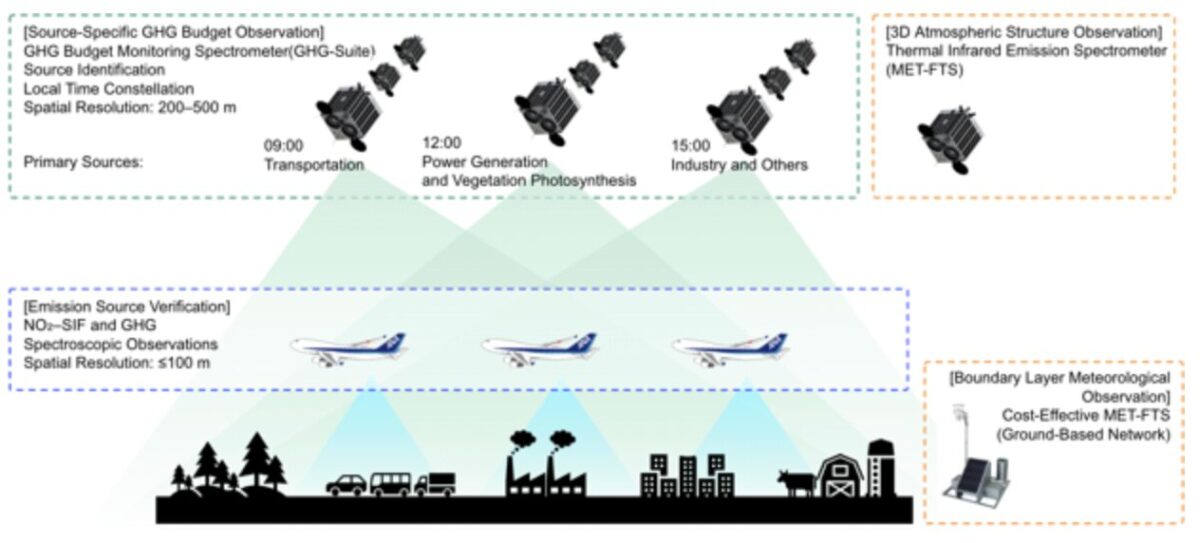
ANA Holdings said it will leverage its commercial flight network to test the new sensors in real-world conditions before they go to orbit. The airline group has previously worked with JAXA on airborne remote sensing research and will help validate satellite data by combining it with aircraft-based observations.
“We are honored to participate in what will be the world’s first greenhouse gas observation project integrating a satellite constellation, scheduled commercial flights, and a ground-based network,” said Masashi Hamade, Director of Business Strategy at ANA Holdings. “Through close coordination between space- and air-based infrastructure, we aim to unlock the use of high-frequency, high-resolution observation data that redefines conventional standards.”
The idea behind the project is straightforward: current methods of measuring greenhouse gas emissions are often too broad or limited to specific regions. Governments and companies are setting net-zero targets, but verifying whether those promises are being kept requires better data. Without reliable, transparent numbers, “greenwashing”,where organizations overstate their environmental efforts, remains difficult to call out.

Japan was the first country to launch a satellite dedicated to greenhouse gas observation, known as Ibuki. This new effort builds on that legacy, with the project led by Akihiro Kuze, a former JAXA project manager who worked on the Ibuki-2 mission.
The key challenge is shrinking the technology. Traditional spectrometers, which measure gas concentrations by analyzing how light is absorbed at certain wavelengths, are large and expensive. The consortium plans to develop a smaller, cheaper version that can be used across satellites, aircraft, and ground stations.
JIJ will apply its expertise in mathematical optimization and quantum computing to process the massive amounts of data the system will generate, helping to produce accurate emissions estimates even in complex urban environments.
A demonstration satellite carrying the new sensor is planned for launch between 2030 and 2032. If successful, the consortium envisions building out a full satellite constellation capable of observing the same regions at different times of day.
The project also involves Kagawa University, MUFG Bank, Tokio Marine & Nichido Fire Insurance, and the US-based Universities Space Research Association.
“Climate change represents one of the most urgent challenges facing humanity,” said Yuya Nakamura, CEO of Axelspace. “To drive effective action by governments and businesses alike, objective and transparent monitoring of greenhouse gas emissions — by specific sources — is essential.”
source