


What are the most powerful US fighters in history? The answer to that question is somewhat subjective and depends on what’s meant by powerful. The A-10 Warthog may be a powerful close air support aircraft, but it is not survivable. The F-22 Raptor was built as the next-generation successor to the F-15, but it is the F-15 that has remained in production and boasts greater numbers.
The F-22 Raptor has been the type-of-the-spear for US air dominance for two decades, but it is penalized due to its low production numbers and narrow mission set. Additionally, the still-maturing F-35 can likely fill more of the air superiority role while the Air Force is rapidly working on its 6th-generation F-47 to replace the Raptor.
North American F-86 Sabre
9,860 F-86s were delivered

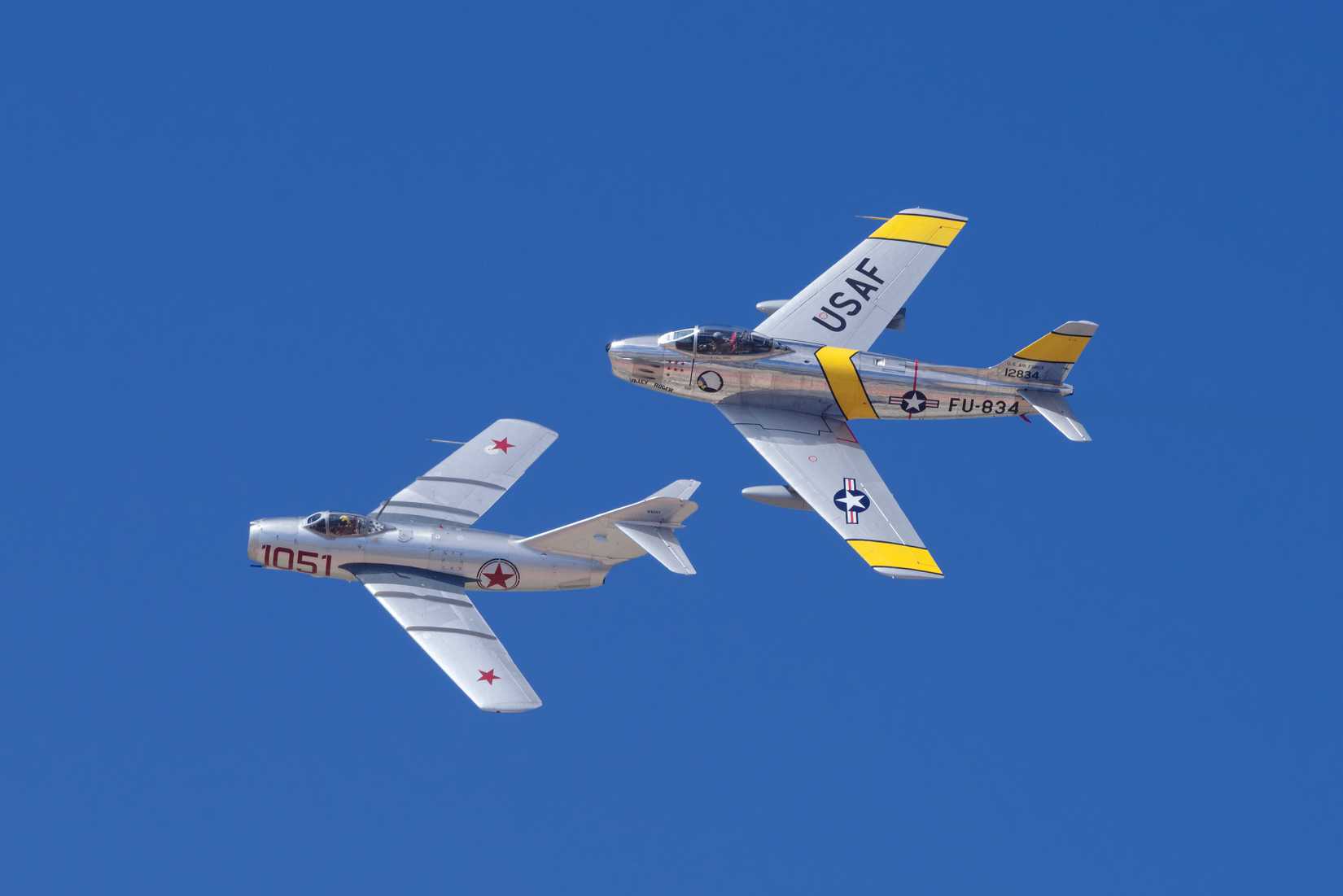
The North American F-86 Sabre is an icon of the Korean War and represented the first truly successful American jet fighter. Almost 10,000 were built, making it by far the most produced Western fighter jet. The first American jet fighter was the Lockheed P-80 Shooting Star. By the time the Korean War broke out, despite early success, it was already falling behind and being outclassed by MiG-15s.
The US responded by rushing the F-86 Sabre to Korea. It soon became famous for its dogfights with Soviet MiG-15s over Korea. While the British and Germans both had jet fighters in service at the end of WWII, there were no jet-on-jet engagements. The F-86 Sabre saw some of the earliest jet-on-jet engagements, and it scored impressive victory rates (reportedly 8:1) over Soviet jets.
The Sabre was the US Air Force’s first swept-wing jet fighter. It made its initial flight in October 1947, with the first production model flying in May 1948. Four months later, it set a new world speed record flying 670.9 mph. According to the Smithsonian, the F-86 Sabre joined the ranks of great fighter aircraft during combat operations high above the Yalu River in Korea.
F-4 Phantom II
5,195 Phantom IIs were delivered


The F-4 Phantom II had its heyday in the 1960s to 1980s; by the 1990s, it was becoming dated. The F-4 was a forward-looking aircraft, perhaps too much so. The first models did not even feature a cannon for dogfights. This quickly proved to be a mistake, and the cannon was added as it became clear that missiles alone were not enough.
No other American fighter jet has shouldered as much of the US’s global airpower at once as the F-4 did. Like the F-35 today, it was used simultaneously by the Air Force, Navy, and Marine Corps. It was also each service’s primary fighter, interceptor, strike aircraft, and Wild Weasel platform (SEAD aircraft).
Its missions included fleet defense, deep strike, and air superiority. The Phantom even carried nuclear weapons. The age of the F-4 has largely ended, although it remains in service in Turkey and, to some degree, in Iran. It is about to be retired in Greece and has recently been retired from South Korean service.


Seven Fighter Jets That Might Rival The F-22 Raptor’s Air Superiority
The F-35 is the closest rival to the F-22 while sixth-generation fighters are underdevelopment that could supersede it.
McDonnell Douglas/Boeing F-15 Eagle
Up to 1,700 F-15s have been delivered


While it is tempting to put the F-22 in the list, that spot is better earned by the F-15 Eagle. Only 187 production models of the F-22 were built, while around 1,700 examples of the Eagle family have been delivered. The Raptor only partially replaced the Eagle, but the Eagle made a comeback and will remain in production into the 2030s.
For 40 years, the F-15 Eagle was the guarantor of US air dominance. With only a limited number of F-22s delivered, it never fully lost that role, although the role is increasingly being absorbed by the F-35. The F-15’s overwhelming superiority in its time allowed it to overcome enemy air forces, posing no meaningful constraint on US air power.
The F-15 could operate as a strike, bomber, and support aircraft with near impunity from the later Cold War to today. In 2025, the US Air Force used them to intercept countless Houthi and Iranian drones, while Israel used them (with F-35s and F-16s) to relentlessly pound Iran, achieving air dominance. It continues to boast 104 air-to-air victories (mostly in Israeli service) with zero air-to-air losses.
F-16 Fighting Falcon
Over 4,600 Fighting Falcons have been delivered

As this article focuses on fighter jets that have a significant impact on the US’s ability to project airpower, the F-16 earns a spot. The F-16 is a lightweight fighter with fewer capabilities than its higher-end counterparts, such as the F-15. But the F-16’s superpowers lay in its versatility, its numbers, and its affordability. On the battlefield, the most powerful asset is the one you have, not the high-end luxury one you wish you had.
The F-16 has been the high-volume workhorse of US tactical aviation for decades. The aircraft remains the most numerous fighter in US Air Force service, although the F-35A will likely overtake it in a few years. The F-16 has not only been the workhorse for the US Air Force, but also for innumerable allies around the world.
The Fighting Falcon has absorbed the day-to-day workload of global operations, from air policing to close air support to strike missions. Importantly, it is the most-produced 4th-generation fighter jet in history, with over 4,600 delivered. While the US Air Force no longer purchases the jet, it remains in production for export customers, and Lockheed Martin is expecting to deliver hundreds more of the updated aircraft.
F/A-18 Hornet/Super Hornet
Up to 2,100 Hornets/Super Hornets have been delivered


When it comes to the Navy, both the F/A-18 Hornet/Super Hornet and the F-14 Tomcat stick out. On an aircraft to aircraft basis, the Tomcat was arguably the more impactful of the two aircraft, and it had the ability to carry out deep strike missions. Deep strike is something the Super Hornet cannot do, and it is a major gap in the Navy’s capabilities.
But the Hornet family wins out for its numbers and being the carrier-based fighter jet in the world to this day. It has been the backbone of US naval aviation since the 1990s, and it continues to account for most carrier sorties. The type remains in production, though it is expected to end production in 2027.
The Tomcat remained in US service between 1974 and 2006, or a period of 32 years. Meanwhile, the Hornet family has been in service since 1987 (47 years ago), and it is expected to remain in service at least until the 2040s and maybe longer. The Navy wants to develop the 6th-generation F/A-XX fighter jet to replace the aircraft eventually. With funding for the F/A-XX remaining in question, the Super Hornet may serve for much longer.

America’s 5 Fastest Fighter Jets Of All Time
The speed kings of TACAIR.
F-111 Aardvark
563 Aardvarks were delivered


Despite low production numbers (563 produced), the F-111 Aardvark squeaks onto the list. Its position could easily go to the F-14 Tomcat, the F-22 Raptor, or the F-104 (which was influential technologically). The variable sweep wing Aardvark was a long-range strike and interdiction fighter that sat somewhere between a fighter and a bomber.
The most exceptional characteristic of the Aardvark was its reach. It was able to fly further, faster, lower, and with more payload, and without tanker support, compared with contemporary aircraft. In Vietnam, the F-111 showed it could fly autonomous deep strike missions at night and in bad weather, while hugging the terrain. This was something no other aircraft could do and survive.
In Europe, the Aardvark was one of NATO’s most credible and conventional and nuclear deterrent aircraft. As late as the Gulf War, the F-111F emerged as one of the most effective strike platforms in the US Air Force’s inventory. It was the first production variable-sweep-wing aircraft.
F-35 Lightning II
Over 1,200 F-35s have been built

The F-35 is the most popular fighter jet on the market and is considered the most advanced fighter jet in the world. The F-22 Raptor is considered the best aircraft in the air dominance role, but it is mostly a one-trick pony. The Raptor has evolved into a multirole fighter, but it remains better suited in its air dominance role. The F-35 is also excellent in the air-dominance role and well-suited to a broader range of missions.
Where the F-35 shines is in penetrating enemy air defenses and executing strikes. It is designed to conduct Suppression of Enemy Air Defenses and Destruction of Enemy Air Defense missions. The aircraft is designed with unparalleled situational awareness, giving it a “god’s eye view” of the battlespace.
The F-35 comes with three main variants: the conventional F-35A, the STOVL F-35B, and the carrier-based F-35C. The aircraft is popular; more F-35s have been produced than all other 5th-generation fighter jets combined. Excluding Chinese fighter jets, more F-35s are likely to be delivered in 2025 than all other non-Chinese fighter jets combined (F-16s, F/A-18s, F-15s, Eurofighters, Gripens, Rafales, Su-30/34/35s, Su-57s, etc.).
source