


An Airbus-led consortium of Spanish companies unveiled the industrial blueprint for the Spanish Air and Space Force’s new Integrated Combat Training System (ITS-C), the program that will retire the service’s aging F-5 fleet.
The contract, signed in December 2025 and worth approximately $3 billion (€2.6 billion), is based on a co-development arrangement between Airbus, as the Spanish prime contractor, and Turkish Aerospace, the manufacturer of the Hürjet advanced jet trainer that forms the basis of the Spanish system.
Designated SAETA II in Spanish service, the 30 aircraft will be customized to a national specification covering avionics, mission systems, and an integrated package of operation and maintenance services for the entire advanced training pipeline. The fleet will replace the 19 Northrop F-5M aircraft that have trained Spanish fast-jet pilots since the late 1960s, the last operational survivors of an original 70-airframe acquisition.
Two-phase delivery from 2028 to 2035

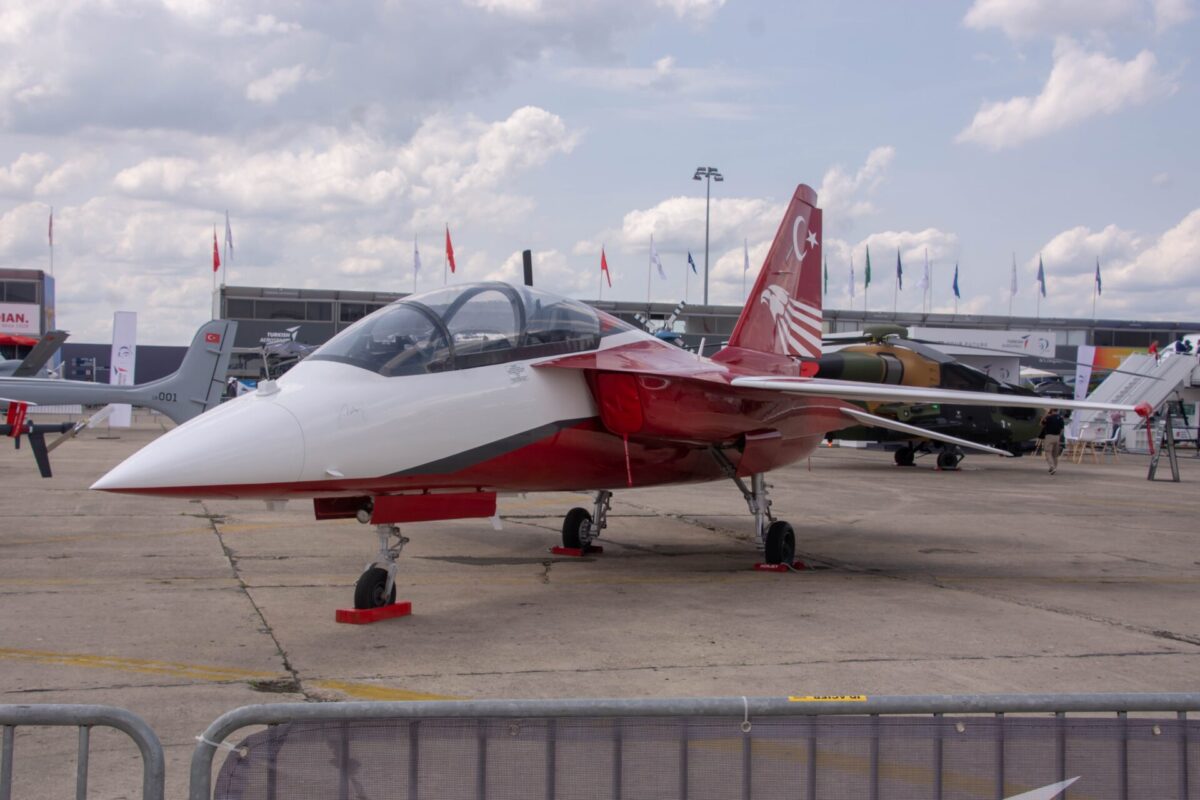
Airbus described the SAETA II rollout as a two-phase program. The first phase, set to begin in 2028, will see Turkish Aerospace deliver an initial batch of 21 aircraft. One of those will be retained by Airbus as a prototype for integrating next-generation avionics and mission equipment, while parallel work continues on the ground-based training environment, which is scheduled to enter service during the 2029-2030 academic year.
In the second phase, all 21 aircraft from the first batch and the nine remaining airframes will be converted to the full Spanish standard, with the simulator suite updated to match. Deliveries of the completed SAETA II configuration, paired with its ground-based training system, are planned between 2031 and 2035.
In parallel, Airbus will lead the redesign of the Fighter and Strike school Training Centre at Talavera la Real Air Base in Extremadura, the home of the Spanish Air and Space Force’s advanced jet training establishment and the eventual operating base for the new fleet. The center will be equipped with new simulators co-developed with Indra and will host the logistical chain for both the aircraft and the synthetic training environment.
Six Spanish suppliers behind the avionics nationalization
The 60% national workshare is concentrated in the elements that turn the baseline Hürjet into a Spanish-specification trainer. Beyond primary parts manufacturing, electrical wiring, and the construction of the conversion center itself, six Spanish companies will supply the core avionics and mission systems: GMV (inertial navigation, GPS and the mission computer), Sener (datalink), Aertec (remote interface unit), Grupo Oesía (audio management), Orbital (VMDR mission recorder) and Indra (Identification Friend or Foe).
Spanish Secretary of State for Defense Amparo Valcarce, speaking at Getafe, said the project mobilized Spanish industry across the value chain and reduced critical dependencies by allowing Spain to “design, integrate, and evolve our own capabilities.”
Once the fleet enters service, the same Spanish industrial base will handle maintenance, in-service updates, and any future evolution of the system without recourse to the original equipment manufacturer.
Trainer leg settled, fighter picture still open
The SAETA II workshare announcement closes a key procurement decision in a cycle that has run uninterrupted since late 2024, alongside Spain’s December 2025 contract for 18 Airbus C295 tactical transports and 100 Airbus helicopters, and the Halcon II Eurofighter order signed in December 2024. With the trainer leg of Spain’s combat air renewal now broadly settled, attention shifts to the front-line fleet, where the picture is considerably less clear.
After ruling out the Lockheed Martin F-35 in August 2025, Madrid signalled in a February 2026 parliamentary reply that the Spanish Air and Space Force’s F-18 fleet could remain in service until 2040, well beyond the original 2030 retirement target. Halcon II will replace part of the Hornet inventory, but the longer-term answer rests with the French-German-Spanish Future Combat Air System, whose Franco-German mediation collapsed on April 18, 2026, and which Macron and Merz have now handed back to their defense ministries for further work in the coming weeks.
source