


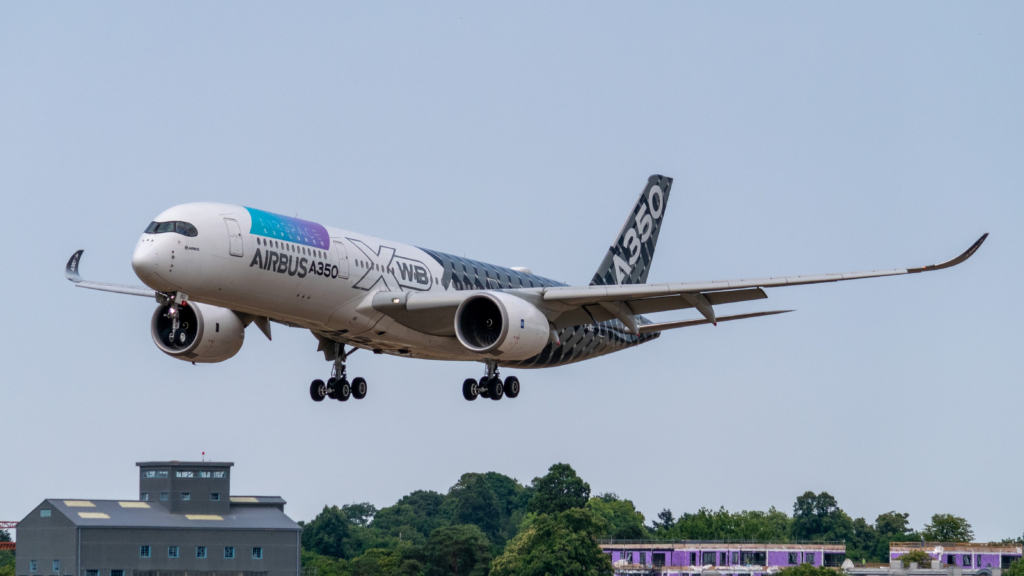
European aircraft manufacturer, Airbus, predicts the global fleet of commercial aviation aircraft will double within the span of the next two decades, as the OEM’s Global Services Forecast (GSF) sees a considerable year-on-year increase in demand for services.
With passenger traffic and commerce continuing to grow and many major operators already facing capacity constraints within their own fleet, Airbus has its work cut out for the coming decades, considering the manufacturer already faces delivery delays and supply chain issues slowing down some of its most popular products.
Year-On-Year Increase In Demand For Service, Traffic, And More

As per the latest forecast data from Airbus, the manufacturer anticipates the global fleet of commercial aircraft to double by the year 2044 to over 49,000 aircraft. The report indicates that the total demand for services recorded in 2025 will be a 10% year-on-year increase. This, driven by the continuous growth of air traffic forecasted in the coming years, will approximately reach $311 billion by 2044 with an anticipated CAGR (Continuous Annual Growth Rate) of 3.6%.
Just like the fleet size, Airbus’ GSF also indicates that the passenger traffic is set to hit a record five billion passengers this year, and this too is expected to double to 10 billion passengers by the year 2044. These statistics from the GSF clearly indicate that the global airline operators will need a growing supply of efficient and reliable aircraft, catering to every type of operation (regional/short haul/long haul) in the coming decades to ensure sufficient capacity is available.
The aforementioned demand for service of $311 billion by 2044 is split by the manufacturer into five segments, the most expensive of which is off-wing maintenance, followed by on-wing maintenance, modifications and upgrades, digital and connectivity, and lastly, training for all the flight and cabin crew required to meet the growing fleet sizes.
Data indicates that the three largest markets for services by 2044 will be China, Europe, and North America, while the three fastest-growing markets in terms of CAGR will be China, South Asia, and the Asia-Pacific.
Airbus’ Massive Aircraft Backlog

The latest order and delivery data as of the end of September show that the manufacturer delivered 73 aircraft to 41 customers in September alone, and to date, this year, delivered 507 aircraft to 79 customers. Simultaneously, during the first nine months of this year, Airbus has recorded a net order for 514 new aircraft, from 33 customers, some of whom are marked undisclosed.
Overall, the manufacturer has well over 8,500 aircraft currently on order, split across multiple aircraft products, including:
|
Airbus Aircraft Types On Backlog |
|||
|---|---|---|---|
|
A220 family |
A320 family |
A330neo |
A350 family* |
*Order includes the A350F model, which is yet to be certified.
As indicated above, the manufacturer has a backlog of aircraft suitable for regional, short-haul, long-haul, and freighter operations.
Earlier this summer, when Airbus’ H1 results were released, the manufacturer stated that it plans to increase aircraft production rate for the A320 family to 75 per month by 2027, while increasing A220 production to 14 aircraft per month in 2026 and A350 aircraft to 12 per month by 2028. As for the A330neo production, only a minor increase is expected, with the current number being four a month, increasing to five a month by 2029.
What About Boeing’s Market Forecast?

Similar to Airbus’ forecasts, the American aircraft manufacturer, 

While the data forecasts growth in the number of narrowbody, widebody, and freighter jets in the next two decades, the data also shows that the fleet size of regional jets around the world will decrease by over 28%. It is worth noting that the aircraft set to be produced in the next 20 years will not only help airlines grow their fleet and operations, but also replace their existing and aging aircraft with newer and more efficient models.
The data further shows that while North America, Eurasia, and China will end up having the largest fleets by 2044, the largest passenger traffic growth will be experienced by South and Southeast Asia, Africa, and China.
source