


Airbus Defence and Space has completed the first demonstration flight of its Bird of Prey uncrewed interceptor, with the drone autonomously detecting, classifying and engaging a medium-sized one-way attack drone during a test at a military training area in northern Germany on March 30, 2026.
The flight marks the first time the Frankenburg Technologies Mark I air-to-air missile has been fired from an airborne platform. The engagement sequence ran autonomously: the Bird of Prey searched for, detected and classified the target before launching one of its guided missiles against the simulated kamikaze threat.
From target drone to interceptor

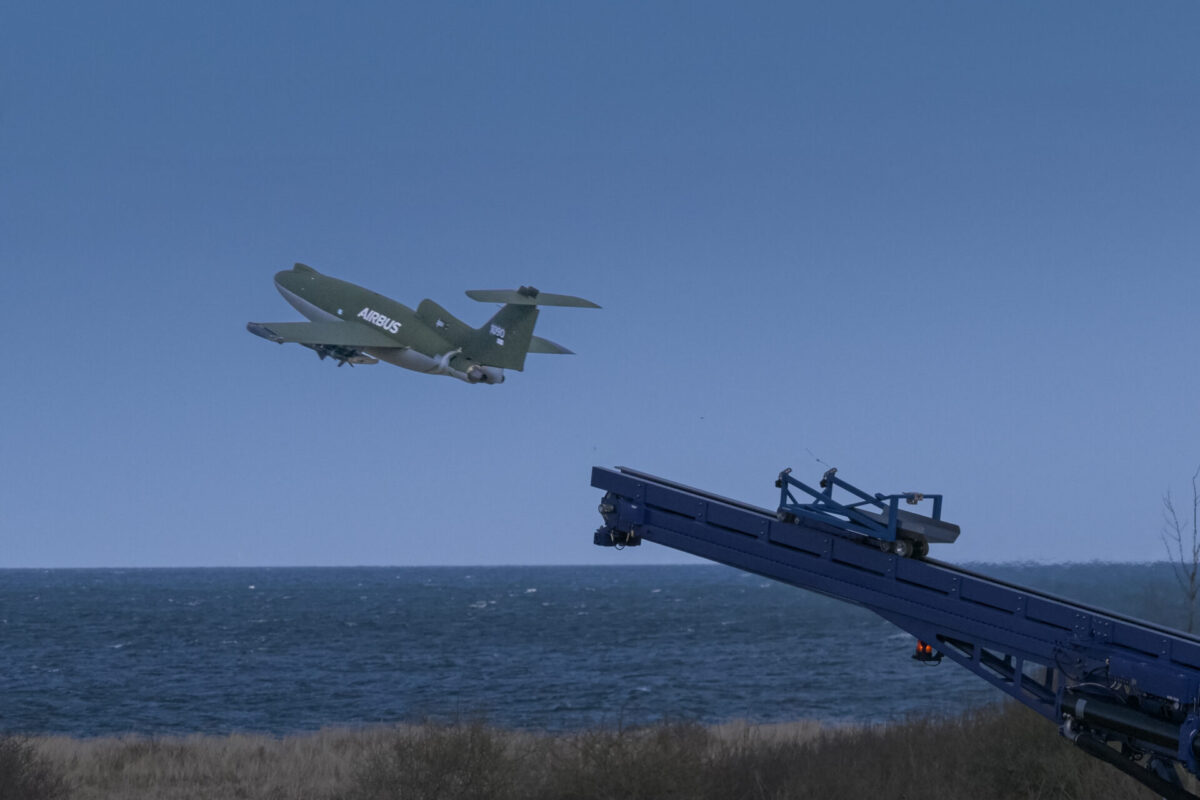
The Bird of Prey is based on a modified version of the Airbus Do-DT25, a jet-powered platform originally developed in the early 2000s as an aerial target for short-range missile training. In its interceptor configuration, the prototype features a wingspan of 2.5 meters, a length of 3.1 meters and a maximum take-off weight of 160 kilograms.
Airbus first unveiled the concept in March 2025 under the name LOAD, for Low-cost Air Defence, at the Unmanned Systems X trade show in Bonn. At the time, the system was presented as a reusable drone capable of carrying up to three guided missiles, launched by catapult and recovered by parachute after completing its mission. It appears to have since been rebranded as Bird of Prey.
The demonstration flight took place nine months after the project started, according to Airbus, a timeline consistent with the accelerated development cycles now common across European defense programs responding to the drone threat highlighted by the war in Ukraine.
Successful first demo flight: Airbus’ uncrewed Bird of Prey interceptor autonomously engages kamikaze drone with @FrankenburgTech missile.
The Airbus ‘Bird of Prey’ is designed to seamlessly operate within NATO’s integrated air defence architecture via established command and… pic.twitter.com/u3Yd5K9uSY
— Airbus Defence (@AirbusDefence) March 30, 2026
Frankenburg’s Mark I: the smallest guided missile
The Mark I missile, developed by Estonian defense startup Frankenburg Technologies, is described as the lightest guided interceptor developed to date, weighing less than two kilograms and measuring 65 centimeters in length. It is a fire-and-forget weapon powered by a solid-fuel rocket motor, equipped with an electro-optical seeker and a fragmentation warhead designed to detonate at close proximity to its target.
The missile has a high-subsonic flight speed and an engagement range of up to 1.5 kilometers. While the prototype Bird of Prey was equipped with four Mark I missiles for the demonstration, Airbus says the operational version will carry up to eight.
Frankenburg, led by CEO Kusti Salm, the former permanent secretary at Estonia’s Ministry of Defense, has positioned the Mark I as a disruptive entry into the short-range air defense market. The company conducted its first full kill-chain intercept against a Shahed-type target drone at the NATO base in Adazi, Latvia, in December 2025. It has since secured partnerships with Babcock for maritime integration and Poland’s PGZ for mass production, with plans to manufacture up to 10,000 missiles per year.
The air-to-air variant integrated onto the Bird of Prey had been previewed in earlier reporting, with a twin-rail launcher and missile combination weighing under eight kilograms, designed to be mounted on small drones.

Fitting into NATO’s layered air defense
Airbus says the Bird of Prey is designed to operate within NATO’s integrated air defense architecture through its Integrated Battle Management System (IBMS), the company’s command-and-control suite for air and missile defense operations.
The pitch is familiar across the European counter-drone sector: a reusable, relatively affordable interceptor that can complement high-end systems such as IRIS-T and SAMP/T by handling the lower tier of the threat spectrum, where the cost-per-engagement math of conventional surface-to-air missiles becomes untenable against cheap, mass-produced drones.
Mike Schoellhorn, CEO of Airbus Defence and Space, framed the system as filling what he called a capability gap in asymmetric conflict, adding that its integration with IBMS would serve as a force multiplier.
Airbus and Frankenburg plan to conduct further flights with a live warhead throughout 2026, aimed at demonstrating the system’s full operational capabilities to potential customers.
Airbus is simultaneously advancing several uncrewed combat programs. In July 2025, the company partnered with US-based Kratos to develop a European variant of the XQ-58A Valkyrie as a loyal wingman for the German Air Force, with operational delivery targeted for 2029.
source