


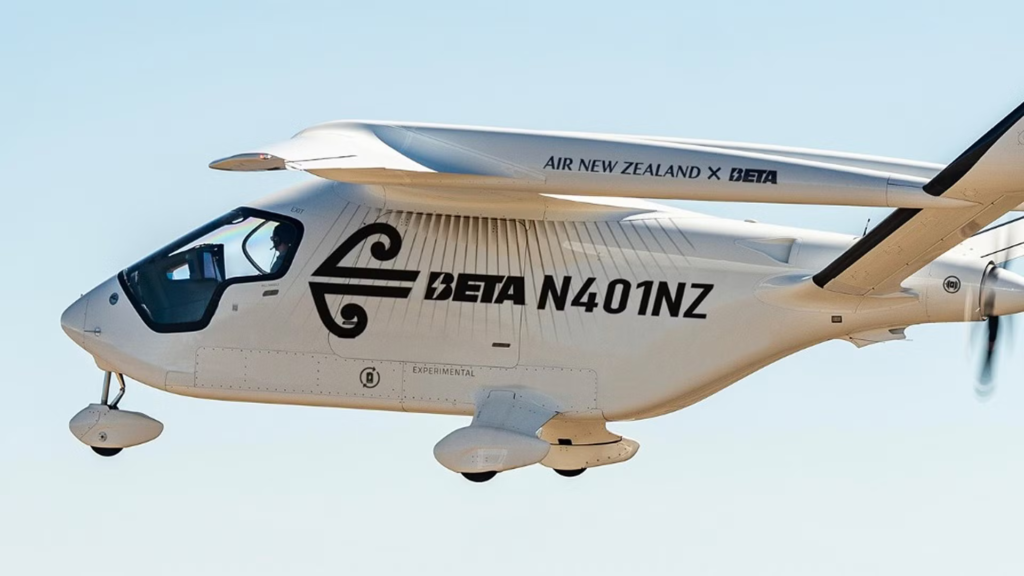
Electric flight has taken off for Air New Zealand. The country’s flag carrier of which bears its name, made its maiden test flight this week as the fully electric BETA ALIA CX300 took flight across the city of Tauranga. The aircraft is manufactured by BETA Technologies, a Vermont-based aerospace manufacturer that specialises in developing eVTOL (electric vertical takeoff and landing) and CTOL (conventional take off and landing) aircraft.
Taking off from Tauranga Airport (TRG) on Friday, October 17, this full battery electric aircraft is leased to the airline for a four-month technical demonstrator programme, which will allow the 

First Stop, Tauranga


Using data from Flightradar24, the BETA Technologies CX300, which bears registration N401NZ (serial number BT31C-0004), departed from Tauranga on October 17 at 08:37, and completed a 57-minute test flight above the city. The airplane took off across the Tauranga harbor, before heading across Matakana Island, and circling above the Bay of Plenty, Pacific Ocean. During the flight, the airplane reached speeds of up to 115 knots while maintaining an altitude of 4,025 feet. The airplane arrived back in Tauranga at 09:34.
The aircraft, which has the capacity to carry two crew and up to 197 cubic feet (5.6 cubic meters) of cargo, can operate using conventional take-off and landing configurations, and due to its electric propulsion, allows the aircraft to operate with net-zero emissions. Baden Smith, Air New Zealand’s general manager of fleet, networks, and strategy, spoke with New Zealand media outlet Stuff about the milestone flight:
“It’s incredibly special to partner with a global innovator like BETA to ensure New Zealand is a part of shaping what the future of flight might look like. This is a small, cautious step to learn and be part of that change.”
Across The Kaimai Range To Hamilton

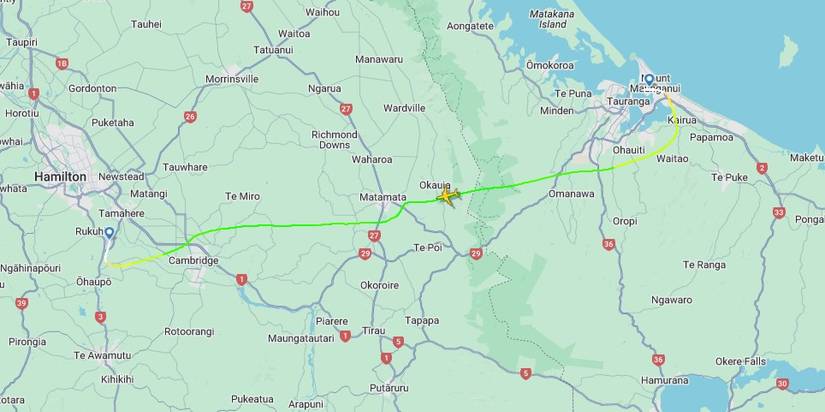
Later on October 17, the aircraft made its second domestic flight, this time traversing the Kaimai Ranges, a mountain range that splits the regions of Waikato and the Bay of Plenty. This flight departed from Tauranga at 15:04, making the 30-minute trip to Hamilton International Airport (HLZ) by 15:35. During this time, the aircraft only reached an altitude of 3,075 feet and a max speed of 102 knots.
This is just the first of many test flights that Air New Zealand will undertake with the ALIA CX300, as the aircraft will remain in Hamilton, where it will be based temporarily, before a shift to the country’s capital, Wellingto,n in December, before further testing, which will include inter-regional flights across the Cook Strait, to Blenheim Airport (BHE).
As explained by BETA Technologies’ director of flight operations, Chris Caputo, these flights are not just a win for Air New Zealand, but also an integral operational blueprint that will be able to serve as a model for other interested operators.
The ALIA CX300


The Alia CX300 is a conventional take-off and landing (CTOL) aircraft, was first announced in March 2023, and is largely identical to the VTOL version of the A250. The aircraft is fitted with Garmin G3000 Prime avionics and is designed to be able to fully charge in less than 60 minutes. This aircraft can be used to transport with configurations for both passenger, cargo, medical, or military operations.
The aircraft is suitable to operate in all weather conditions, and its capabilities to slot into standard airport infrastructure will allow the aircraft to easily be introduced to standard operations. Air New Zealand has already invested in the necessary charging facilities at Hamilton, Wellington, and Blenheim airports, with 65kW mobile chargers installed through support from the carrier’s Climate and Nature fund.
Air New Zealand has two of these aircraft on order, with another 20 purchase rights. Not only will the nation’s flag carrier one day operate these aircraft, but also the New Zealand Air Ambulance Service, which has two of their own A350 (VTOL) on order.
source