


The 787 Dreamliner is one of the most popular selling widebody aircraft types of all time, and is perfect for routes that demand between 248 and 300 passengers. The range varies depending on the variant. However, with the 787-8, according to Boeing, it can cruise to around 7,305 nmi (13,530 km), compared to the 787-9 at 7,565 nmi (14,010 km), and 787-10 for 6,330 nmi (11,730 km). This has demonstrated the aircraft’s versatility on many popular routes for Air Canada, opening new markets that may not have been served before, or for some time.
A Quick Look At Air Canada’s Fleet


As already mentioned,
Widebody operations are served by a mix of the Airbus A330-300, Boeing 777-200LR, 777-300ER, 787-8, and 787-9. The carrier expects to receive the larger Dreamliner variant 787-10, of which it has 14 on order between 2026 and 2030. The airline has exercise rights for another 12 options should it see fit.
Air Canada is also looking to a more sustainable future and has explored the Heart Aerospace ES-30, a 30-seat hybrid electric regional aircraft that could be efficient for short-haul regional routes. These aircraft are expected to land with Air Canada before the end of the decade and could cover an electric-only range of up to 100 nautical miles (200 kilometers) or a hybrid electric range of 220 nautical miles (400 km).
Flying High With The 787 Dreamliner
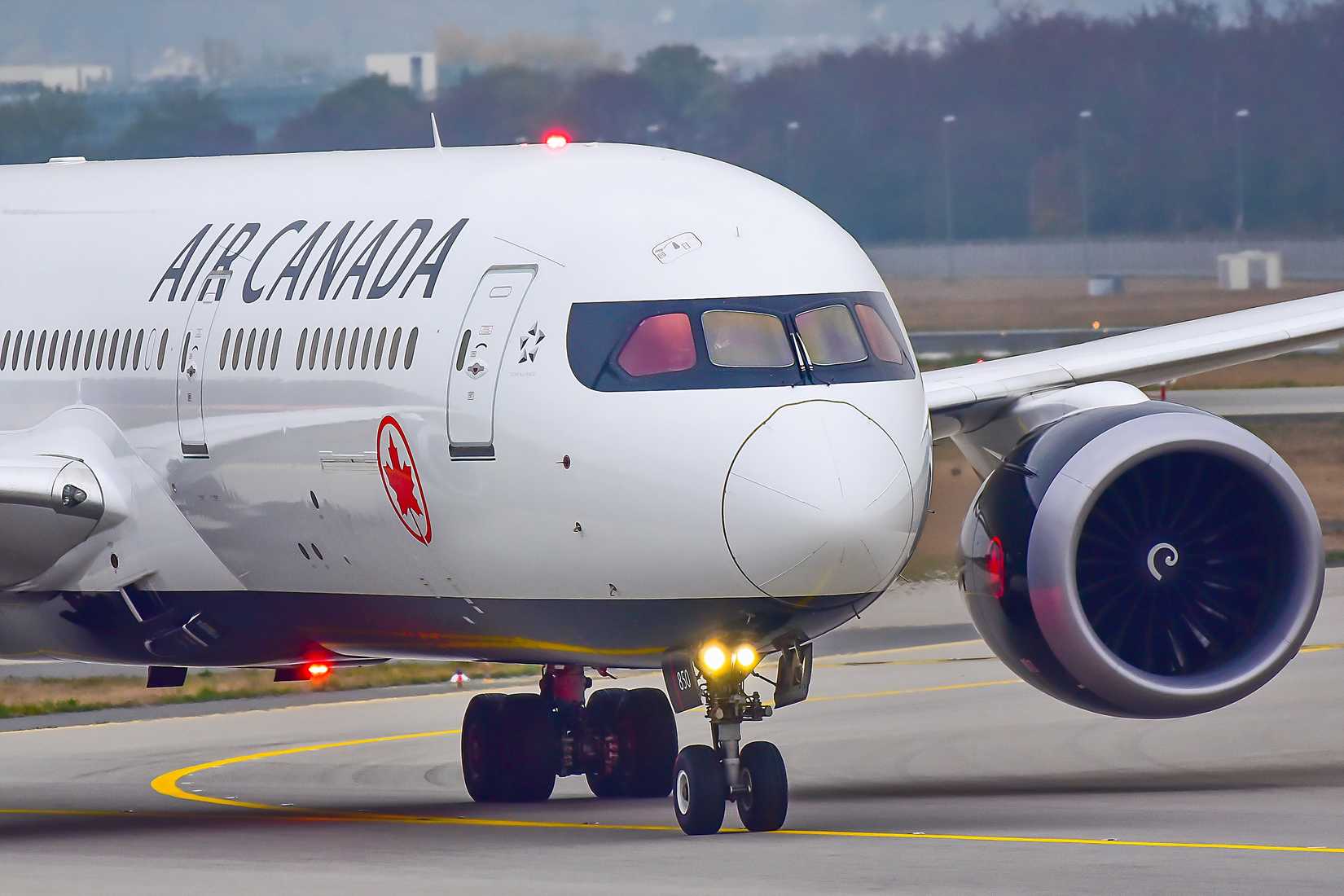
Air Canada introduced the 787 back in May 2014 and was the first airline in Canada to operate the popular type. The airline now operates these aircraft to destinations worldwide. The airline boasts an industry-leading premium travel experience on several North American routes, and its Air Canada Signature class lures premium customers with Executive Pods, which include lie-flat seats, duvets, pillows, and mattress pads, along with up to 600 hours of on-demand seatback entertainment.
Premium Economy also suits the middle-class market, with larger seats than economy class, that offer additional legroom. Complementary wines, spirits, and beers accompany elevated seasonal meals. Pillows and blankets let you sit back and relax, paired with an adjustable headrest, ambient mood lighting, and an individual reading light. According to the Air Canada website, the airline has an extensive reach with this versatile aircraft:
For those in economy, you’ll still be able to enjoy the usual creature comforts, with complimentary dining on all international routes, a personal seatback touchscreen TV with endless hours of entertainment, while also receiving a pillow and blanket when it’s time to get some zzz’s or become more comfortable. EnRoute, the airline’s complimentary magazine, can also be found in the seat pocket.


Why In The World Does Air Canada Fly The Boeing 787 And Not The Airbus A350?
Talk of tariffs earlier this year caused a panic for Air Canada, but the airline did not commit to a switch from the 787 to the A350.
Air Canada’s Top Routes With The 787


While the airline boasts an extensive route network with the 787 Dreamliner, Simple Flying, with the help of data from Cirium, an online aviation analytics company, decided to dig into the numbers and understand the most popular routes offered with this iconic aircraft. The city pair with the highest number of services in 2025 is domestic, with Vancouver (YVR) and
The flight time between Vancouver and Toronto is approximately four hours, 45 minutes, and Air Canada’s 787 service between the cities is complemented by an extensive narrowbody schedule, with almost hourly departures throughout the day. Competition on the route is provided by other key Canadian carriers as listed below, which outlines the total number of flights in November, as per data from Cirium:
|
Airline |
Route |
Flights In November 2025 |
Route |
Flights In November 2025 |
|---|---|---|---|---|
|
Air Canada |
Toronto to Vancouver |
292 |
Vancouver to Toronto |
291 |
|
Flair Airlines |
Toronto to Vancouver |
73 |
Vancouver to Toronto |
73 |
|
Porter Airlines |
Toronto to Vancouver |
90 |
Vancouver to Toronto |
90 |
|
WestJet |
Toronto to Vancouver |
137 |
Vancouver to Toronto |
137 |
The Vancouver and Toronto city pair connects two major Canadian cities, while also likely seeing a large amount of transit traffic. Vancouver is Air Canada’s Pacific gateway, providing more nonstop flights to Asia and Oceania than any other carrier from YVR. Toronto, on the other hand, has an extensive network of North and South American destinations, partnered with a robust schedule of flights to and from Europe.
Going International

Vancouver International Airport (YVR) to 
Air Canada serves this city pair with a daily service in each direction, providing a total of 108,770 available seats each calendar year, or 2,091 on average per week. Given the route’s length, this represents a total available seat miles (ASMs) of 695,336,610.
Competition on the route is starting to heat up, with both Cathay Pacific and Hong Kong Airlines offering services to Vancouver. Additionally, Cathay Pacific also flies non-stop between Hong Kong and Toronto Pearson International Airport (YYZ).

Air Canada’s 10 Longest Routes: What To Expect Onboard
The carrier’s longest route comes in at 7,965 miles long.
Busiest Flight To Europe

Air Canada’s busiest nonstop flight with the 787-9, destined for Europe, connects Montréal-Pierre Elliott Trudeau International Airport and London Heathrow Airport (LHR). This route will be offered a total of 360 times in 2025, operating all but five days across the year. Direct competition on the Montreal to London route is offered by 
This route adds sufficient capacity to Air Canada’s busiest European destination, from which the airline provides nonstop flights from most major Canadian airports (Calgary, Halifax, Ottawa, Toronto–Pearson, and Vancouver). Additional seasonal flights are added from London to Mumbai during peak travel periods. Data for the Montreal to London city pair is below:
|
Data |
Montreal To London |
London To Montreal |
|---|---|---|
|
Flights In 2025 |
360 |
359 |
|
Seats In 2025 |
107,280 |
106,982 |
|
Available Seat Miles (ASMs) |
348,767,280 |
347,798,482 |
|
Distance Gate To Gate (Miles) |
3,251 |
3,251 |
|
Distance Gate To Gate (Kilometers) |
5,201 |
5,201 |
Other European routes offered by Air Canada from Montreal include year-round flights to Barcelona, Brussels, Frankfurt, Geneva, Lisbon, Lyon, Madrid, Milan–Malpensa, Paris–Charles de Gaulle, Rome–Fiumicino and Toulouse, while seasonal services are added to Amsterdam, Athens, Catania (from June 4, 2026), Copenhagen, Dublin, Edinburgh, Naples, Nice, Palma de Mallorca (from June 17, 2026), Porto, Reykjavík–Keflavík and Venice.
Other Notable Mentions

Additional key routes for Air Canada with the 787 Dreamliner, including the airline’s nonstop service between Vancouver and Seoul’s 
The sole South American link in this analysis goes to the carrier’s nonstop service between Toronto Pearson and São Paulo/Guarulhos International Airport (GRU). Air Canada operates the route in 2025 with a total of 354 services onboard the 787-9, which represents a total of 105,492 available seats. This covers a distance of 5,074 miles (8,118 kilometers), or 535,266,408 available seat miles. Currently, Air Canada is the sole operator of flights between Toronto Pearson and São Paulo; however, the airline also offers nonstop services to Rio de Janeiro, and Air Transat is set to launch its own Brazilian service to Rio from February 4 next year.
Following Sao Paulo comes another domestic service, this time connecting the country’s capital (Ottawa) to the west. Air Canada will maintain a total of 343 non-stop flights between Ottawa/Macdonald–Cartier International Airport (YOW) and Vancouver, which has an approximate flight time of five hours and 30 minutes. The link offered with the 787-9 complements the carrier’s other daily narrowbody services, and adds a total of 102,214 available seats across the year. This route, which covers a total of 2,214 miles (3,542 kilometers), represents 226,301,796 available seat miles.
Other notable mentions include Vancouver to 
source