


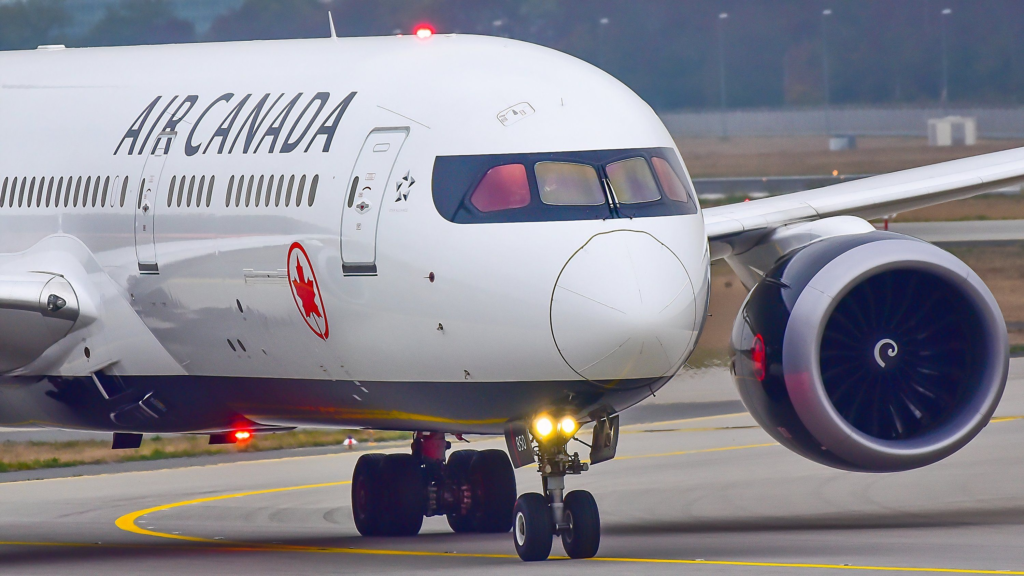
Air Canada’s financial outlook has taken a hit this week, with the Canadian flag carrier estimating that its August flight attendant strike forced the cancellation of more than 3,000 flights and cost the airline approximately US $270 (CA $375) million. The airline is now forecasting earnings of up to US $2.23 (CA $3.1) billion for this financial year, as reported by the Financial Post.
Based in Montreal, Air Canada operates from three key hubs: Montréal–Trudeau International Airport (YUL), Vancouver International Airport (YVR), and 

Where Has The Money Gone?

Not only will the airline suffer from lost revenue from the thousands of canceled flights, but it is also set to bear the brunt of customer refunds and compensation. It has also been estimated that, due to subdued customer appeal in August, there has been a dip in booking demand of approximately 2%, according to Travel Mole. These negative costs have been partially offset by savings on pre-purchasing jet fuel at lower costs. However, the airline has to record a one-time US$125 (CA$175) million charge, which relates to pensions and labor-related expenses.
In August, flight attendants went on strike and walked off the job following an ongoing dispute over pay. This sparked a national debate, where the flight attendants belonging to the Canadian Union of Public Employees defied a back-to-work order that was enforced by the Canadian Labour Board. Leaders of the Union eventually settled with the airline; however, this was voted down by its members. The two sides now sit in arbitration. Zohair Khan, co-founder and chief operating officer at Airfairness, noted to the Globe and Mail how this strike affected passengers around the world:
“I don’t think people realize the number of travellers in the air at any given day of the year – three days and over half a million people impacted around the world.”
More Than $47 Million In Compensation Owed To Passengers


In a report by Money.ca, it has been estimated that more than US$47 (CA$66) million is owed to passengers following strike-related inconveniences. Canadian law, however, may make it challenging for passengers to obtain this cash. 
Airfairness, which analyzed the costs to passengers following labor disruptions under European Union and British laws covering compensation for passengers, estimates that up to US$47 (CA$66) million could be owed to passengers. Seeing that more than 54,000 passengers were left stranded in Europe, and another 15,000 in the United Kingdom. This was just a portion of the more than 551,000 passengers across the globe who had their flights directly affected.
Air Canada passengers who have had their flight canceled or delayed by more than three hours are entitled to travel change options. If none of these are feasible, passengers can request a refund for the unused portion of the ticket. However, for compensation, this is a situation that is within the carrier’s control, and it was not notified more than 15 days in advance. This could see the airline passengers claim up to US $720 (CA$1,000) if their flight was delayed more than nine hours.
The First Union To Resist A Return To Work Order

The Air Canada strike brought the national carrier to a standstill, and the Federal Government tried its best to get people back to work by issuing a return-to-work order. However, the Canadian Union of Public Employees (CUPE) members refused, and this marked the first union to resist such an order.
Air Canada remains the largest airline in Canada, and operates a fleet of more than 200 Airbus and 
source