


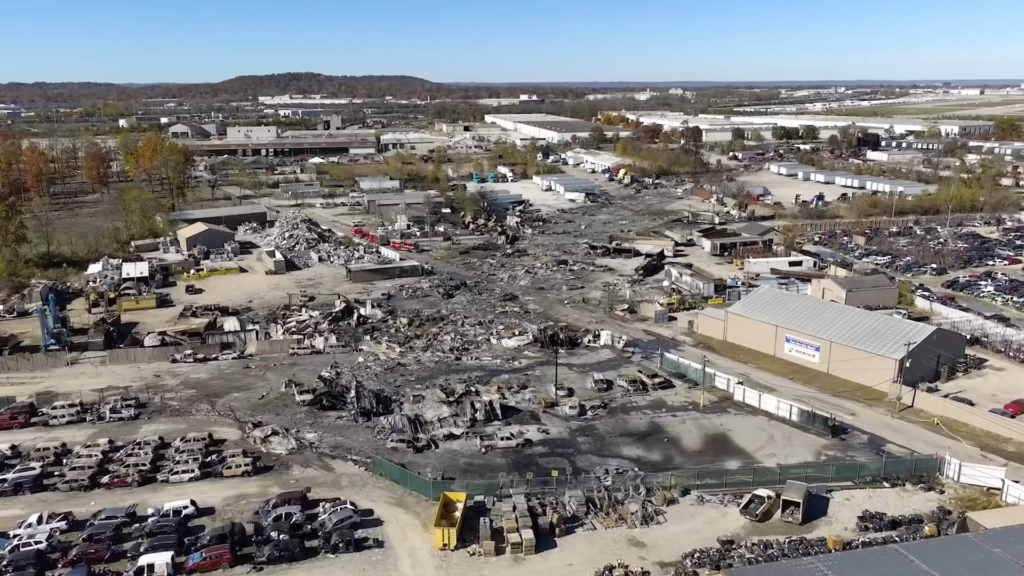
Drone footage released by the National Transportation Safety Board (NTSB) has shown just how destructive UPS Flight 2976 was upon impact, as it came to an abrupt end while attempting to depart from Louisville International Standiford Field (SDF) on November 4. The flight, operated by a McDonnell Douglas MD-11, is believed to have suffered engine separation during takeoff, which resulted in it crashing into the industrial area near the end of the runway.
This incident, which killed the three crew members onboard and a further 11 innocent victims who were working near the crash site, is the deadliest in history for UPS, a subsidiary of the United Parcel Service, one of the world’s largest cargo carriers. The aircraft, a 34-year-old MC-11 BCF, was 34 years old at the time of the incident, and had been flying since 1991 (initially for Thai Airways, before its conversion to a freighter for UPS in 2006).

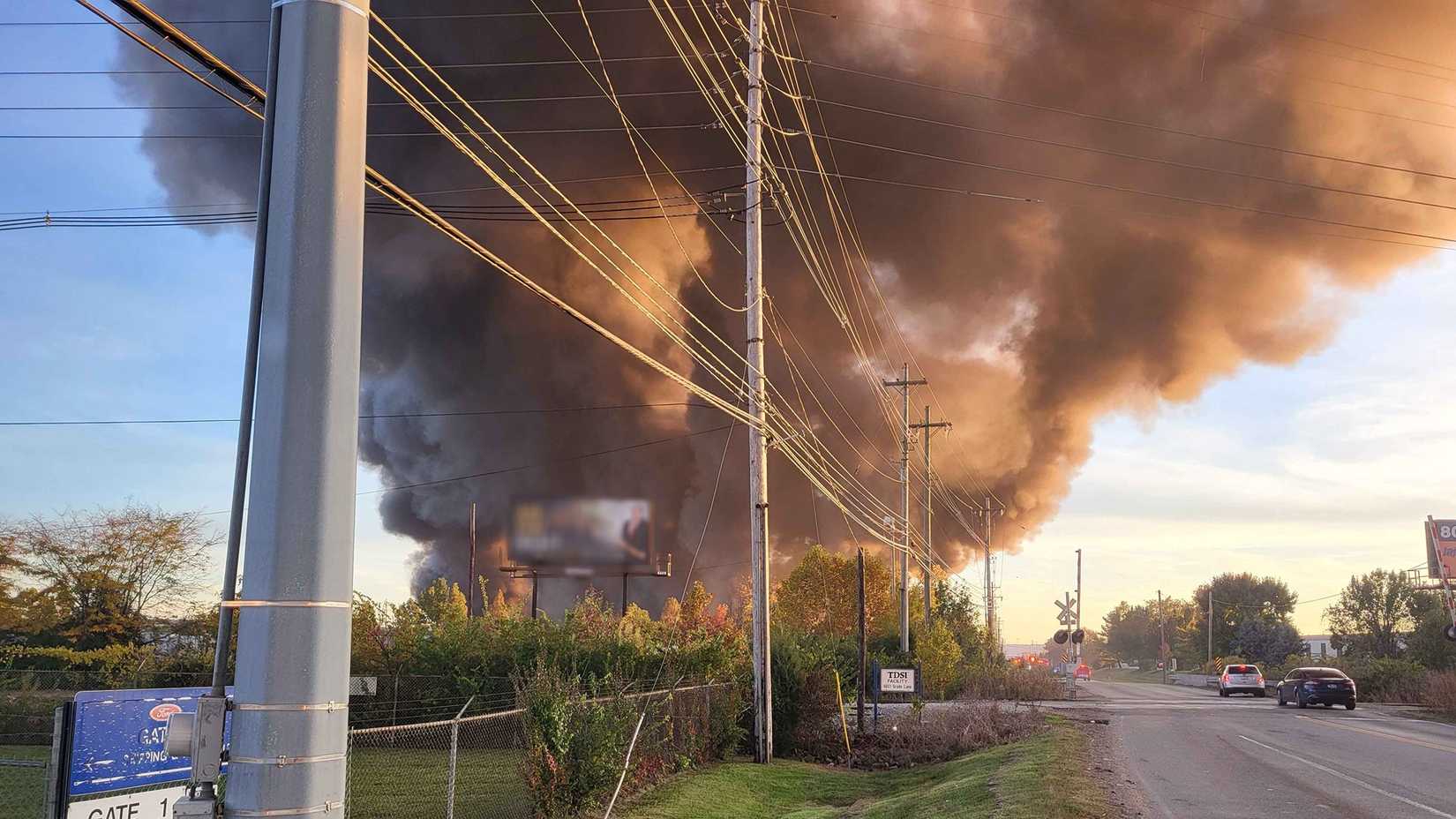
The third and final on-site media briefing was hosted earlier today, where preliminary information was reported that the Federal Aviation Administration (FAA) has combed through initial flight data, which showed the aircraft had gained an altitude of 100 feet (30 meters) before it plummeted into the ground.
Investigators remain in the fact-gathering phase and have now established the exact boundaries of the debris field. However, if locals find any additional pieces of evidence, they are asked to contact the NTSB by emailing them at witness@ntsb.gov. It is believed that all spot fires are now contained. However, the local fire department is on standby if additional fires pop up.
Cockpit voice recording data has been captured with around two hours and four minutes of ‘quality’ recording, which does include the completed standard checklists that are required before departure, and the expected preflight briefings. Initial review of the recordings identified that around 37 seconds after the pilots called for takeoff bell, there was a persistent bell that remained chiming for 25 seconds, until the recording ended, subsequently, when the aircraft met its final fate.
Months Before The Full Transcript Of Voice Recorders Will Be Made Public


Todd Inman, the 48th member of the NTSB, noted that it is likely ot be months before the transcript of voice recordings is available for public review. In the meantime, the NTSB will continue to study the transcript of the cockpit recordings. Initially, they have stated that the differing alarm types have meanings. However, they would like to understand exactly what happened and led to the engine fire, to paint a clear picture of what occurred. The ending of the recordings is expected to be once the airplane makes its final point of impact.
The persistent chime of a bell is believed to be the signal for engine fire, which is believed to have only commenced once the airplane was past the flight’s decision speed, which allows them to abort takeoff. This means UPS Flight 2976 was past the critical point, where the aircraft could’ve aborted takeoff and remained on the runway.
Investigators have been able to identify that the bulk of the number one engine pylon is believed to be still attached to the engine when it separated from the rest of the aircraft.
A Dark Day For UPS Airlines

The three pilots onboard were Capt. Richard Wartenberg, First Officer Lee Truitt, and International Relief Officer Capt. Dana Diamond. Simple Flying extends its condolences not only to the families of these UPS crew members but also to the individuals killed on the ground.
Launched in 1988, UPS is one of the world’s largest cargo airlines in terms of freight volume flown. It is a wholly owned subsidiary of the United Parcel Service. It operates under a hub-and-spoke model from its primary hub at Louisville, known by the airline as ‘Worldport’. It has additional hubs across the United States at Anchorage, Columbia (South Carolina), Chicago–Rockford, Dallas/Fort Worth, Miami, Ontario, Philadelphia, and Seattle–Boeing. International hubs also support its global reach, which includes Clark, 

UPS Airlines has a fleet of nearly 300 aircraft, which, according to ch-aviation, is made up of 52 Airbus A300-600RF, 11 Boeing 747-400F, two Boeing 747-400BCF, 30 Boeing 787-8F, 75 Boeing 757-200PF, 94 Boeing 767-300F (of which it was the launch customer, and has another 15 on order), and 27 McDonnell Douglas MD-11F. One of its MD-11s, N262UP, was the last ever built.
source