


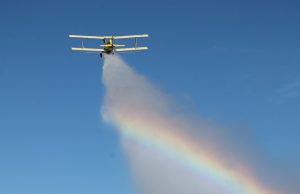
Airplanes aren’t used strictly for transportation. They have other applications, such as spraying crops with herbicides, pesticides and other protection products. Known as crop dusters, these specialized airplanes play an important role in the agriculture industry. Here are six fun facts about crop dusters.
#1) Early Models Were Converted WW1 Biplanes
Some of the first crop dusters were military biplanes used during World War I, such as the Curtiss JN4 Jenny. The Jenny was a two-seat, single-engine biplane used primarily to train pilots during World War 1. Following the war, many units were sold to private owners. The Jenny eventually found its way into the hands of farmers who modified it for use in agriculture.
#2) Originally Used to Distribute Powder
Most modern crop dusters are used to distribute liquid-based protection products over crops. During the early years of crop dusting, though, they were used to distribute powder-based protection products. The term “crop dusting” is a direct reference to these powder, dust-like products.
#3) Fly Low
Crop dusters aren’t designed to fly high like commercial jets. Rather, they are designed to fly very low — often at just 10 to 30 feet. Flying low allows these specialized airplanes to effectively distribute their products over the crop canopy. The higher they fly, the more distributed the products will be, meaning some herbicide or pesticide may land outside of the crops.
#4) Large Product Capacity
Because they are used to spray large crops spanning dozens or even hundreds of acres, it shouldn’t come as a surprise to learn that crop dusters have a large product capacity. Some of them can carry 100 to 200 gallons of product in specialized chemical hoppers. Others, though, can carry anywhere from 400 to 800 gallons of product.
#5) More Than Just Spray Crops
While crop dusters are used primarily to spray protection products over crops, that’s not their sole purpose. They are often used for seeding. Crop dusters can be fitted with seed-filled hoppers that distribute seeds over land. They can also be used to control invasive plant species, or even support wildfire-fighting efforts.
#6) Typically Powered By Turboprops
Most crop dusters don’t use jet engines. Instead, they are powered by turboprops. Turboprops are gas-fed turbine engines that turn a propeller. They lack the speed of jet engines, but they offer a lightweight and fuel efficient propulsion system. For crop dusting, this makes turboprops a popular choice.
In Conclusion
Crop dusters have come a long way from the modified World War I biplanes. Today, these specialized aircraft are an essential part of modern agriculture, helping farmers protect crops, plant seeds and manage large areas of land quickly and efficiently.