


20 years after the aircraft entered service in December 2005, the F-22 Raptor remains the benchmark for United States Air Force air dominance. The jet fused low observability, supercruise, and extreme agility before rivals fielded comparable designs. The aircraft layered sensor fusion and secure links to create a “first-look, first-shot, first-kill” envelope. The airframe itself is rather large, with a 62 ft 1 in (18.9 m) length and a wingspan measuring 44 ft 6 in (13.6 m). This anchors America’s high-end air defenses, even though production of the aircraft ended years ago after just 187 were produced, far fewer than were originally ordered by the Air Force. Official data lists a ceiling of above 50,000 ft (15,000 m) and exceptionally high-mach performance, with the supercruise exceeding Mach 1.5.
The aircraft entered combat for the first time over Syria in 2014, and it stood watch during homeland defense and quick-reaction alert scenarios across the Pacific and Europe over the next few decades, all before downing a high-altitude balloon in 2023. Meanwhile, modernization programs are in the works, to help the aircraft maintain its relevance as Next-Generation Air Dominance platforms continue to develop. The aircraft is fitted with AIM-120D and AIM-9X missile system integration, electronic-protection upgrades, and Link 16 networking platforms. The aircraft’s ferry range with two external tanks exceeds 1,850 miles (2,977 km), and its internal fuel reaches around 18,000 lbs (8,200 kg). This article reviews the Raptor’s design, specifications, and service record. After about 20 years, the Raptor has held up quite effectively.
An Overview Of The F-22 Raptor

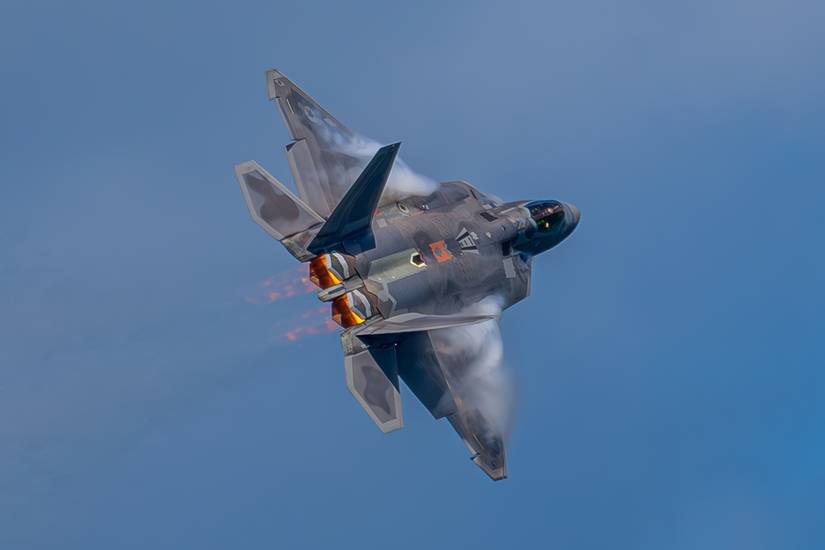
The F-22 Raptor originated from the 1980s Advanced Tactical Fighter program in order to replace the F-15 Eagle in an air-superiority role. The aircraft pairs low-observable shaping and materials with powerful sensors and high kinematics, including a pair of Pratt & Whitney F119-PW-100 engines, each offering around 35,000 lbs (15,876 kg) of thrust, feeding supercruise and thrust-vector agility. The platform blends a diamond wing, all-moving tails, and serpentine inlets in order to shield aircraft while internal bays preserve low drag and the aircraft’s overall signature.
The aircraft’s cockpit fuses inputs from radar, passive sensors, and electronic-support measures into a tactical picture that prioritizes threats and weapon solutions. In its air-to-air configuration, the jet carries six AIM-120 AMRAAM and two AIM-9 Sidewinder missiles, and for air-to-ground missions, it can trade four AMRAAM stations for a pair of 1,000-lb (454-kg) GBU-32 JDAM munitions while retaining two AMRAAMs in its arsenal. An internal M61A2 20-mm cannon with 480 rounds offers close-range firepower. The aircraft has a top speed exceeding Mach two, with supercruise above Mach 1.5 and a service ceiling exceeding 50,000 ft (15 km). The jet’s ferry range is over 1,850 miles (2,977 km) with two external tanks. Dimensions remain large by modern fighter standards, but compact for this kind of fifth-generation fighter, which allows for exceptional maneuverability and dispersed operations.
Although the aircraft’s production decreased to 187 aircraft, successive modernizations have included the addition of AIM-9X and AIM-120D packages to the aircraft. The jet has also been fitted with enhanced electronic protection, geolocation upgrades, and Link 16 transmitters. These improvements allow the aircraft to be a credible threat against evolving threats as the Air Force awaits the continued development of Next-Generation Air Dominance systems in the 2030s.
What Capabilities Does The F-22 Raptor Bring To The Table?


The F-22 Raptor’s central capability and the principal reason why the astronomically expensive aircraft was developed by the Air Force is the plane’s ability to offer see-first and shoot-first capabilities while remaining extremely challenging for enemies to hunt down. The jet comes with low observable geometry and materials that absorb radar waves, making the aircraft difficult to find. Internal bays keep weapons effectively hidden until they are launched.
Two powerful F119 engines provide the acceleration and energy needed to dictate terms on the battlefield, with supercruise beyond Mach 1.5 enabling rapid repositioning without the need for fuel-thirsty afterburners. The aircraft can operate above 50,000 ft (15,000 m), extending overall combat capabilities. The aircraft’s sensor-fusion architecture curates inputs from radar and passive systems into a single, prioritized picture while reducing pilot workload and compressing the overall kill chain.
The aircraft’s baseline loadout of six AIM-120 AMRAAMs, in addition to a pair of AIM-9s, allows it to cover beyond-visual-range shots. The jet’s diversified munitions payload capabilities allow it to enter pretty much any kind of theater and serve almost any kind of mission. Overall, fleet constraints do exist, primarily due to the small size of the fleet. The amount of manpower needed to keep these aircraft in exceptional combat shape is excessive, and maintenance is thus quite costly as a result.
A Look At The F-22 Raptor’s Specifications

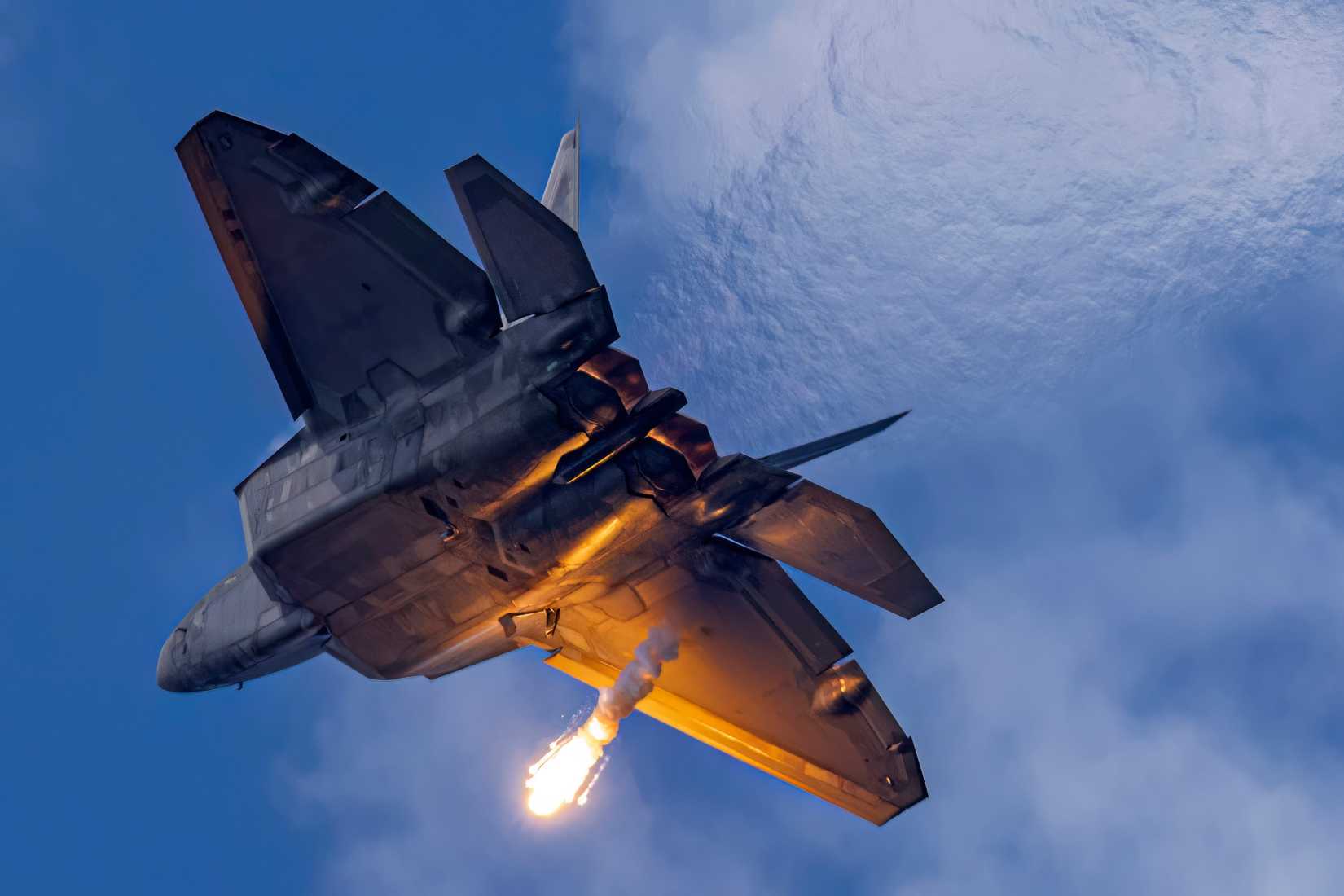
The F-22 Raptor measures around 62 ft 1 in (18.9 m) in length, with an exceptionally wide wingspan of 44 ft 6 in (13.6 m). The aircraft is 16 ft 8 in (5.1 m) tall. The aircraft’s empty weight is around 43,340 lbs (19,700 kg), with a maximum takeoff weight of 83,500 lbs (38,000 kg). The jet’s powerplant is a pair of Pratt & Whitney F119-PW-1000 turbofans with two-dimensional thrust-vectoring nozzles, each of which is in the 35,000 lb (15,876 kg) thrust class. The jet can carry around 18,000 lbs (8,200 kg) of fuel internally, with two external tanks carrying an additional 26,000 lbs (11,900 kg) when deployed.
The aircraft offers exceptional Mach 2+ performance, with supercruise greater than Mach 1.5. The jet’s service ceiling exceeds 50,000 ft (15 km), with a ferry range that allows it to comfortably fly between major stations. The aircraft can also be fueled by tankers, giving it essentially unlimited in-theater range. The jet’s armament, as mentioned, includes a variety of AIM-120 AMRAAM and AIM-9 Sidewinders, alongside an internal M61A2 20-mm cannon that can hold 480 rounds. Air-to-ground armament packages can offer some additional capabilities. Here are some additional specifications for the F-22 Raptor, according to data published by the United States Air Force:
|
Category: |
F-22 Raptor Specification: |
|---|---|
|
Wing aspect ratio: |
2.36 |
|
Thrust-to-weight ratio: |
1.08 |
|
Typical combat range: |
530 miles (850 km) |
The aircraft’s advanced avionics suite, which includes an integrated sensor-fusion suite with active electronically scanned array radars, allows it to target enemies far before it is spotted. The aircraft’s survivability is fundamentally unmatched, with comprehensive low-observable shaping and materials, serpentine inlets, and internal weapon carriage. Extensive electronic protection is also on offer.
A Look At The F-22 Raptor’s Service History

The F-22 Raptor entered service in December 2005 after operational testing validated the aircraft’s air dominance role. Initial operational squadrons were placed at Langley Air Force Base in Virginia and Elmendorf Air Force Base (which is now known as Joint Base Elmendorf-Richardson) in Alaska. Additional units were later placed at facilities in Florida and Hawaii. Production of the aircraft concluded in 2011, with 187 production aircraft ultimately delivered and the final jet rolling out that December. For around a decade, the fleet deterred and trained without combat, while debuting in September 2014 over Syrian skies, where it conducted precision strikes and served as a stealthy escort for aircraft operating in command-and-control functions.
In the years since, the F-22 Raptor has executed homeland defense and quick-reaction alerts across North America, being deployed to Europe and the Pacific for air policing, exercises, and the interception of foreign aircraft when tasked. In February 2023, a Raptor shot down a high-altitude surveillance balloon with an AIM-9X off South Carolina, the first documented air-to-air kill for the type.
Aircraft modernization efforts proceeded in spirals. Increment 3.1 added improved ground mapping, while Increment 3.2A added enhanced electronic protection and communication links. The munitions-oriented Increment 3.2B integrated AIM-9X and AIM-120D missiles into the aircraft’s mission package, improving geolocation and other upgrades.
How Effectively Has The F-22 Raptor Held Up?
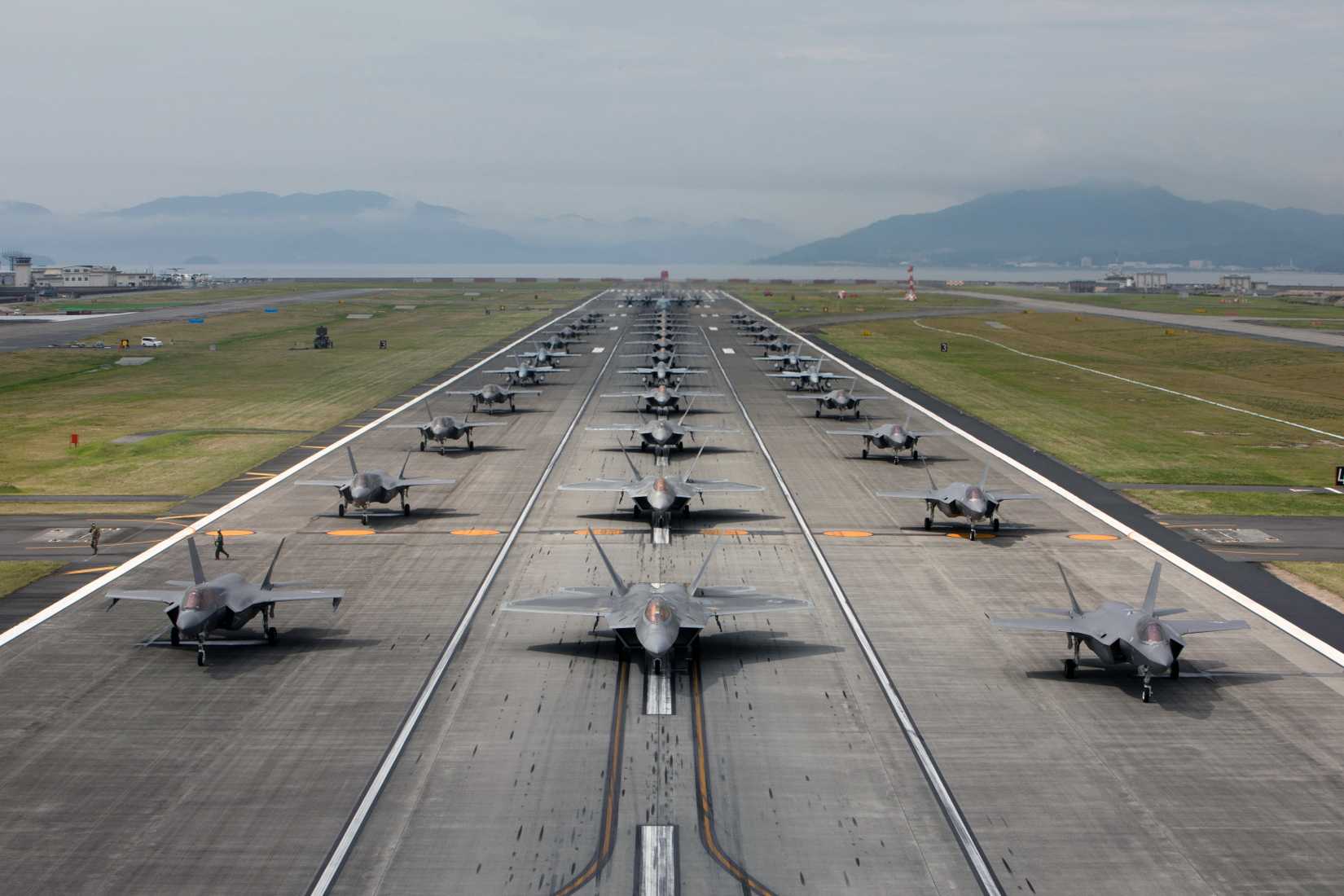
The F-22’s original job was to provide uncontested air dominance to the United States Air Force. In this capacity, the jet has held up remarkably well decades after it entered service. The aircraft offers low observability, supercruise, and completely unmatched thrust-vectoring agility. Sensor fusion and upgraded missiles help extend the aircraft’s overall reach. In mixed packages, the jet remains a superb overall enabler.
The aircraft sanitizes airspace, escorts strike fighters, and cues shooters through secure links that now include two-way linking systems. Aircraft reliability and low-observable sustainment are improved over time, reducing overall aircraft downtime from early-fleet levels. Aircraft limitations remain manageable. The small fleet itself constrains overall surge capacity and drives per-tail training demand. Low-observable upkeep remains manpower-intensive, and growth volume for new sensors or additional internal weapons is finite.
Compared with the more advanced Lockheed Martin F-35 Lightning II, the Raptor’s air-to-ground flexibility is a bit more limited. However, the jet’s kinematics, high-altitude performance, and stealth at speed remain fundamentally unmatched. Operationally, the aircraft has met requirements from Syria for homeland defense and for Pacific and European deterrence, demonstrating the aircraft’s continued relevance in permissive and contested airspace.
What Are Our Key Takeaways From This Information?
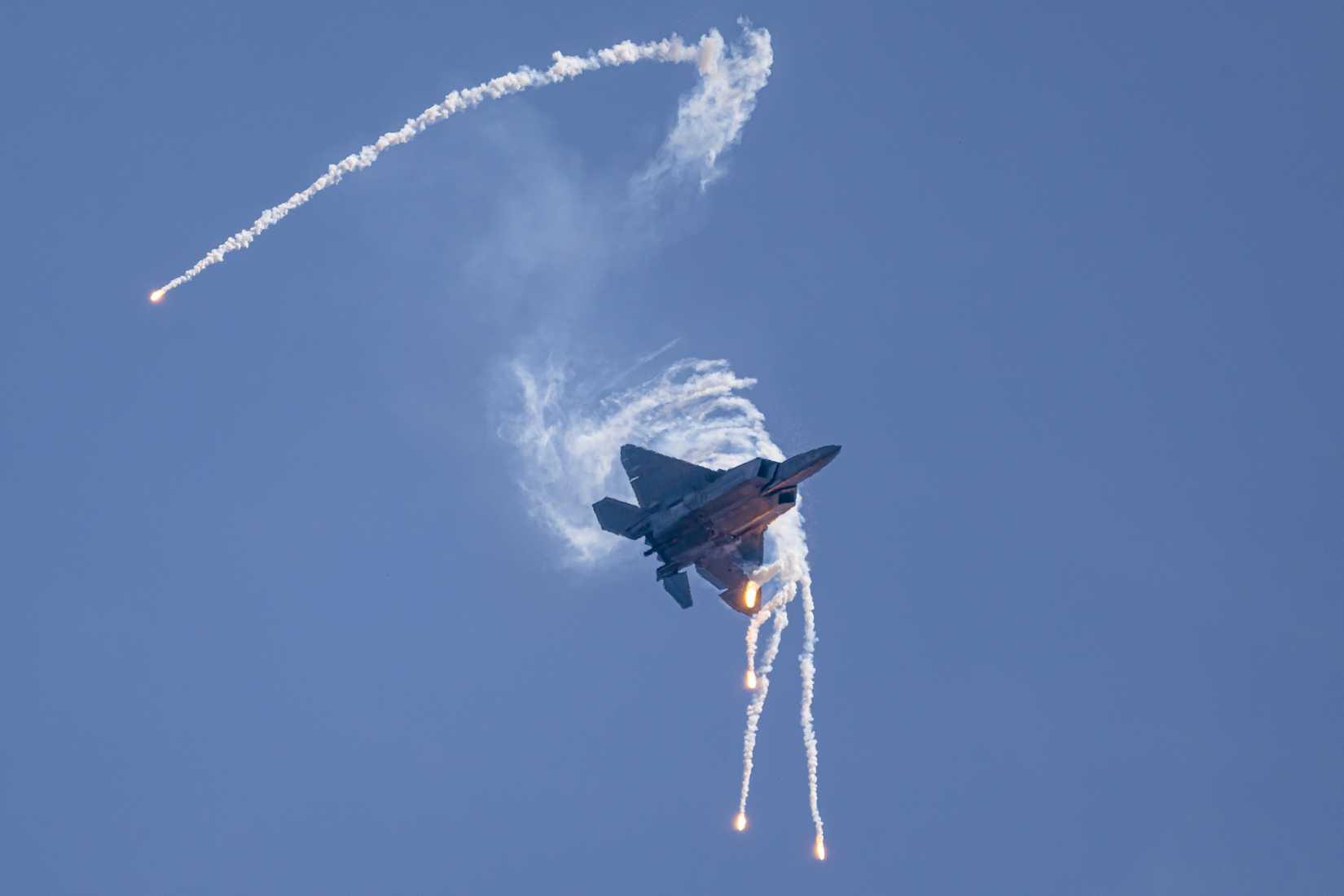
Two decades into its service history, the F-22’s core advantages, including low observability, supercruise, and overall kinematics, remain decisive, and modernization has extended its overall relevance. Official specifications still matter from an operational standpoint. The aircraft’s service ceiling is impressive, and its internal carriage helps keep drag and radar signatures low.
Combat experience for the aircraft is also more limited in comparison to other legacy models. The aircraft has still proven an effective enabler of air dominance. The jet’s history of precision striking and homeland defending, in addition to the documentation of an air-to-air kill in 2023, highlighted its capabilities.
For the most part, the aircraft has barely been deployed for the simple fact that it has barely been needed. The aircraft is incredibly capable to the point that other platforms can execute most of the Air Force’s mission objectives, meaning that it has yet to be fully needed in most combat capacities.
source